
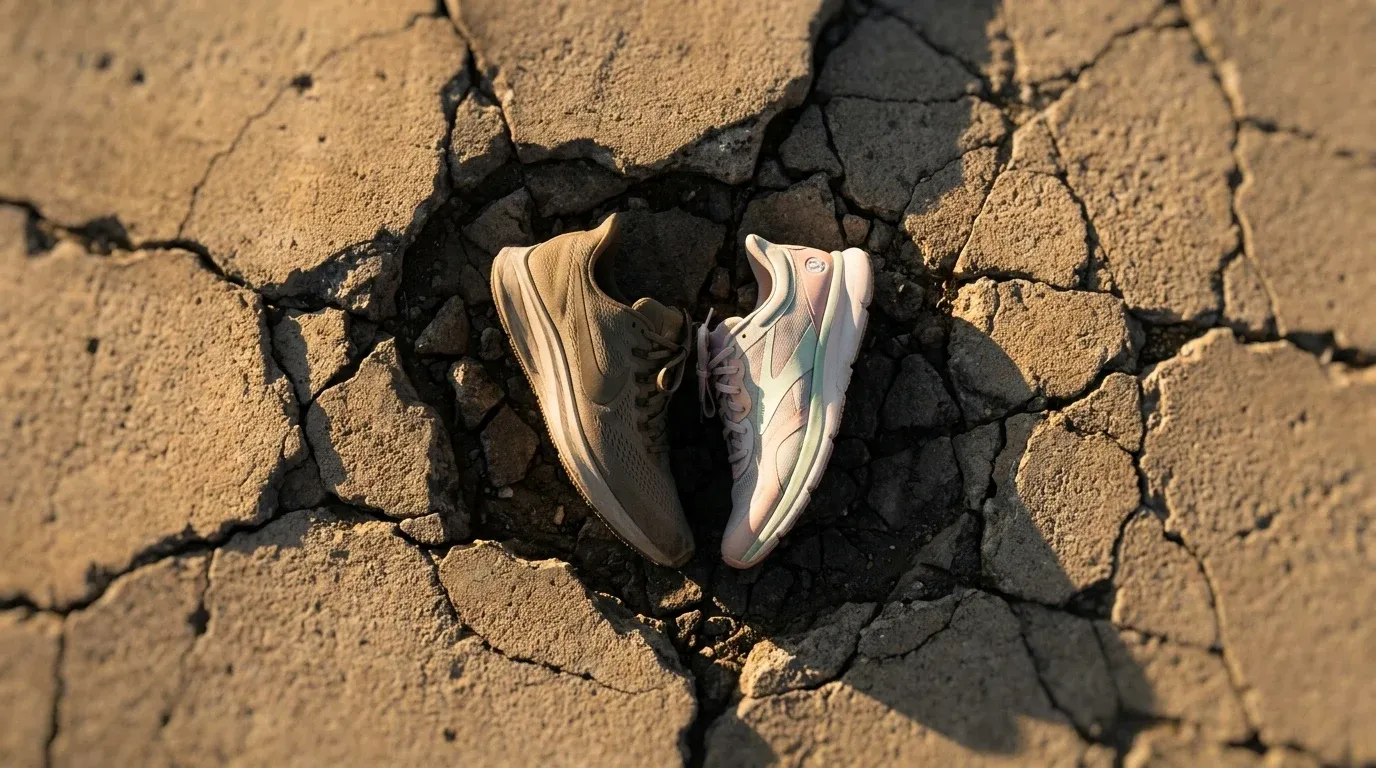
Two of the most powerful names in athleisure are hitting the floor at the same time. Nike is trading at a 12-year stock low as of late June 2026. Lululemon has fallen to an 8-year low. Both are undergoing leadership changes. Both are cutting guidance. And the fitness industry should be paying close attention, because this isn't just a story about two struggling corporations. It's a structural signal about where the premium apparel category is cracking and what that means for operators, coaches, and brands building inside it.
Two Dominant Brands, Two Simultaneous Collapses
Nike's decline has been well-documented. Years of over-reliance on retro lifestyle silhouettes, an ill-timed pivot away from wholesale partnerships, and a DTC strategy that failed to deliver the margin expansion it promised. The result is a stock price that hasn't been this low since 2014, with incoming leadership tasked with rebuilding product credibility and channel relationships simultaneously.
Lululemon's story is more surprising to most observers. The brand spent the better part of a decade defining what premium athleisure meant. Its community flywheel, ambassador program, and product positioning around technical performance at a lifestyle price point seemed almost recession-proof. But the company has now reduced its full-year guidance, citing struggles with product innovation, slowing traffic, and margin pressure. That reversal is significant.
What makes this moment structurally interesting isn't that one dominant brand is struggling. It's that both are struggling simultaneously, against the same macro backdrop, in the same price band. That convergence is worth unpacking.
The Macro Layer: Consumer Spending Under Pressure
Neither Nike nor Lululemon operates in a vacuum. Both brands sit firmly in the mid-to-premium consumer discretionary category, with Lululemon's core leggings and outerwear consistently priced between $80 and $350, and Nike's performance and lifestyle lines ranging from $90 to $250 for footwear and $60 to $150 for apparel.
That price band is under specific pressure in 2026. Consumer spending on discretionary goods has softened across the US and UK, with persistently elevated cost-of-living expenses compressing the budgets of the exact demographic these brands have historically captured: the 28 to 45-year-old, fitness-adjacent, dual-income household. When that consumer is cutting back, an $128 pair of leggings or a $140 running shoe becomes a considered purchase rather than an impulse one.
The timing also matters. Both brands are navigating leadership transitions while simultaneously managing inventory, margin, and demand challenges. Leadership instability during a macro downturn is a compounding problem. Investors are pricing in both the earnings risk and the execution risk, which is why stock declines this deep tend to overshoot fundamentals on the downside.
Why This Is a Structural Signal, Not Just a Stock Story
The simultaneous weakness of Nike and Lululemon tells you something specific about where the athleisure category is breaking. These two brands, between them, define the mainstream of the segment. Nike owns performance credibility and mass-market scale. Lululemon owns premium lifestyle positioning and community loyalty. If both are losing, it's not a brand-specific failure. It's evidence that the center of the market is hollowing out.
That hollowing is being driven by two competing forces. At the value end, brands like Halara, Vuori alternatives in accessible pricing, and private-label options from major retailers are capturing price-sensitive consumers who used to trade up. At the premium performance end, specialist brands with clear technical differentiation, On Running, Hoka, Satisfy Running, and Arc'teryx in technical outerwear, are capturing the consumer who wants product credibility over brand heritage.
The broad middle, which is exactly where Nike and Lululemon have been operating, is the segment that's getting compressed from both directions. That's not a cyclical problem. It's a positioning problem, and positioning problems don't resolve with a new CEO or a new product line in the first quarter.
The Competitive Window for Challenger Brands
Here's the opportunity that operators and emerging brands should be tracking. When two incumbents are simultaneously pulling back on marketing spend, renegotiating wholesale relationships, and managing internal reorganization, they create space. Ambassador programs get audited. Sponsorship budgets get cut. Community programming becomes less consistent.
That's exactly when challenger brands with performance-specific positioning or genuine community infrastructure can accelerate. The fitness industry has its own version of this dynamic. As the broader sector consolidates, as we've seen with Mindbody, ClassPass and EGYM merging into a $7.5B platform, smaller operators and brands with a clearly defined niche are often better positioned to capture loyalty than mid-tier generalists.
The brands gaining ground right now share a common characteristic: they're not trying to be everything. On Running built its entire identity around a specific heel strike technology. Satisfy Running targets a narrow ultrarunning aesthetic. Vuori made its bones in the male yoga and casual performance category before expanding. Specificity is winning where generalism is losing.
For challenger apparel brands looking to gain shelf or digital share in 2026, the playbook is clear. Go narrow, go deep on community, and don't compete in the exact price band where Nike and Lululemon are fighting their defensive war. Go just above or just below it.
What This Means for Fitness Operators Stocking Retail
If you're a gym operator with a retail component, a boutique studio with branded merchandise, or a wellness facility that co-brands with apparel partners, the signals from Nike and Lululemon have direct implications for your partnership and product decisions heading into the second half of 2026.
Brand equity is a real input in co-branding calculations. When a partner brand's consumer perception is weakening, the halo effect that co-branding typically generates becomes less reliable. An operator who locked in a Nike or Lululemon co-branding arrangement in 2023 or 2024, when both brands were at different equity levels, may need to revisit what that partnership is actually delivering in terms of perceived value to their membership.
This doesn't mean abandoning those relationships. Nike and Lululemon have deep distribution infrastructure, fulfillment reliability, and still carry significant name recognition. But it does mean being more deliberate about how you present the partnership, what margin you're accepting for branded merchandise, and whether you're offsetting with challenger brand options that carry stronger community credibility with your specific member demographic.
Operators who are serious about retail revenue as a growth channel in 2026 should be auditing their brand mix now rather than waiting for the next quarterly signal. The member who's already reconsidering their $128 legging purchase is the same member you need to retain on their membership. How you navigate that tension matters. The ABC Fitness data on consistency beating acquisition reinforces why member experience, including the products you endorse and stock, is a retention variable, not just a revenue variable.
The Community Equity Question
Lululemon's decline deserves particular attention from fitness operators because its brand was built on exactly the model many boutique operators aspire to. In-store community events, ambassador networks, ambassador-led local programming, and a pricing strategy that positioned purchase as an aspirational identity signal. That model worked spectacularly for about a decade.
What appears to have broken it is a failure to keep the product innovation pace ahead of the brand premium. When the product becomes commoditized but the price remains premium, the community rationale starts to fray. Consumers who joined the ecosystem for the identity signal start questioning the value transaction. That's a lesson with direct application for fitness operators building their own community models.
Community loyalty is earned and maintained through consistent delivery of the experience members joined for. It doesn't sustain on brand identity alone. The operators getting this right in 2026, including those using run club models to deepen local retention, understand that the programming has to keep delivering. Gym run clubs are one of the strongest community retention tools operators are deploying this year, precisely because they create recurring, low-cost touchpoints that keep members engaged beyond the four walls of the facility.
The Read for 2026 and Beyond
Nike and Lululemon will survive this cycle. Both have the balance sheet depth, brand recognition, and distribution scale to stabilize. But the category shift that their simultaneous decline is signaling won't reverse. The mid-to-premium athleisure generalist is a harder position to hold in 2026 than it was in 2022, and that pressure is structural, not temporary.
For fitness brands, operators, and coaches building their own positioning right now, the lesson is the same one that the apparel market is delivering the hard way. Generalism is expensive. Specificity is defensible. Community loyalty requires ongoing delivery, not just identity architecture. And in a compressed consumer spending environment, the brands that win are the ones whose members and customers can articulate exactly why they're worth the price.
If you can't answer that question clearly for your own brand in 2026, the macro environment will answer it for you. And it won't be generous about it. For operators thinking through how their broader brand partnerships stack up in a consolidating industry, Crunch Fitness's aggressive expansion and brand evolution strategy offers a useful contrast case in how scale brands are choosing to respond to the same market pressure.