
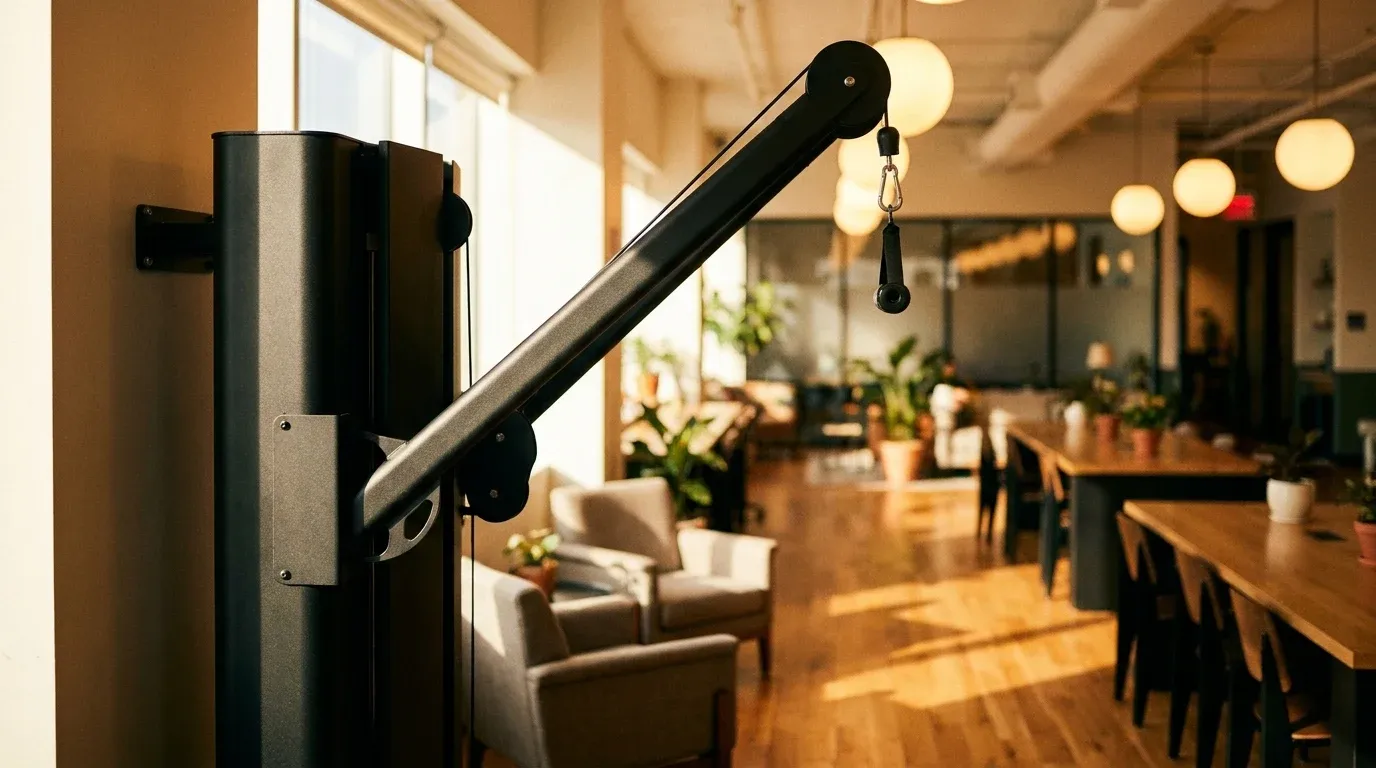
Premium connected fitness has spent the better part of a decade selling itself to consumers one household at a time. Tonal's new partnership with WeWork signals that era is shifting. As of October 2026, Tonal is deploying its AI-powered digital strength training systems across nine U.S. WeWork co-working locations, moving the brand decisively into the business-to-business channel and opening a distribution model that the home fitness category has never fully exploited.
This isn't a marketing stunt. It's a structural bet on where premium fitness demand is actually moving: into the workplace, into recurring B2B contracts, and away from the saturated direct-to-consumer funnel that punished so many connected fitness brands after 2022.
Why the Workplace Channel Makes Strategic Sense Right Now
Tonal CEO Todd Bartee framed the WeWork rollout around a specific insight: there is "accelerating demand for workplace fitness" among professionals who cannot realistically fit traditional gym visits into dense, back-to-back schedules. That's not a fringe user. That's the core knowledge-worker demographic that co-working spaces are built around.
WeWork members skew toward founders, consultants, remote professionals, and small business teams. These are people with disposable income and a documented interest in performance optimization. They're also people whose schedules make a 45-minute commute to a gym genuinely difficult to justify. Putting Tonal units inside the building where they already spend eight or more hours a day removes the single biggest barrier to consistent strength training: logistics.
For Tonal, the unit economics shift favorably in this environment. A high-dwell-time, high-income audience means utilization rates per unit can exceed what most home installations deliver. A single Tonal in a busy WeWork common area reaches dozens of users per week rather than the one or two household members a residential unit typically serves.
The B2B Channel Bypasses a Saturated Market
Direct-to-consumer connected fitness has been difficult territory since the post-pandemic correction. Peloton's well-documented struggles reshaped how the entire category thought about customer acquisition costs and hardware margin. Big-box retail hasn't offered much relief either. Shelf space is expensive, discounting is aggressive, and the premium positioning that brands like Tonal depend on erodes quickly in a retail environment designed around price comparison.
The WeWork channel sidesteps both problems entirely. There's no consumer ad spend required to reach the end user. There's no retail partner taking margin. The contract is B2B, the relationship is institutional, and the brand stays premium because access is curated rather than mass-distributed. If you're a fitness equipment brand watching your customer acquisition costs climb year over year, that's a meaningful structural advantage.
It also opens a recurring revenue model. Rather than a one-time hardware sale, B2B deployments can be structured around service contracts, software subscriptions, and multi-unit agreements that generate predictable monthly revenue. That's a fundamentally different financial profile than selling a $3,000 piece of equipment to a household that may or may not renew its software subscription after year one.
This shift mirrors broader momentum in the fitness industry. PE-backed gym rollups are accelerating in 2026, and institutional capital is increasingly attracted to fitness businesses with contractual, recurring revenue rather than volatile membership churn. Tonal's B2B move positions the brand inside that investment thesis.
A Broader Convergence: Clinical Care, Workplace, and Fitness Infrastructure
Tonal's WeWork deployment doesn't exist in isolation. It lands in the same week as Lemonaid Health's acquisition of Dr. B's fitness and longevity business, a deal that closed on October 5, 2026, and explicitly includes clinical partnerships with national gym brands alongside HSA and FSA integration. That detail matters.
HSA and FSA eligibility turns fitness infrastructure into a healthcare expenditure. When a strength training session becomes a tax-advantaged medical expense, the total addressable market expands significantly. Employers who already fund wellness benefits have a clear path to subsidizing employee access to equipment like Tonal's. The clinical legitimacy that a Lemonaid-style partnership provides is exactly the kind of third-party validation that makes corporate procurement decisions easier.
The science supports this framing. Research consistently links strength training to meaningful reductions in all-cause mortality, improved metabolic markers, and cognitive benefits. Studies have shown that one year of consistent resistance training can make your brain functionally two years younger. That's the kind of outcome data that corporate HR departments and health insurers are increasingly paying attention to.
For fitness equipment brands and wellness operators, the convergence of clinical care, workplace access, and connected hardware isn't a future scenario. It's the architecture that's being built right now, deal by deal.
The Market Backdrop: Where $23 Billion Goes Next
The global strength training equipment market is projected to reach $23.12 billion by 2031. Within that figure, connected and AI-integrated systems are driving the premium segment. Tonal's B2B pivot targets this growth vector directly, at a moment when AI-powered personalization is becoming a genuine differentiator rather than a marketing claim.
Tonal's system uses sensors and adaptive algorithms to adjust resistance in real time, track progressive overload, and generate workout recommendations based on actual performance data. In a multi-user commercial environment, that capability becomes more valuable, not less. Each user gets a personalized experience regardless of fitness level, which solves the core problem that most workplace fitness installations have always faced: equipment that's either too advanced or too basic for the range of users who encounter it.
The AI layer also generates the kind of engagement and retention data that institutional clients want to see. A WeWork location manager can track utilization. A corporate client can report on employee wellness metrics. That data infrastructure is something a standard cable machine or free weight rack simply cannot provide, and it's what makes the recurring software contract defensible over time.
This positions Tonal alongside other tech-forward fitness platforms that are rethinking how fitness infrastructure gets built and distributed. AI gym software platforms like 1club are raising capital specifically to replace legacy fitness management systems, which signals that the technology layer across the entire fitness vertical is being rebuilt from the ground up.
What This Means for Brands Watching Distribution Strategy
If you're operating a premium fitness equipment brand, a connected wellness platform, or a fitness-adjacent business thinking about your next growth channel, Tonal's WeWork playbook offers a clear strategic template.
- Institutional anchors reduce customer acquisition costs. A single WeWork contract covers multiple locations, multiple users, and generates brand exposure without paid media.
- B2B contracts create recurring revenue. Hardware sales are one-time. Service and software agreements are not. The financial profile of a B2B fitness business looks more like SaaS than consumer electronics.
- Workplace placement captures the time-constrained professional. The user who can't commute to a gym is not a lost customer. They're a captive audience if you put the equipment where they already are.
- Clinical and HSA/FSA integration expands the total addressable market. When fitness equipment qualifies as a health expense, the procurement conversation shifts from discretionary to essential.
- AI personalization makes multi-user deployment commercially viable. Without adaptive technology, shared equipment defaults to the lowest common denominator. With it, the experience scales without sacrificing quality.
The broader wellness economy is consolidating around a few key channels: clinical care, employer benefits, and premium consumer experiences. Oura's IPO trajectory and its push to own the health OS layer reflects the same underlying logic. The brands that position themselves at the intersection of data, clinical credibility, and workplace access are building a more defensible market position than anything direct-to-consumer can offer right now.
It's worth noting that the demographic most valuable to corporate wellness programs, professionals aged 35 to 55, is also the group with the most to gain from consistent strength training. The evidence on the minimum effective dose of strength training for people over 40 is increasingly clear, and employers are starting to treat that evidence as an operational issue, not just a personal health matter. Reduced absenteeism, lower healthcare claims, and better cognitive performance at work are outcomes with dollar figures attached to them.
The Signal Is Structural, Not Seasonal
Tonal's deployment into WeWork locations is nine units. That's a pilot, not a national rollout. But the strategic logic it encodes is significant. Premium connected fitness brands that survived the post-2022 correction did so by finding revenue models that didn't depend entirely on consumer sentiment. The brands that are growing in 2026 are the ones that identified institutional demand early and built toward it.
WeWork isn't the only corporate real estate platform in the market. Office parks, corporate campuses, hotel brands, and residential luxury developments all represent the same institutional logic applied to different physical environments. If Tonal's nine-unit pilot performs, the template scales across all of them.
The home fitness category built an enormous amount of brand equity between 2020 and 2022. The B2B workplace channel is where that equity gets converted into durable, recurring business. Tonal's move is the clearest signal yet that the category's most sophisticated brands understand exactly where the next phase of growth is coming from.