
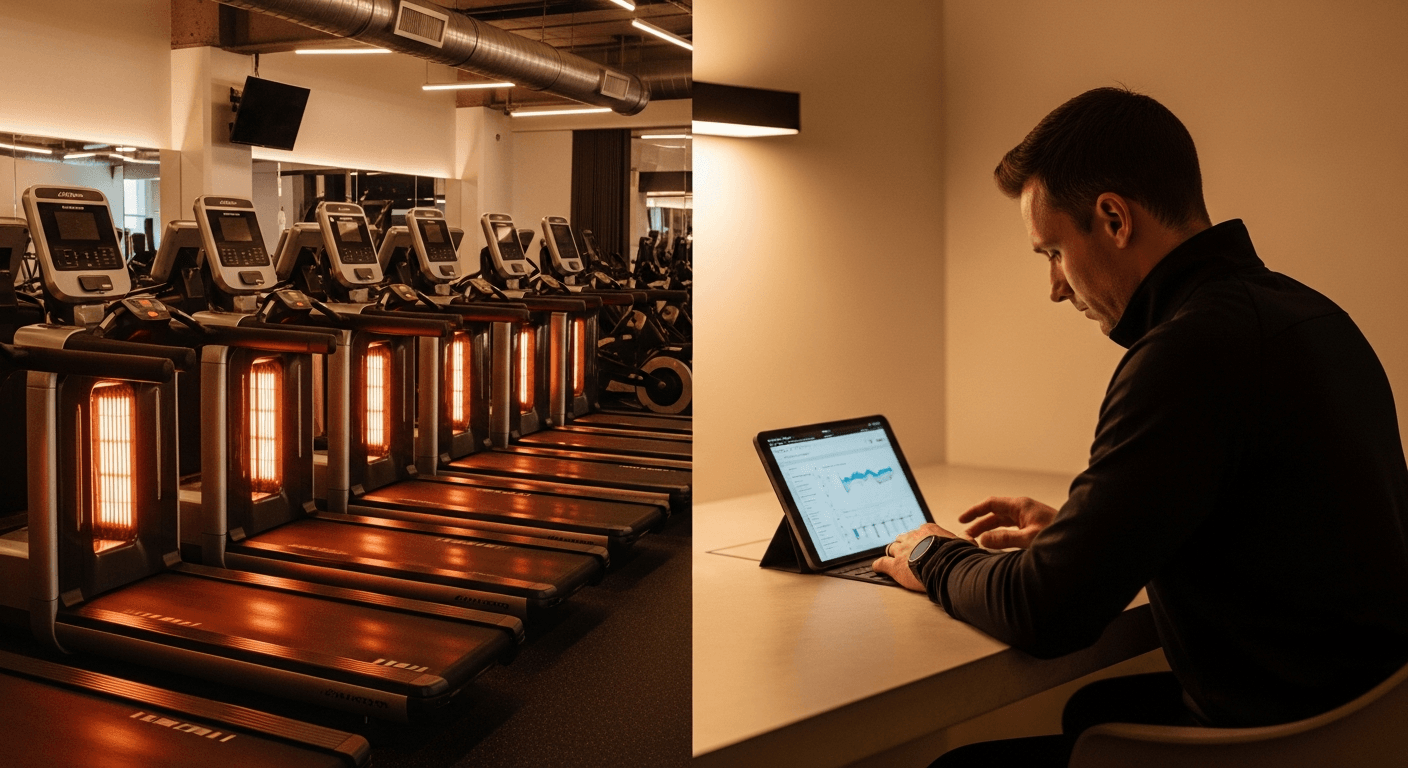
On April 24, 2026, HOTWORX quietly changed the competitive landscape for independent coaches. The infrared fitness franchise launched TrainingTRAX, an AI-powered personal training system embedded directly inside its Burn Off App, available exclusively to Sweat Elite members. It's precision programming, delivered at scale, inside a franchise ecosystem that already operates in hundreds of locations across North America.
That launch didn't happen in a vacuum. In Q1 2026 alone, EoS Fitness completed 14 acquisitions and reinvested $10 million into its operations. If you're an independent coach whose core value proposition is program delivery, the message from the franchise sector is clear and it's worth paying close attention to.
What TrainingTRAX Actually Does
TrainingTRAX isn't a generic workout generator. HOTWORX built it to eliminate guesswork for members by delivering personalized training plans that adapt based on individual data. It sits inside the existing member app, which means adoption friction is near zero. Members who already use the Burn Off App to book infrared sessions now have AI coaching in the same interface they opened this morning.
The system is gated behind the Sweat Elite subscription tier, which positions it as a premium retention tool rather than a free feature. That's a deliberate product decision. Gym chains have learned that members who use more touchpoints inside an ecosystem churn at lower rates. TrainingTRAX doesn't just coach members. It binds them to the platform.
From a technical standpoint, the launch represents what's increasingly possible when a franchise with centralized data infrastructure meets modern AI model deployment. HOTWORX can iterate on TrainingTRAX across every location simultaneously. An independent coach updating a program does it one client at a time.
The EoS Fitness Signal Is Just as Important
TrainingTRAX gets the headlines, but the EoS Fitness numbers deserve equal attention. Fourteen acquisitions in a single quarter, backed by $10 million in operational reinvestment, is not a growth story. It's a consolidation story. Well-capitalized gym chains are absorbing independent facilities, expanding their member bases, and immediately deploying tech-driven coaching as a retention and differentiation tool inside those acquired locations.
This is the structural shift. The gym chain of 2024 competed on equipment and location. The gym chain of 2026 competes on coaching infrastructure. When EoS acquires a facility, it doesn't just bring dumbbells and branding. It brings a digital coaching layer that independent operators and solo coaches can't easily replicate.
For a deeper read on how platform economics are reshaping independent coaching businesses, Coaching Platforms in 2026: Trends That Change the Business Model breaks down the structural forces that were already in motion before TrainingTRAX launched.
Two-Front Pressure on Independent Coaches
If you're running an independent coaching business in 2026, you're facing competitive pressure from two directions at once.
From below, AI-powered program delivery is commoditizing the most visible part of what coaches sell. A Sweat Elite member can now receive personalized programming, in-app, without hiring anyone. The perceived value of a generic 12-week program dropped significantly the moment TrainingTRAX went live. If your business is built on selling templated programs or generic periodization, that product is now competing against a franchise-backed AI running at scale.
From above, the EoS-style consolidation is shrinking the independent gym ecosystem where many coaches work. When a local gym gets acquired, the new ownership often restructures its personal training model, sometimes favoring in-house digital tools over independent contractors. Coaches who relied on affiliate relationships with those facilities lose access to both clients and referral pipelines.
The Personal Training 2026: Strong Demand, Harder Growth analysis covers this tension directly: client demand for coaching remains strong, but converting that demand into sustainable revenue is getting structurally harder for solo operators.
Where AI Coaching Cannot Compete Yet
TrainingTRAX is a precision programming tool. It is not a behavior change system. That distinction matters more than most franchise marketing materials will acknowledge.
Research consistently shows that adherence, not program design, determines the majority of long-term client outcomes. A coach who can identify why a client keeps skipping Thursday sessions, reframe their relationship with recovery, and hold them accountable through a difficult life transition is doing something that no current AI system can replicate at the depth required to produce lasting results.
The populations where this gap is widest are also the populations with the highest willingness to pay. GLP-1 users need coaches who understand the muscle preservation implications of rapid weight loss and can build programming that accounts for changing body composition month by month. As covered in Muscle Loss After 40: How to Actually Stop It, the physiological stakes for this cohort are significant and the margin for programming error is narrow.
Masters athletes navigating age-related recovery shifts need someone who understands the nuance between deload and regression. Return-to-sport clients need clinical coordination that sits outside any franchise app's current capability. These are not edge cases. They're high-value niches with unmet demand and real complexity that justifies premium pricing.
The High-Ticket Coaching Niches in 2026: Where the Real Money Is report identifies several of these populations explicitly, and the thread connecting all of them is that their needs exceed what algorithmic coaching can currently address.
The Strategic Repositioning Independent Coaches Need
The coaches who will be most exposed to franchise AI competition are those whose service looks like what the AI delivers: structured programs, exercise libraries, macro targets, and weekly check-ins conducted primarily through an app. If your offer is indistinguishable from what TrainingTRAX provides, the price comparison will not favor you.
The repositioning isn't complicated, but it requires discipline. Here's what actually differentiates a human coach from franchise AI at this stage of the technology:
- Behavioral coaching depth. You can identify the emotional and psychological patterns driving non-adherence. No current AI coaching system has that clinical read on a client's actual life.
- Relationship continuity. A client who goes through a divorce, a job loss, or a health scare doesn't need a revised program. They need a coach who knows them well enough to adapt the entire engagement in real time.
- Niche clinical fluency. Working with GLP-1 users, perimenopause clients, post-surgical athletes, or masters competitors requires knowledge and judgment that franchise platforms are not yet equipped to deliver safely.
- Accountability architecture. The best coaches build systems around their clients, not just programs for them. Frequency adjustments, habit scaffolding, and environmental design are human coaching functions that require real context.
For coaches whose client base skews older, the longevity angle is particularly compelling. The science linking fitness to lifespan extension, detailed in Being Fit in Midlife Actually Extends Your Lifespan, gives human coaches a powerful narrative: you're not just building bodies, you're building years. That's a conversation TrainingTRAX cannot have.
The B2B Opportunity Most Coaches Are Missing
Here's the angle that almost no one in the independent coaching space is talking about yet. Franchise chains deploying AI coaching systems need people who actually understand coaching to make those systems work properly.
TrainingTRAX needs to be trained on sound programming principles. It needs to be audited for safety when applied to vulnerable populations. It needs coaches who can identify when the AI is generating output that would harm a client with a specific injury history or medical condition. That's expertise that does not exist inside a software development team.
Independent coaches with deep domain knowledge in periodization, special populations, or sports performance are positioned to consult directly with franchise chains on AI system design, content development, and safety auditing. This is a B2B revenue stream that did not meaningfully exist 12 months ago. A coach who charges $150 per hour for client sessions might charge $250 to $400 per hour for AI coaching consultation inside a franchise rollout.
It requires a different kind of outreach. You're not pitching to a client. You're pitching to a VP of Product or a Head of Member Experience. But the value proposition is clear: your expertise makes their AI coaching system safer, more effective, and less likely to produce the liability exposure that comes with poorly calibrated automated programming.
What to Do This Quarter
The TrainingTRAX launch and the EoS acquisition spree are signals, not verdicts. Independent coaching is not dying. It's differentiating. The coaches who respond strategically now will be better positioned in 18 months than they are today. Those who don't will find their mid-market positioning increasingly squeezed.
Audit your current offer. If it's primarily program delivery, build a layer of outcome-based, relationship-driven services that you can clearly articulate. Identify one niche population you can serve with more depth than any AI currently can. And if you have enough credibility in programming or special populations, start having conversations with the franchise operators in your market about what their AI coaching rollouts actually need from experienced humans.
The franchise sector just made a large bet on automated coaching. The right response isn't panic. It's precision about where your value actually lives.