
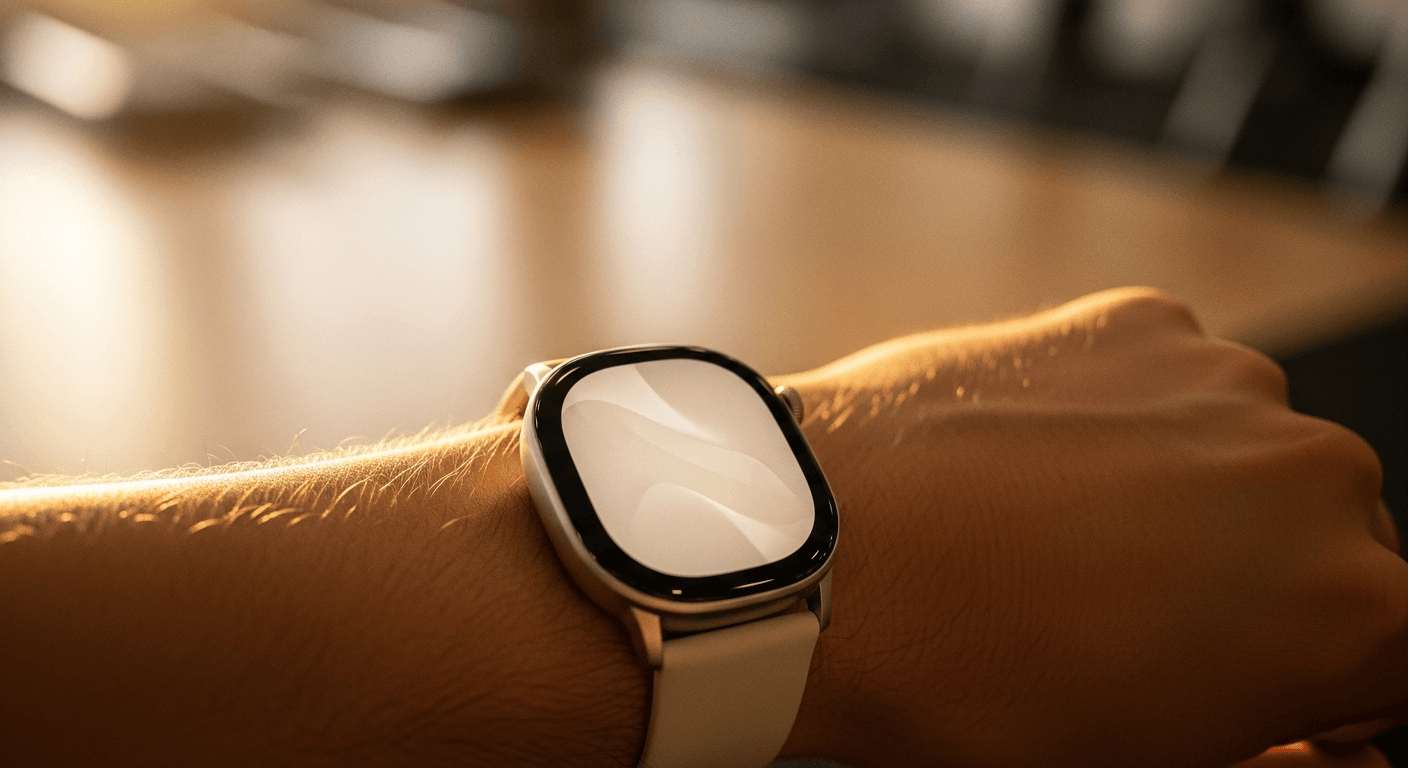
Morgan Stanley's May 19, 2026 industry analysis doesn't bury the lead. On-device AI for real-time coaching and personalized health insights is identified as the defining wearable trend of the year. Not a feature update. Not a niche product category. The defining trend. If you're a coach who hasn't repositioned your value proposition, that finding should read as a direct warning.
The technology has matured faster than most coaching businesses have adapted. Wearables now process biometric data locally, without cloud latency, and deliver coaching-style feedback in real time. Heart rate variability, sleep staging, recovery scores, movement quality flags. These are outputs that coaches used to charge for interpreting. Now they appear on a client's wrist before you've sent your morning check-in message.
What the Morgan Stanley Report Actually Means for Your Business
The compression isn't hypothetical. The report confirms that on-device AI is collapsing the perceived value of data delivery as a coaching service. Clients who pay $150 to $250 per month for a remote coaching package increasingly ask a fair question: what are you giving me that my device isn't?
If your answer involves words like "programming," "tracking," or "check-ins based on your data," you're competing with hardware that ships once and runs indefinitely. That's not a competition you win on price. The coaches most exposed are those whose service is structured around delivering information that AI now surfaces automatically.
The report also signals that this shift is accelerating. Chip efficiency improvements mean on-device processing is no longer reserved for premium wearables. Mid-tier devices are integrating the same AI coaching layers. The addressable market for AI-delivered real-time feedback is expanding downward through price points, which means the displacement pressure on coaches isn't limited to clients who can afford a $400 WHOOP band. It's spreading to the mass market.
For a deeper look at how WHOOP's $10 billion valuation is already reshaping coaching strategy, WHOOP at $10B: The Coaching Business Moves That Follow outlines the positioning shifts that follow that kind of platform growth.
Gyms Are Becoming Data Pipelines. That's an Opportunity and a Threat.
The gym model is evolving in a direction that intersects directly with this AI shift. Facilities are repositioning as integrated wellness destinations, not just spaces with equipment. That means piping wearable data directly into member experiences: adaptive programming on floor displays, recovery-based class recommendations, biometric-triggered check-ins at the front desk.
For coaches operating inside these facilities, that infrastructure creates a real B2B opportunity. Gyms building out these ecosystems need human expertise to design the frameworks that AI executes, to handle member escalations when automated recommendations fall short, and to lead the programming logic that drives the platform. That's a contract role that didn't exist three years ago.
But the same infrastructure shrinks the margin for solo operators who rely on individual client data interpretation as their primary deliverable. When the gym's app is already synthesizing a member's WHOOP recovery score, Garmin sleep data, and in-facility performance metrics into a daily recommendation, a separate remote coach delivering the same insight is redundant. Solo coaching margins are compressing precisely because the infrastructure that used to require a coach now runs automatically.
The coaches capturing B2B gym contracts in 2026 are the ones who walked in with a curriculum, a behavior change framework, and a track record in client retention. Not a certification and a training split.
The Repositioning That Actually Insulates You From Substitution
The emerging platform landscape is consistent on this point. Coaches who reposition around interpretation, accountability, and behavior change are significantly more insulated from AI substitution than those delivering program design or data summaries.
On-device AI is exceptionally good at pattern recognition and output delivery. It's not equipped to navigate the psychological friction that causes a client to skip workouts for three weeks, eat reactively under work stress, or abandon a protocol the moment life gets complicated. That's not a technology gap that will close quickly. Human motivation is messy, context-dependent, and often irrational. That's where your leverage lives.
Practically, repositioning means auditing what you're actually selling. If your client deliverables are primarily a training plan, weekly data review, and form check videos, a significant portion of that stack is under substitution pressure. If your deliverables are primarily structured accountability, behavioral pattern recognition, and guided decision-making during high-stress periods, you're in a different category entirely.
The research on biometric coaching in chronic condition management reinforces this. mHealth Biometrics and Coaching: The T2D Study Coaches Need demonstrates that human coaching combined with biometric data produces meaningfully better outcomes than data delivery alone. The data doesn't motivate. The coach does.
Subscription structures that lock in accountability relationships over time also matter here. Coaches building recurring revenue around ongoing behavioral support rather than program delivery cycles are better positioned on both the revenue and retention side. The mechanics of that model are worth understanding in detail. Subscription Models: How Trainers Build Predictable Revenue covers the structural shift from transactional to retained coaching income.
Where Fitness Capital Is Flowing in 2026
Investment patterns confirm the strategic direction. Fitness capital in 2026 is favoring scalable, technology-integrated formats over traditional one-on-one models. Two examples illustrate this clearly.
BODY20's EMS scaling model has attracted significant attention as a format that delivers high-intensity training in 20-minute sessions using electromuscular stimulation. The efficiency proposition is sharp: equivalent stimulus to a longer conventional workout, compressed into a format that slots into a busy schedule. The business model scales because the technology standardizes the session, reducing dependence on individual trainer variability. Franchise operators are expanding on the strength of that standardization.
Bala, the design-forward fitness equipment brand, secured backing from Mark Cuban and Maria Sharapova. That investment reflects a broader thesis: that fitness consumers in 2026 are buying identity and aesthetics alongside function. The product positioning treats equipment as a lifestyle object, and the capital followed that framing. Neither Bala nor BODY20 are traditional coaching businesses. That's the point. The capital is flowing to formats that don't require a coach at the center of every transaction.
This doesn't mean one-on-one coaching is dying. It means the ceiling on undifferentiated one-on-one coaching is lower than it was two years ago. The formats attracting growth capital have either automated the coaching layer or eliminated it entirely in favor of technology-delivered stimulus.
The Practical Moves Worth Making Now
If you're sitting with a coaching business that's primarily structured around program delivery and data check-ins, the repositioning isn't a rebrand. It's a service redesign. Here's what that looks like in practice.
- Audit your deliverables against AI substitution risk. For each component of your current service, ask whether a wearable's on-device AI could replace it within 12 months. Be honest. If the answer is yes for more than half your stack, you're exposed.
- Build behavior change frameworks into your client agreements explicitly. Not as a soft benefit but as a named, structured deliverable. Clients need to understand they're paying for accountability architecture, not just programming.
- Pursue B2B positioning with gym and wellness facility operators. The integrated wellness destination model needs human expertise to function. That's a contract market, and it's growing faster than the individual client market.
- Develop fluency in interpreting the data your clients' devices produce. Not to deliver it back to them but to identify the gaps between what AI flags and what's actually happening. That's a clinical-adjacent skill set, and it commands premium pricing.
- Understand the performance science your clients are seeing on their devices. When a client's wearable tells them their recovery is green but they feel flat, knowing whether to push or hold requires context that AI doesn't carry. Research showing that less fit individuals require different training volumes to achieve comparable outcomes, as detailed in Less Fit? You Need More Exercise to Get the Same Results, is exactly the kind of nuanced science that informs those calls.
The coaches who will absorb the least revenue damage from the on-device AI shift are not the ones who fight the technology. They're the ones who've already moved to a position the technology can't occupy. Interpretation over delivery. Accountability over information. Behavioral precision over generic programming.
Morgan Stanley's analysis isn't predicting a future threat. It's describing a current market condition. The coaches reading it as a call to action now have a lead over those who'll read it as history in 2027.
The underlying science your clients need you to translate hasn't gotten simpler either. As evidence continues to build around longevity-focused training, as covered in Muscle Strength Predicts Longevity, Especially in Women, the interpretation layer between raw data and meaningful behavior change remains a fundamentally human job. Own that layer before the hardware does.