

On May 29, 2026, PersonalHour announced a new growth funding round aimed at expanding its AI-powered Pilates coaching platform. The raise targets smarter workout recommendations, personalized reformer guidance, and deeper automation of the instruction layer. It's a significant move on its own. Paired with everything else happening in connected fitness right now, it's a clear signal that the industry's direction has been decided.
The question for working coaches isn't whether AI will change Pilates instruction delivery. It already is. The question is how fast, and whether you're building something that survives the transition.
Two Funding Moves, One Direction
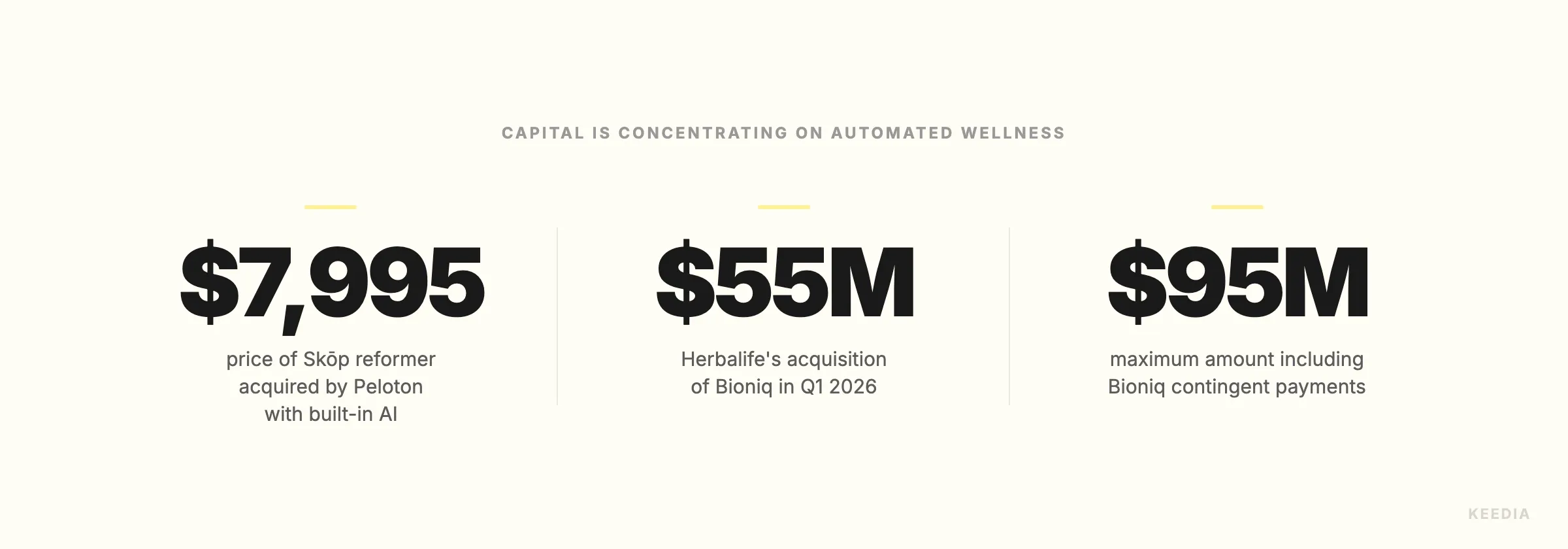
PersonalHour's raise doesn't exist in isolation. Earlier this year, Peloton acquired Skōp, a smart reformer system, at a retail price of $7,995 per unit. That deal confirmed what the hardware side of the industry has been signaling for months: connected equipment companies are no longer content to be delivery devices for human instruction. They want to own the coaching relationship entirely.
If you want a fuller picture of what the Peloton-Skōp deal means for your studio or solo practice, Peloton Buys Skōp: What the Pilates Bet Means for Coaches breaks down the strategic implications in detail. The short version: when a reformer can give technically accurate cues, track your client's form, and adapt the session in real time, the argument for paying a premium for in-person instruction gets harder to make to a cost-conscious client.
PersonalHour's funding accelerates the software side of the same equation. Smart reformer guidance and AI-generated programming are no longer prototype features. They're funded, actively developed products with distribution ambitions. Two well-capitalized companies are now building toward the same outcome from different directions, one through hardware, one through software.
The Broader Capital Signal
These moves aren't limited to Pilates. The Q1 2026 Health and Wellness M&A report documented Herbalife's acquisition of Bioniq Health-Tech for $55 million, with up to $95 million in contingent payments. Bioniq's model centers on highly personalized, data-driven wellness delivery, the kind of individualized protocol design that coaches have historically positioned as their core value proposition.
That acquisition tells you something important about where institutional capital thinks the value lives in wellness: in data, personalization infrastructure, and scalable delivery systems, not in individual practitioners. That's not a pessimistic read. It's an accurate one. And it has direct implications for how you structure your business.
The AI coaching pressure isn't confined to fitness, either. CoachHub's AI Push: Threat or Leverage for Independent Coaches? examines how enterprise coaching platforms are deploying AI across professional development and performance contexts, and what independent coaches can learn from the playbook being used against them.

What's Actually Being Automated
Here's where coaches sometimes misread the threat. AI isn't coming for your relationship with clients, at least not yet, and not directly. What it's automating is instruction delivery: cueing, form correction, session sequencing, progressive overload management, and basic accountability check-ins. Those are real, time-consuming parts of what coaches do. But they're not the parts clients pay premium rates for when they're truly committed to a result.
The commoditization risk is specific. If your value proposition is primarily "I teach you how to do Pilates correctly," a well-designed AI system running on a $7,995 smart reformer poses a genuine long-term threat to your pricing power. If your value proposition is "I help you achieve a specific outcome, track your progress rigorously, and keep you accountable through the hard stretches," that's a substantially harder thing to automate.
This distinction matters enormously for how you position yourself right now, not after the platforms mature further.
The Narrowing Window for Independent Coaches
Multiple funded competitors are in active product development simultaneously. PersonalHour has capital. Peloton has distribution. The time between "early AI coaching product" and "good enough to satisfy most clients at a lower price point" is compressing. You have a window to build something that doesn't depend on being better at instruction delivery than an AI with 24/7 availability and no scheduling friction.
The asset you need to build is proprietary client outcome data. Not just session logs, but documented results: what your clients achieved, over what timeframe, starting from what baseline. That record, built over months and years, is something no newly launched platform can replicate. It becomes the evidence base for your positioning, your pricing, and your referral credibility.
For practical frameworks on structuring your business to remain competitive as automation scales, The Hybrid Coaching Model: Why 50% of Trainers Chose It (And How to Build One) is worth working through carefully. The hybrid structure, combining in-person depth with scalable remote touchpoints, is well suited to the moment we're in.
Where Differentiation Actually Lives Now
Given what's being funded and where AI capability is heading, here's a clear-eyed picture of where independent coaches can actually hold ground:
- Outcome accountability: AI platforms deliver sessions. They don't yet hold clients genuinely accountable in the way a human relationship does. Your ability to notice when a client is stalling, address the behavioral or psychological block underneath it, and adapt the approach accordingly is still a human capability. Build your practice around demonstrating that.
- Specialization depth: Broad Pilates instruction is the most exposed surface area. Narrow specializations, such as post-surgical rehabilitation, perimenopause-specific programming, or athletic performance Pilates, require clinical nuance and relationship trust that generic AI systems aren't built for. If you're not already developing a specialty, this is the moment to choose one.
- Integrated health context: Clients aren't just movers. They're sleeping poorly, managing stress, dealing with hormonal changes, and navigating injury history. A coach who can address Pilates programming within that broader context provides something fundamentally different from a smart reformer. Resources like Exercise and Menopause: The Evidence-Based Protocol for Perimenopause and Beyond are examples of the kind of domain depth that supports genuine specialization conversations with clients.
- Community and belonging: Group dynamics, shared progress, and human connection remain motivators that AI doesn't replicate well. Small group programming built around a defined client identity, not just a fitness modality, is one of the most defensible models available to independent coaches right now.
Pricing Pressure Is Coming. Prepare Now.
When smart reformer subscriptions hit the market at $50 to $100 per month with unlimited AI-guided sessions, the comparison pressure on your rates will be real. Clients who are already price-sensitive will feel it most. That's not a reason to cut your prices. It's a reason to be extremely clear about why your rates are what they are, backed by documented outcomes rather than credentials and hours worked.
If you haven't done a rigorous review of your positioning relative to current market data, Online Coaching Pricing 2026: Market Data to Set Your Rates Right provides a current benchmark framework. Understanding where you sit in the market, and why, is foundational to surviving the pricing pressure that automation will accelerate.
The premium segment of the market is also expanding in ways that reward specialization. The luxury wellness category grew 88% in revenue terms recently, and that growth is concentrated among practitioners who have built identifiable expertise and a documented track record. If you're positioned correctly, the AI wave doesn't just threaten your practice. It filters out generalist competitors and increases the relative value of coaches who can demonstrate real outcomes for specific client populations.
What to Do This Quarter
PersonalHour's funding round is a useful forcing function. It makes the timeline concrete. Here's what matters in the near term:
- Audit your current client documentation. Are you capturing baseline assessments, progress benchmarks, and outcome data systematically? If not, build that system now.
- Identify your specialization lane. Where do you already have the deepest client relationships and the strongest results? That's where your positioning should sharpen.
- Review your program structure for accountability features. How many touchpoints do you have between sessions? How are you tracking client follow-through and addressing dropout risk?
- Evaluate your hybrid capacity. Can you serve clients effectively between in-person sessions with remote tools? That flexibility matters more as AI platforms compete on accessibility.
The coaches who will be most exposed over the next two to three years are those whose value proposition is primarily transactional: I provide sessions, you attend them. The coaches who will be most resilient are those whose value proposition is relational and outcome-oriented: I help you get somewhere specific, and I have the records to prove I've done it before.
PersonalHour's funding round didn't create that distinction. It just made it more urgent.