
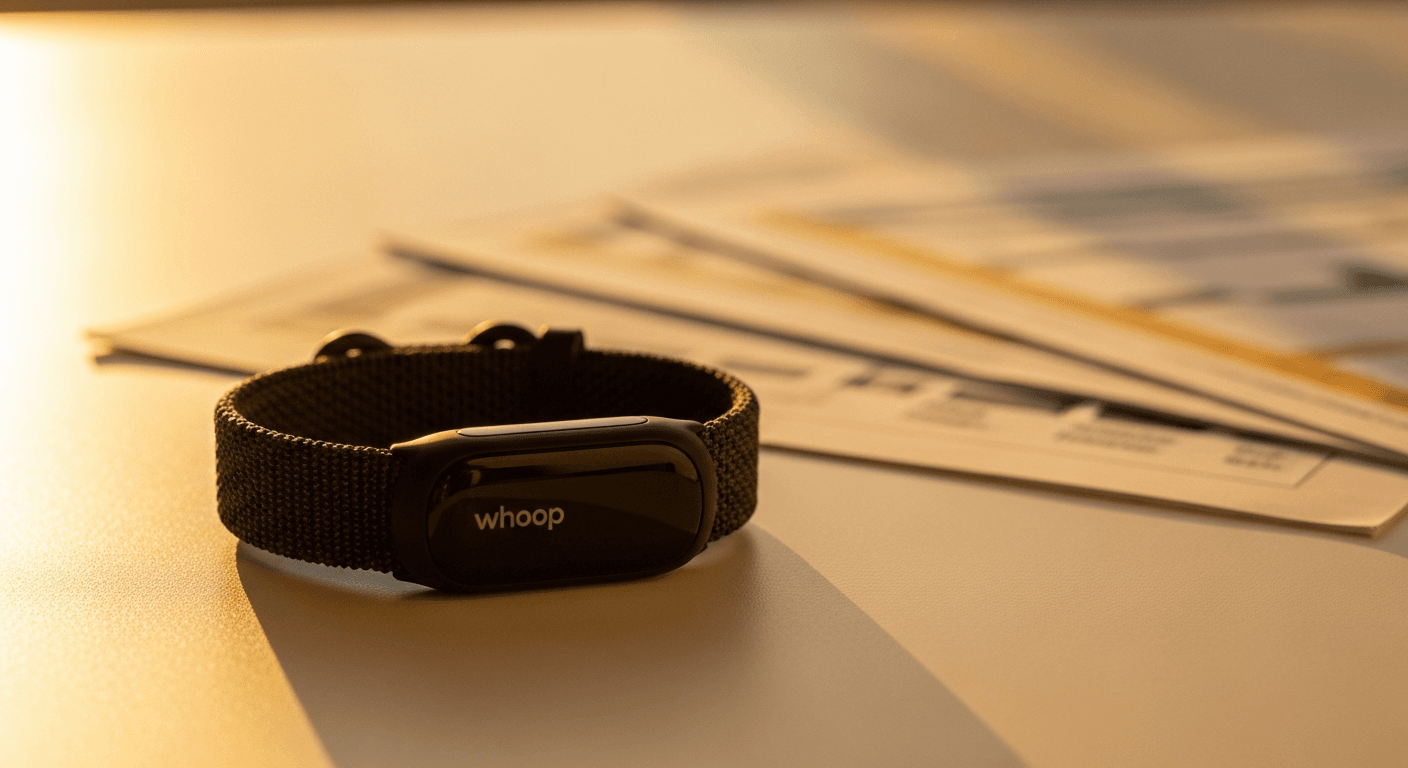
In March 2026, Whoop closed a $575 million Series G round at a $10.1 billion valuation. That number matters far beyond the wearables industry. It signals that physiological data collected at scale is now being priced as healthcare infrastructure. And for coaches paying attention, it maps directly to where premium coaching fees are heading.
This isn't a story about a gadget company getting overvalued. It's a story about what your clients are wearing on their wrists, what they expect you to do with that information, and why coaches who can bridge that gap are building a competitive position that no $30/month app can replicate.
What Whoop's Valuation Actually Represents
Whoop's platform sits on more than 24 billion hours of physiological data. That dataset feeds AI models that generate recovery scores, strain recommendations, HRV baselines, and sleep stage breakdowns for users around the clock. The company isn't selling a heart rate monitor. It's selling a continuous health prediction engine.
At a $10.1 billion valuation, investors are pricing Whoop alongside companies that operate in clinical health, not consumer electronics. That compression between fitness and medicine is the structural shift you need to understand. The data class that Whoop has built, and that competitors like Garmin and Apple are racing to match, is now the same data class that hospital systems, insurance companies, and corporate wellness programs want access to.
For coaches, that shift creates both pressure and opportunity. Pressure, because your clients are arriving with data they didn't have two years ago. Opportunity, because most coaches still don't know what to do with it.
Client Expectation Drift Is Already Here
Here's the practical reality: a client wearing Whoop is not just tracking steps. They're getting a daily recovery score, a sleep performance percentage, a respiratory rate trend, and a recommended strain level for the day. They open that data before they open your training plan.
When they walk into a session with a 38% recovery score and you push them through a high-intensity interval block, one of two things happens. Either they underperform and feel confused about why, or they start to wonder whether their coach is actually using the information available to them. That second outcome is the one that erodes client retention.
The coaches who are winning right now are not the ones who dismiss wearable data as consumer noise. They're the ones who've built programming systems that treat recovery scores as inputs, not background information. That shift in workflow is where the differentiation starts.
This also connects to broader trends in how clients define results. Rest and recovery have become foundational priorities for fitness consumers in 2026, not afterthoughts. A client who tracks recovery daily expects their coach to speak that language fluently.
The Data Fluency Premium in Coaching Pricing
Standard session delivery, whether in-person or online, is being commoditized. AI-generated programming tools are improving fast. Clients can get a 12-week strength plan from a chatbot in under 60 seconds. What they can't get from a chatbot is a coach who looks at their HRV trend over the last three weeks, cross-references it with their sleep data and training load, and makes a judgment call about whether to deload this week or push through.
That interpretive layer is what justifies premium pricing. Coaches who've built fluency in wearable outputs, specifically the ability to read strain-to-recovery ratios, identify HRV suppression patterns, and adjust programming accordingly, are charging $300 to $600 per month for hybrid coaching packages where data review is a formal part of the service. Coaches without that skillset are competing on price, often dropping below $150 per month to retain clients.
The market structure here is explored in depth in the context of the hybrid coaching market, which is now driving $15.6 billion in annual revenue globally. The coaches capturing the high end of that market are almost universally offering data-informed services, not just session delivery.
If you want a concrete look at what the income structure of top-tier coaches actually looks like, the breakdown of how top hybrid coaches earn $350K or more per year shows that data fluency is consistently one of the defining differentiators at that income level.
What Data Fluency Looks Like in Practice
You don't need a clinical degree to become a competent interpreter of wearable outputs. You need a framework and consistent application. Here's what that looks like across the major data categories Whoop provides:
- Recovery score: A composite of HRV, resting heart rate, sleep performance, and respiratory rate. A score below 33% warrants a reduced training load or active recovery session. A score above 66% supports high-strain work. The middle range requires judgment based on training phase and client history.
- HRV baseline: More useful than any single HRV reading is the trend line. A client whose 7-day HRV average is dropping week over week is signaling accumulated stress, regardless of how they feel subjectively. That's a programming flag, not a coaching failure.
- Sleep stage data: Slow-wave sleep is where physical recovery happens. REM is where cognitive and emotional processing occurs. A client consistently short on slow-wave sleep is not going to adapt well to high-volume strength work. Knowing that changes how you program and what conversations you have.
- Strain score: This measures cardiovascular load across the full day, not just training. A client who does a moderate gym session but then runs around after two young children all afternoon has a different total strain than their training log suggests. That context matters for recovery planning.
The intersection of sleep and training outcomes is increasingly well-documented. Research on how sleep and moderate exercise together protect mental health reinforces why coaches who track both variables are better positioned to support client outcomes holistically, not just physically.
The B2B Channel That Whoop's Valuation Opens for Coaches
The $10.1 billion valuation doesn't just change what clients expect from coaches. It changes who coaches can work with professionally.
As wearable data crosses into healthcare-grade territory, the gap between fitness coaching and clinical health services is narrowing. Physicians working in preventive medicine, occupational health, and corporate wellness programs are increasingly comfortable recommending coaches who can interpret biometric data. That's a referral pipeline that didn't exist in any meaningful way five years ago.
Corporate wellness is the most immediately accessible channel. Large employers running wellness programs are actively looking for coaches who can work with employees who wear Whoop or similar devices and translate that data into behavior change. These contracts typically run $5,000 to $20,000 per year per program, depending on group size and service scope. That's a revenue category that has nothing to do with per-session pricing.
On the clinical side, coaches with demonstrated data fluency are becoming credible referral partners for primary care physicians managing patients with metabolic risk, cardiovascular concerns, or sleep disorders. The research landscape supports this. Studies examining whether cardio or strength training is more effective for diabetes prevention are exactly the kind of applied research that positions a data-fluent coach as an informed partner in a patient's care team, not just a personal trainer.
This doesn't require a medical credential. It requires that you understand the data well enough to communicate clearly with clinicians, document your observations, and stay within your scope of practice while demonstrating professional competence.
Building Your Data Coaching Stack
If you're not already integrating wearable data into your coaching practice, here's a practical starting point:
- Get fluent in one platform first. Whoop, Garmin, Oura, and Apple Watch all present data differently. Pick the one your clients are most likely to use and understand its metrics deeply before spreading across platforms.
- Build a data intake protocol. Before each week's programming, review the previous week's recovery trends, not just workout logs. Make this a formal step in your workflow, not an optional check-in.
- Create a communication framework. Clients don't need a lecture on HRV physiology. They need a sentence or two that tells them what the data means for today's session. Practice translating data into plain language.
- Document your adjustments. When you modify a program based on recovery data, note it. Over three to six months, that documentation becomes evidence of your methodology and a powerful tool for client retention and referral conversations.
- Position data review as a service tier. Don't give away data analysis as a free add-on. Price it into a coaching tier that reflects the time and expertise it requires.
The Moat Is Built Now, Not Later
Whoop's $10.1 billion valuation is a market signal, and the window to act on it is open right now. The coaches who build data fluency in 2026 are not going to be easily displaced by the coaches who start in 2028, because the client relationships, the referral networks, and the documented outcomes will already be established.
The fitness industry has always rewarded coaches who stayed ahead of what clients needed before clients knew to ask for it. Physiological data interpretation is that skill for this moment. The infrastructure exists, the client demand is building, and the valuation of the companies behind it confirms that this data class is not going away.
You don't need to become a data scientist. You need to become the coach who knows what a suppressed HRV trend means for a 47-year-old client with a heavy workload, and who builds a training week that accounts for it. That's the skill. That's the moat.