
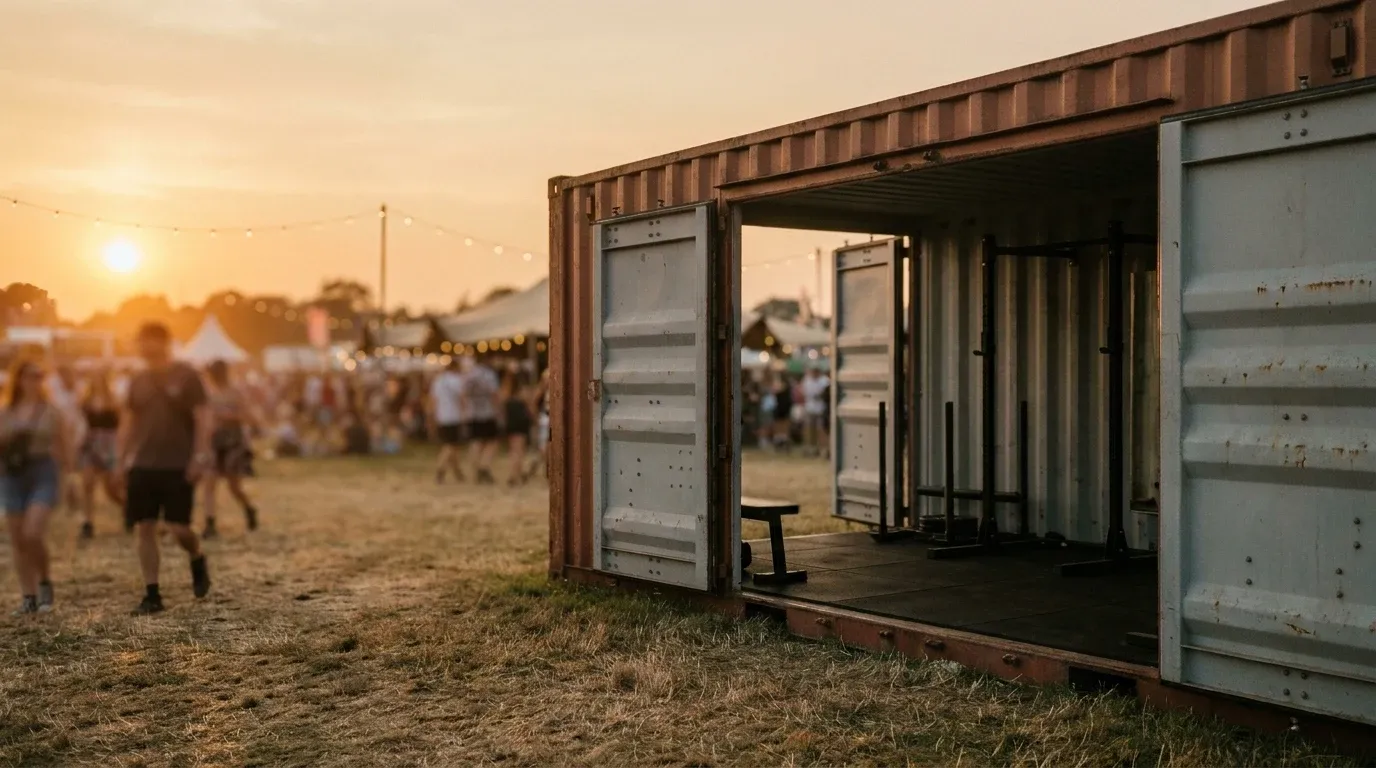
On September 29, 2026, Barry's rolled out something that had no precedent in the premium fitness space: a fully functional studio built from repurposed shipping containers, parked at Austin City Limits, ready to deliver its signature Run x Lift experience to festival crowds. No lease negotiation. No build-out timeline. No permanent commitment.
The Barry's Mobile Studio isn't a marketing stunt dressed up as innovation. It's a structural rethink of how premium fitness brands grow, and it carries real implications for every operator watching studio rent climb and member acquisition costs follow close behind.
What Barry's Actually Built
The mobile studio replicates the core Barry's experience inside a containerized format designed for rapid deployment. That means treadmills, weight floors, the signature red lighting, and the class structure that built the brand's reputation. The goal wasn't approximation. It was replication at a fraction of the fixed cost.
Choosing Austin City Limits as the launch venue wasn't accidental. The festival draws a concentrated, high-income demographic, the exact profile Barry's targets in its permanent locations. Ticket prices for the event start well above $300, which functions as a natural income filter. Barry's didn't have to hunt for its ideal customer. The festival did that work already.
That's a meaningful shift in acquisition logic. Traditional studio expansion assumes you plant a flag in a target market, build out the space, and then spend aggressively to attract members. Barry's inverted that sequence entirely.
Separating Member Acquisition from Real Estate
The most strategically significant thing about the mobile studio model is what it decouples. Real estate has historically been the forcing function for premium fitness expansion. You identify a market, sign a lease, invest in build-out, and hope the demand materializes. The capital is committed long before the first member walks through the door.
Barry's is now testing markets before making that commitment. The mobile studio seeds demand, collects data on conversion and engagement, and gives the brand a clear signal about whether a permanent location makes sense. That's a reversal of the traditional franchise expansion sequence, and it significantly de-risks the growth model.
For context on how aggressively the broader industry is pursuing physical expansion, Gold's Gym recently signed a 15-unit franchise deal in Southern California, a move that requires enormous upfront capital and long-term lease exposure. Barry's mobile approach sits at the opposite end of that risk spectrum, at least in the early market-entry phase.
The underlying economics are worth making explicit. A premium studio build-out in a major US market typically runs between $500,000 and $1.2 million before the first class is scheduled. Monthly rent in high-demand urban corridors has risen sharply in 2026, with some operators reporting lease costs exceeding $25,000 per month in cities like New York, Los Angeles, and Austin itself. A containerized mobile unit eliminates that exposure during the validation phase.
The Event Demographic Advantage
Not every event is created equal for fitness brand activation. Barry's selection of Austin City Limits reflects a specific kind of demographic targeting that goes beyond raw attendance numbers. The festival draws the wellness-adjacent, experience-oriented consumer who is already predisposed to premium fitness spending.
That's different from setting up a booth at a trade show or sponsoring a 5K. The mobile studio asks participants to actually do the workout, which means the brand impression is experiential rather than passive. Research consistently shows that experiential marketing drives stronger brand recall and higher downstream conversion than impression-based advertising. Barry's isn't just reaching its target demographic at ACL. It's getting them to sweat in its space.
That distinction matters when you're thinking about customer lifetime value. A member who discovered Barry's at a festival and converted to a recurring membership represents a different kind of relationship than someone who saw a paid social ad. The activation itself is doing qualification work.
What Independent Operators Can Take From This
Barry's has the brand equity and operational infrastructure to pull off a bespoke shipping container studio. Most independent gym operators don't. But the underlying principle scales down considerably, and that's where the real lesson sits.
Pop-up and event-based activations have typically been treated as marketing line items, one-off brand awareness plays that are difficult to attribute and hard to repeat. The Barry's model reframes them as acquisition channels with measurable economics. If you can calculate the cost of running a pop-up activation, count the leads or trial sign-ups generated, and track how many convert to paying members, you have a customer acquisition cost figure that's directly comparable to digital advertising or referral programs.
In markets where studio rent has risen significantly in 2026, that comparison is increasingly favorable. A well-executed local activation at a farmers market, a running event, or a community festival might generate 30 to 50 qualified leads at a fraction of what paid digital channels cost per conversion in competitive metro markets.
The operators who will benefit most from this model are those expanding into secondary cities where there's demand but limited brand awareness. A pop-up activation in a new neighborhood lets you test pricing sensitivity, assess competitor density, and build a waitlist before you've signed anything. That's not a small advantage when lease terms in 2026 are locking operators into five to seven year commitments.
Of course, acquisition is only half the equation. Bringing a new member through the door, whether that door is a shipping container or a permanent studio, only matters if your retention systems are strong enough to keep them. The six-month retention cliff remains one of the most expensive problems in gym operations, and no amount of creative acquisition strategy compensates for a leaky retention model on the back end.
The Broader Strategic Picture for Premium Fitness
Barry's mobile studio arrives at a moment when premium fitness is navigating a genuine strategic tension. Consumer demand for high-quality, class-based training remains strong. But the cost structure of delivering that experience through permanent real estate has become increasingly difficult to justify in markets where rents have outpaced membership price increases.
The industry is responding in different ways. Some operators are pursuing scale through franchise agreements and private capital. Private capital has been targeting fitness businesses aggressively, drawn by the recurring revenue model and the post-pandemic recovery in physical attendance. Others are experimenting with hybrid models that combine in-person and digital offerings to reduce their real estate dependency.
Barry's approach is arguably more elegant than either of those paths in the early-market-entry context. It doesn't require giving up equity or control, and it doesn't dilute the in-person experience that justifies premium pricing. It simply removes the real estate commitment from the front end of the growth sequence.
That's meaningful for the broader industry because Barry's is demonstrating that the format itself can be flexible without compromising the product. The brand identity, the instructor talent, the programming, the community feel: all of that travels. What doesn't have to travel is a long-term lease.
New entrants are also paying attention to format flexibility. REVL Training's US expansion strategy reflects a similar interest in testing market fit before committing to full build-outs, a pattern that suggests the Barry's model may be ahead of a broader industry shift rather than an isolated experiment.
The Minimum Viable Format Question
Here's the question every premium operator should be sitting with right now: what is the minimum viable format to acquire a high-value member in your target market?
For Barry's, the answer turned out to be a shipping container at a music festival. For a boutique strength studio, it might be a four-week pop-up in a residential neighborhood with underserved demand. For a cycling brand, it could be a temporary outdoor installation timed to a local gran fondo or charity ride.
The format changes. The principle doesn't. You don't have to own the real estate to own the experience. And you don't have to commit the capital before you've validated the demand.
Barry's Mobile Studio isn't proof that permanent locations are obsolete. Its existing studios are performing and the brand continues to expand through traditional formats in proven markets. What the mobile studio proves is that the acquisition phase doesn't have to look like the operating phase. You can earn the right to a fixed location by demonstrating demand through a moveable one first.
For operators watching their acquisition costs rise and their lease renewal terms harden, that's not a small insight. It's a reframe of what expansion can look like when real estate stops being the only available playbook.