
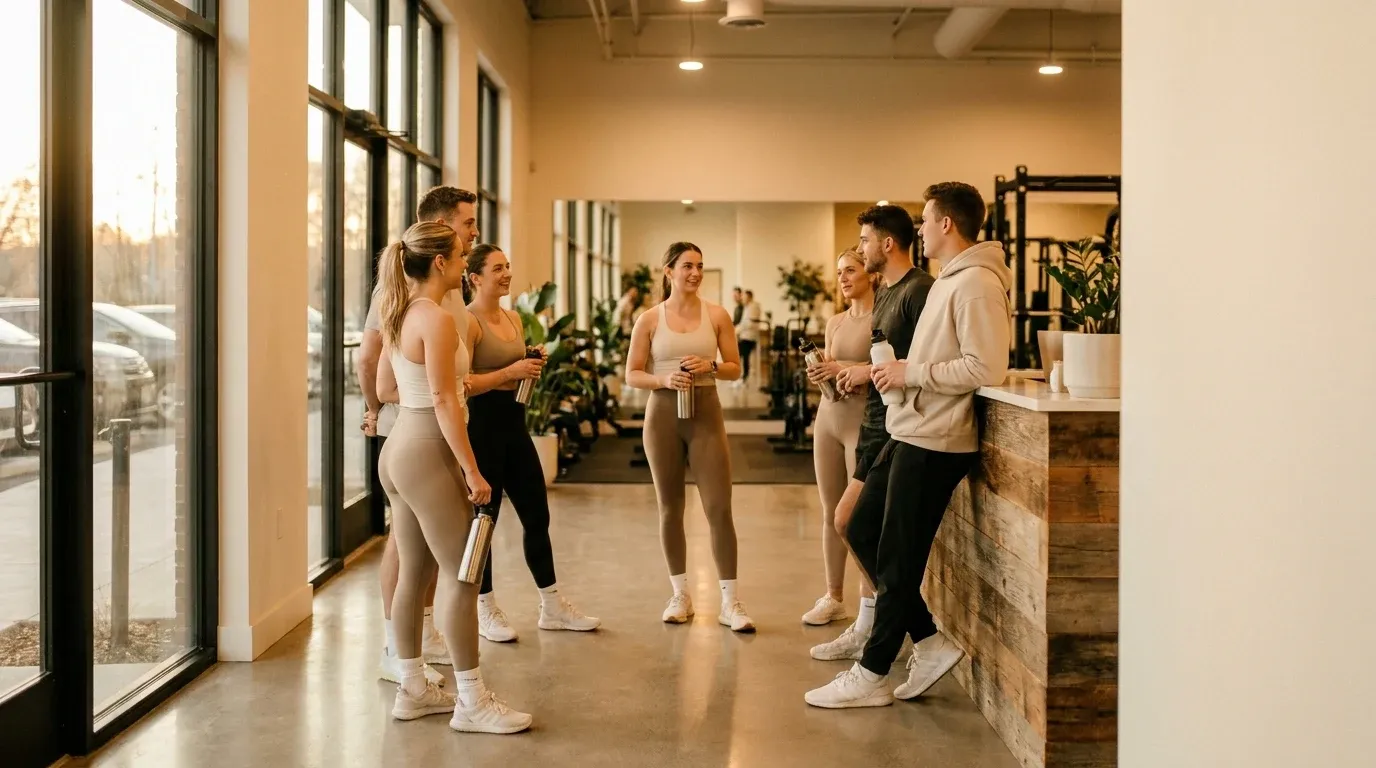
The numbers are no longer anecdotal. According to August 2026 ClassPass research, 53% of adults aged 18 to 34 now identify fitness and wellness activities as their primary social outlet, ranking it above nightlife, dining out, and entertainment. That's a majority of the most commercially coveted demographic in consumer spending actively choosing the gym as the place where they belong.
This isn't a wellness trend cycling through. It's a structural reallocation of discretionary time and money, and gym operators who treat it as such will be positioned to capture something far more durable than a membership spike. Those who don't will keep designing facilities for a generation that no longer exists.
Why the Shift Is Real, and Why It's Lasting
Gen Z entered adulthood inside a period of deep social fragmentation. Pandemic years accelerated loneliness metrics that were already climbing, and the digital-first adolescence that preceded those years left a cohort that is, by its own admission, starved for in-person ritual and shared physical experience.
The appetite for real-life connection isn't a reaction. It's a need that has been chronically unmet. Bars and clubs, historically the default social infrastructure for young adults, no longer fill that gap. They're transactional, expensive relative to perceived value, and structurally built around consumption rather than shared effort or identity. The gym, when designed correctly, offers something different: a reason to show up repeatedly, a community of regulars, and an identity worth belonging to.
Sociologists use the term "third place" to describe the spaces between home and work where community forms. Coffee shops, barbershops, and religious institutions have held that role for decades. Fitness facilities are now competing for that position, and in the 18 to 34 cohort, they're winning it.
This has direct financial consequences. Group Fitness ROI: The Member Data Operators Can't Ignore documents a consistent pattern: members who participate in group programming show significantly higher retention rates and longer lifetime value than those who use a facility purely for solo training. Community isn't a soft benefit. It's a retention mechanism with hard economics behind it.
What Gen Z Actually Wants From a Gym
It's worth being precise here, because "community" has become so overused in fitness marketing that it risks meaning nothing. What this cohort is actually seeking is specific.
They want structured belonging. Not open-ended socialization, but a reason to show up at the same time, with the same people, around the same shared challenge. They want rituals: the Thursday 6am crew, the monthly challenge leaderboard, the post-class debrief that happens naturally when you've designed a space for it. They want to feel recognized by name, not just scanned in.
They also want identity alignment. A gym's brand, aesthetic, and values function as signals about what kind of person trains there. For a generation that treats consumption as self-expression, membership is a statement, not just a utility purchase. Operators who have built clear brand identities around belonging rather than generic performance messaging are better positioned to attract and retain this cohort.
Traffic data supports this pattern. July 2026 gym traffic data shows boutique studios leading in retention metrics even as high-volume low-price facilities hit record sign-ups. The implication is that the formats built around curated community experience are holding members longer, even while they charge more.
The Operator Levers That Actually Move the Needle
If you're running a facility or managing a portfolio of locations, the strategic question isn't whether Gen Z is showing up. They are. The question is whether your operation is designed to keep them.
Here's where operators with a community-first thesis are pulling ahead.
Structured social programming. This means intentional formats beyond the class schedule. Member-led running clubs, monthly lifting challenges with public tracking, beginner cohorts that start together and progress together. These create the repeated touchpoints that convert a one-time visitor into a regular. The programming doesn't need to be elaborate. It needs to be consistent and socially anchored.
Post-class community space. Facility layout decisions communicate priorities. If your locker rooms are premium and your lobby is a bottleneck with two benches and a water dispenser, you're designing for throughput, not belonging. Operators investing in post-workout lounges, café adjacencies, or even simple seating clusters near studio exits are seeing those investments pay back in session frequency and referral rates.
Onboarding that introduces, not just activates. The standard onboarding flow, a tour, a PT consultation, a scan of the app, optimizes for activation. What it doesn't do is introduce a new member to the people they'll see every week. Operators who build a social dimension into the first 30 days, pairing new members with an existing community group, scheduling them into a beginner cohort, or assigning a point of contact beyond the front desk staff, see measurably lower early churn.
The trainer relationship matters here too. When a new member connects with a coach who fits their actual training style and communication preferences, retention outcomes improve significantly. What actually makes a great trainer match goes beyond credentials and specialization. For Gen Z in particular, the interpersonal fit is often the deciding factor in whether they stay engaged beyond the first month.
Member-led identity. The most durable community signals come from members, not marketing. Operators who create visible mechanisms for member expression, submitted transformation stories, leaderboard visibility, member-hosted events, ambassador programs with genuine social credibility, activate a word-of-mouth engine that paid acquisition can't replicate. Gen Z trusts peers, not brands. Your best marketing asset is a 23-year-old regular who feels ownership over the community they helped build.
How to Market to This Cohort Without Missing the Point
The mistake most operators make on social platforms is leading with performance metrics. Before-and-after imagery. Personal records. Transformation timelines. This content resonates with a segment, but it's not the primary driver of acquisition for a cohort motivated by connection rather than physique optimization.
Content that reflects shared experience, the 6am crew, the inside jokes, the post-class conversations, the community challenge results, performs differently. It signals belonging rather than aspiration, and belonging is what this cohort is shopping for.
Your scheduling density also functions as a marketing signal. A class that's perpetually full looks like a community worth joining. A half-empty 7pm slot communicates something different. Operators who consolidate scheduling around peak demand windows, rather than spreading classes thin across the day to maximize nominal access, create the social proof that attracts more of the same cohort.
It's also worth noting what this generation is tracking. Wearables adoption among 18 to 34 year olds is high, and the data they generate has shifted from performance monitoring to social sharing. ACSM's 2026 fitness trends data reflects a category where connected metrics are increasingly communal rather than private. Operators who integrate with this behavior, through leaderboard visibility, challenge tracking, or community-facing progress tools, are meeting members where their attention already is.
The Revenue Architecture Behind the Shift
The financial case for designing around community isn't speculative. Member lifetime value is a function of retention duration multiplied by average revenue per member. If your community-focused programming increases average tenure from 8 months to 14 months, that's a compounding effect on unit economics that outperforms most acquisition investments.
There's also an upsell dynamic that community enables. Members who feel socially embedded in a facility are more likely to purchase personal training packages, participate in premium programming tiers, and buy merchandise that signals their identity. Belonging creates commercial permission that a purely transactional membership relationship doesn't.
The competitive context matters too. Fitness stock performance in 2026 reflects a bifurcating market: high-volume low-price facilities expanding on accessibility, and experience-led operators commanding premium pricing and stronger retention. The middle ground, moderate pricing with undifferentiated programming and generic community gestures, is where operators are getting squeezed from both directions.
If you're positioned in that middle, Gen Z's shift to fitness as social infrastructure is both a pressure and an opportunity. The pressure is that they'll find community somewhere, and if you're not building it deliberately, a competitor is. The opportunity is that the structural demand for what community-first facilities offer has never been higher, and the cohort driving it has decades of membership spend ahead of them.
Design for belonging. The workouts will follow.