
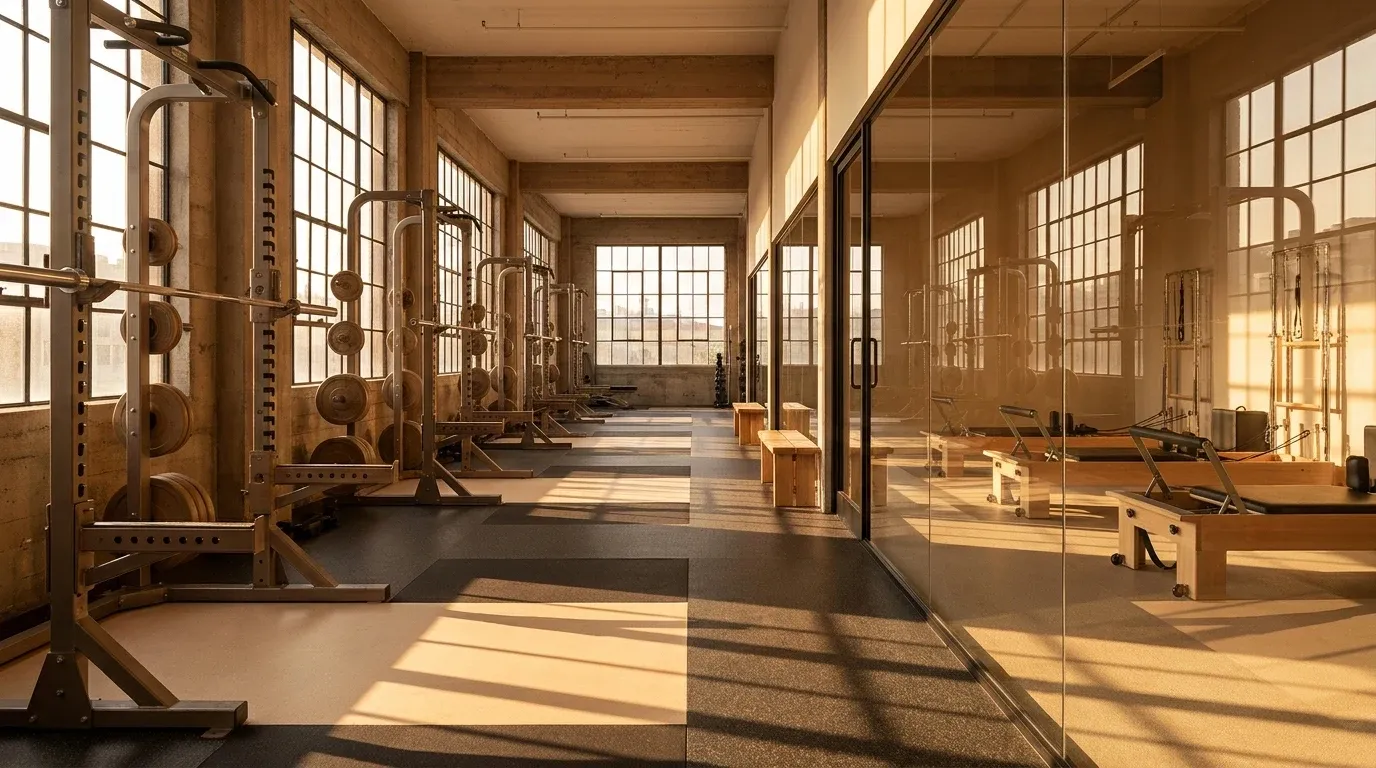
The Athletech News Gym of the Future Report 2026 doesn't leave much room for slow movers. Three structural shifts are reshaping how fitness facilities are designed, programmed, and monetized. Operators who treat these trends as future-state planning items are already behind the facilities that started reallocating budgets twelve months ago.
Here's what the data says, and what it means for your capital and programming decisions right now.
1. Strength Training Is Claiming the Floor
Strength training has moved from a section of the gym to the organizing principle of the gym. The 2026 HFA Benchmarking Report, covering 244 operators across nearly 27,000 facilities in 40 countries, confirms what most operators already feel in their walk-throughs: free weights, functional rigs, and plate-loaded equipment are consistently the most-used areas on the floor.
Member demographics are driving this directly. Strength training is no longer the domain of bodybuilders and performance athletes. It's the primary training modality for a broad cross-section of adults who are increasingly aware of what research has made clear: muscle mass is a long-term health asset. As covered in Your Strength Starts Declining at 35. Now What?, the physiological case for prioritizing resistance training is pushing members toward barbells and dumbbells earlier and more consistently than previous generations.
That behavioral shift has floor-plan consequences. Facilities that haven't reconfigured since 2019 are operating with a cardio-to-strength ratio that no longer reflects how their members actually train. The operators who've expanded their strength footprint. Removing underutilized elliptical banks, adding squat racks, restructuring turf space. Are reporting measurable improvements in member satisfaction scores and time-on-floor metrics.
If you're still running a floor layout built around cardio equipment, that layout is costing you retention.
2. Boutique-in-Box Is Blurring the Category Lines
The boutique-versus-big-box binary that defined the 2010s fitness landscape is collapsing. Larger clubs are no longer ceding specialty programming to standalone studios. They're absorbing it. The result is a format the industry is calling "boutique-in-box": premium, concept-driven experiences embedded inside full-service facilities.
This means a $60-per-month member can now access a cycling studio, a reformer Pilates bay, and a high-intensity interval zone within a single membership. The economics are forcing traditional boutiques to compete on something other than exclusivity, and they're forcing large-format operators to compete on something other than price and convenience.
For operators, the programming implications are significant. You can't simply add a branded zone and call it a boutique experience. Members who've paid $30 per class at standalone studios know what quality programming feels like. The instruction, the scheduling cadence, the room design, all of it has to hold up. Crunch 3.0 Las Vegas: What the Fourth Club Tells Operators illustrates how large-format operators are approaching this integration challenge at the facility design level.
The operators winning this format war are also thinking carefully about programming mix. Boutique-in-box works best when the embedded concepts complement rather than cannibalize each other, and when the broader member base has a clear on-ramp into specialty formats. That's a coaching and staffing challenge as much as it's a real estate one. The evolution of the trainer role is central here. The Personal Trainer of 2026 Is Not Just Counting Reps outlines how that role is shifting toward behavioral programming and long-term lifestyle management, exactly the skill set boutique-in-box environments require.
3. AI Is Moving From Novelty to Infrastructure
Connected technology and AI-driven personalization are no longer differentiators for high-end facilities. They're becoming baseline expectations. The Gym of the Future Report identifies AI as the primary lever for personalized training delivery, member engagement, and revenue growth. That last point is the one most operators underweight.
AI-driven systems aren't just about delivering better workouts. They're about identifying at-risk members before they cancel, surfacing upsell opportunities at the right moment, and reducing the administrative burden on coaching staff so they can spend more time with members. When structured correctly, these systems shift technology from a cost center to a measurable retention and revenue tool.
The member engagement angle matters more than most operators realize. With 81 million people holding US fitness facility memberships in 2025, a new all-time high, the demand backdrop is genuinely favorable. But a larger membership base also means more competition for share of wallet. Members have more options than at any point in fitness history. The facilities keeping them aren't necessarily the cheapest or the closest. They're the ones that make members feel seen and supported on an individual level.
AI personalization is what enables that at scale. A coaching app that adjusts programming based on session history, flags plateaus, and prompts timely check-ins does something a static group class schedule cannot. The comparison isn't hypothetical. Coaching App vs. Human Coach: Which One Do You Need? breaks down where technology fills the gap and where human coaching remains irreplaceable. For operators, the answer is usually: both, deployed intelligently.
Operators delaying AI adoption aren't holding a neutral position. They're actively falling behind facilities that have already integrated personalization into their retention and upsell workflows.
Recovery Is No Longer a Luxury Add-On
Recovery services have completed the journey from aspirational differentiator to core offering. Red light therapy, infrared sauna, contrast therapy, and compression recovery are no longer amenities that justify a premium tier. A growing segment of members now expect them as part of what a serious facility provides.
This shift is partly cultural. Wellness awareness has expanded significantly post-pandemic, and members who train seriously understand that recovery is part of the training cycle, not a reward for it. Sauna After Lifting: Does It Help or Hurt Your Gains? reflects the kind of applied recovery questions members are actively researching. They're walking into your facility already informed, already expecting infrastructure to match their knowledge.
For operators, recovery services now need to be evaluated as revenue lines and retention tools, not cost centers or marketing props. The facilities threading this correctly are building recovery into membership tiers rather than selling it as a à la carte add-on, creating stickiness that goes beyond the training floor.
The Revenue Backdrop Is Strong. The Margin for Error Isn't.
Eighty-one million US fitness facility memberships in 2025 is a number worth pausing on. The fitness industry has never had a larger addressable base. Operators enter 2026 with genuine tailwinds: post-pandemic health awareness, demographic groups newly committed to strength and longevity, and a cultural moment where gym membership carries social currency it hasn't had in decades.
But strong demand doesn't distribute itself evenly. Members at all-time highs also means more facilities competing for the same wallets, more options for members who feel underserved, and lower switching costs than ever. The question isn't whether people want to work out. It's whether they want to work out in your facility specifically.
That answer depends on whether your floor layout reflects how members actually train today, whether your programming mix includes the specialty formats members increasingly expect, whether your technology infrastructure makes members feel individually supported, and whether your recovery offering has kept pace with member expectations.
Facilities that delay strength floor reconfiguration, boutique integration, or AI adoption aren't waiting for better information. They're watching competitors act on the information that's already available. 50% of New Members Leave in 6 Months: Fix That First is a reminder that the biggest retention challenge isn't keeping long-term members. It's converting new ones before the six-month window closes. The structural shifts in the Gym of the Future Report are exactly the levers that move that number.
What Operators Should Prioritize Before 2026 Ends
The report doesn't ask for a five-year transformation roadmap. It asks for capital and programming decisions that can begin now. Here's where to focus:
- Audit your floor ratio. If cardio equipment occupies more than 40% of your training floor, you're out of step with current member behavior. Map out a reconfiguration timeline that prioritizes functional strength space.
- Evaluate your specialty programming gap. Identify which boutique formats your members are paying for elsewhere, cycling, reformer, HIIT, mobility, and build a business case for embedding at least one within your existing facility footprint.
- Commit to one AI-driven engagement system. Start with retention risk scoring or personalized programming delivery. Measure it against a control group. The ROI case for AI in member retention is no longer theoretical.
- Price recovery correctly. If you're offering infrared or red light therapy as an upsell, test bundling it into your mid-tier membership. Recovery as a retention mechanism outperforms recovery as a revenue line item in most member segments.
- Staff for the boutique-in-box model. Embedded specialty programming fails without coaches who can deliver it. Invest in instructor development or strategic hires before you open the floor space.
The 2026 facility that's winning isn't necessarily the largest or the newest. It's the one that's made deliberate decisions about space, programming, technology, and recovery in response to what members are actually demanding. That facility exists today. The question is whether it's yours.