

Germany's LifeFit Group just received regulatory clearance from the Bundeskartellamt — Germany's federal competition authority — to absorb 21 Just Fit clubs in the Rhineland region. The green light, issued on March 19, 2026, marks yet another milestone in one of the fastest buy-and-build campaigns European fitness has seen in years.
Key Takeaways
- LifeFit Group Acquires Just Fit Clubs, Surpasses 200 European Gyms Germany's LifeFit Group just received regulatory clearance from the Bundeskartellamt — Germany's federal competition authority — to absorb 21 Just Fit clubs in the Rhineland region.
- The green light, issued on March 19, 2026, marks yet another milestone in one of the fastest buy-and-build campaigns European fitness has seen in years.
- Four Acquisitions in Under 18 Months Since Waterland Private Equity backed LifeFit Group in September 2024, the company has completed four acquisitions across the DACH market.
If you're a gym operator anywhere in the DACH region (Germany, Austria, Switzerland), this deal isn't background noise. It's a signal about where the market is heading and how fast it's moving.
Four Acquisitions in Under 18 Months
Since Waterland Private Equity backed LifeFit Group in September 2024, the company has completed four acquisitions across the DACH market. The Just Fit deal is the latest. Before it, the acquisition of the FIT/One Group pushed LifeFit into Austria for the first time, expanding its geographic footprint beyond Germany's borders.
Combined, these moves have brought LifeFit's club count to over 210 locations. The stated target is 250-plus clubs by 2028. At the current pace, that figure looks conservative rather than ambitious.
This kind of velocity is only possible with serious capital behind it. Waterland is a private equity firm with a clear playbook: identify a fragmented market, back a consolidator, and scale through acquisition faster than organic growth alone could achieve. European fitness, still highly fragmented compared to the US market, fits that template well. For broader context on the numbers driving these decisions, the fitness club market data every gym owner should be tracking in 2026 makes the investment thesis clear.

A Dual-Tier Model Built for Scale
LifeFit doesn't operate a single brand. It runs a two-tier structure built around Fitness First RED (accessible, value-oriented) and Fitness First BLACK (premium). That split is deliberate and strategically important.
The RED tier targets price-sensitive members who want functional, well-equipped facilities without the premium markup. Think monthly memberships in the $35 to $55 range. The BLACK tier targets members willing to pay $80 to $120 or more per month for enhanced amenities, group classes, and a higher-end environment.
By operating both, LifeFit captures demand across price points without cannibalizing itself. A member who finds the BLACK tier too expensive doesn't walk out the door. they drop to RED. A RED member who wants to trade up stays within the same group. It's a model that mirrors what successful multi-brand hotel groups and gym chains have done in the US for years.
This dual-tier structure is increasingly common in European roll-ups precisely because it raises the ceiling on total addressable membership without requiring separate infrastructure investments for each segment.
Consolidation Is the New Growth Strategy Across Europe
LifeFit isn't operating in a vacuum. Across Europe, the largest gym operators are growing through acquisition rather than building new clubs from scratch. Basic-Fit has been expanding aggressively through targeted buys. McFit continues to consolidate independent operators. Virgin Active has pursued selective acquisitions in markets where organic growth has slowed.
The era of easy greenfield expansion. finding an empty retail space, signing a lease, and filling it with members. is effectively over in most mature European urban markets. Real estate costs are high, competition for viable sites is intense, and the cost of acquiring an existing member base through a club purchase is often lower than the cost of building one through marketing and new openings.
Private equity is accelerating this shift. When a firm like Waterland backs a platform, the mandate is typically to deploy capital through acquisitions, not to wait for organic growth to compound. The result is a faster consolidation cycle than the market would produce on its own. This pattern isn't unique to fitness. You're seeing the same dynamics play out in supplement distribution, as covered in the analysis of the Europa Sports and Lone Star Distribution merger and what it signals for consolidation across the sector.
Technology infrastructure is consolidating alongside physical assets. The recent Playlist and EGYM merger at a $7.5 billion valuation underscores that software, equipment, and club networks are all moving toward larger, more integrated platforms. The operators who understand both sides of that equation will be better positioned than those watching only the real estate moves.
What This Means for Independent Gym Operators
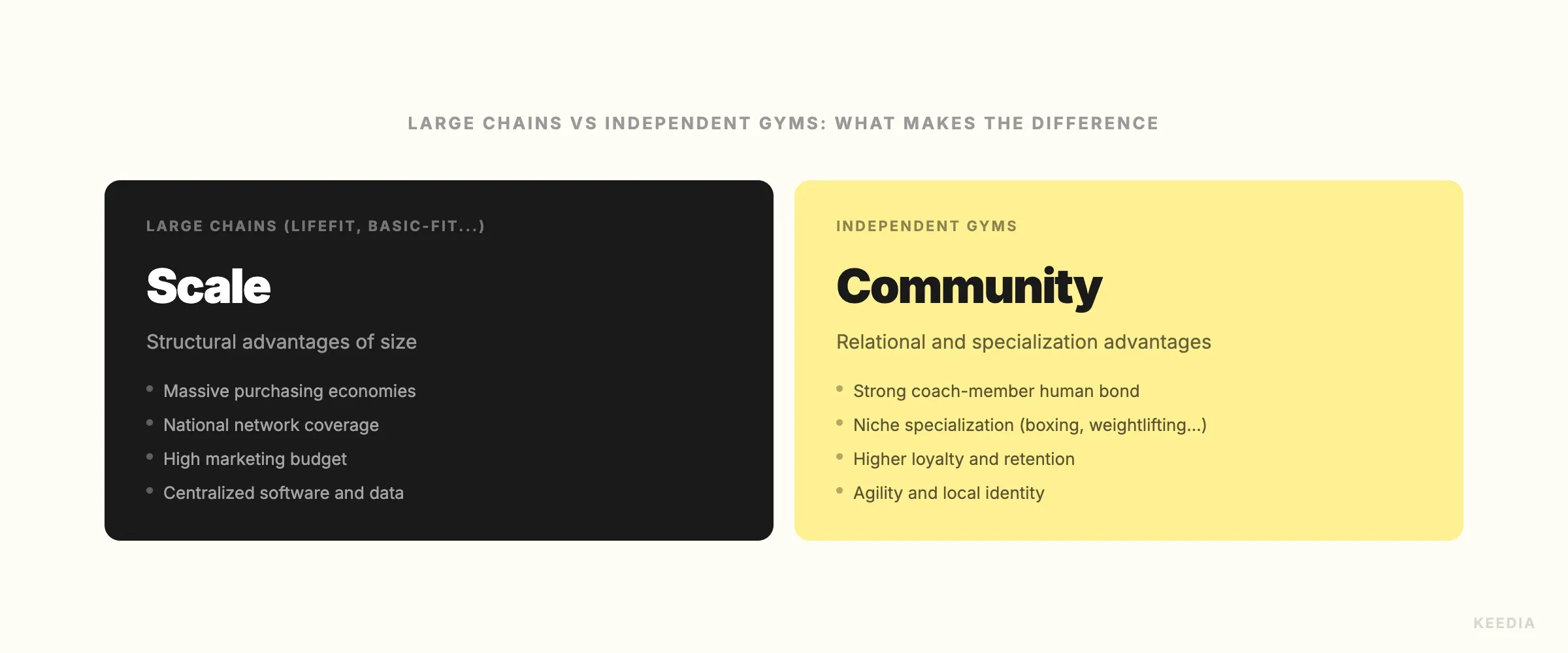
If you run an independent club in Germany, Austria, or anywhere consolidation is accelerating, the LifeFit expansion creates two distinct realities. The pressure side is real: a 210-club network with private equity backing operates at cost structures you can't match. Equipment contracts, software licensing, insurance, marketing. all of it gets cheaper per club at scale. That price advantage flows downstream to members in the form of competitive monthly rates.
But the opportunity side is equally real, and it's one that chains consistently underestimate. What LifeFit's model cannot deliver at scale is genuine community. A 21-club regional acquisition, however clean the integration, creates disruption. Staff changes, brand changes, pricing changes. Members who chose Just Fit for its local culture and familiar faces don't automatically transfer that loyalty to the acquiring brand.
Independent gym owners who build retention around relationships, specialized programming, and member recognition hold a structural advantage that scale operators struggle to replicate. If you're not already measuring what actually drives member loyalty in your club, the strategies in this breakdown of gym member retention approaches that are working in 2026 are worth your time.
The clubs that survive and grow alongside consolidation aren't the ones trying to compete on price. They're the ones making it obvious why a member would pay more to belong to something smaller and more specific. Premium pricing holds when the experience justifies it. That's not a theory. it's what the data from independent operators consistently shows.
The DACH Market as a Template for What Comes Next
Germany and Austria are currently the most active fitness M&A markets in Europe, but the conditions driving consolidation there — fragmented ownership, high urban real estate costs, post-pandemic membership recovery, and available private equity capital — exist across the continent.
Watch for similar consolidation patterns to emerge in markets like the Netherlands, Poland, and the Nordics over the next 24 months. The DACH playbook will likely serve as the template. Private equity's continued investment in budget gym platforms in the US confirms that this isn't a regional phenomenon. it's a global restructuring of how fitness is owned and operated.
For LifeFit specifically, the path to 250 clubs by 2028 now looks more like a floor than a ceiling. The Just Fit clearance adds 21 locations in a single regulatory decision. If the acquisition pipeline stays active, and there's no indication it won't, the 250-club target could arrive well ahead of schedule.
The question for every gym operator in the region isn't whether consolidation is happening. It's whether your club is positioned to thrive inside that new landscape or become part of the next portfolio transaction.