
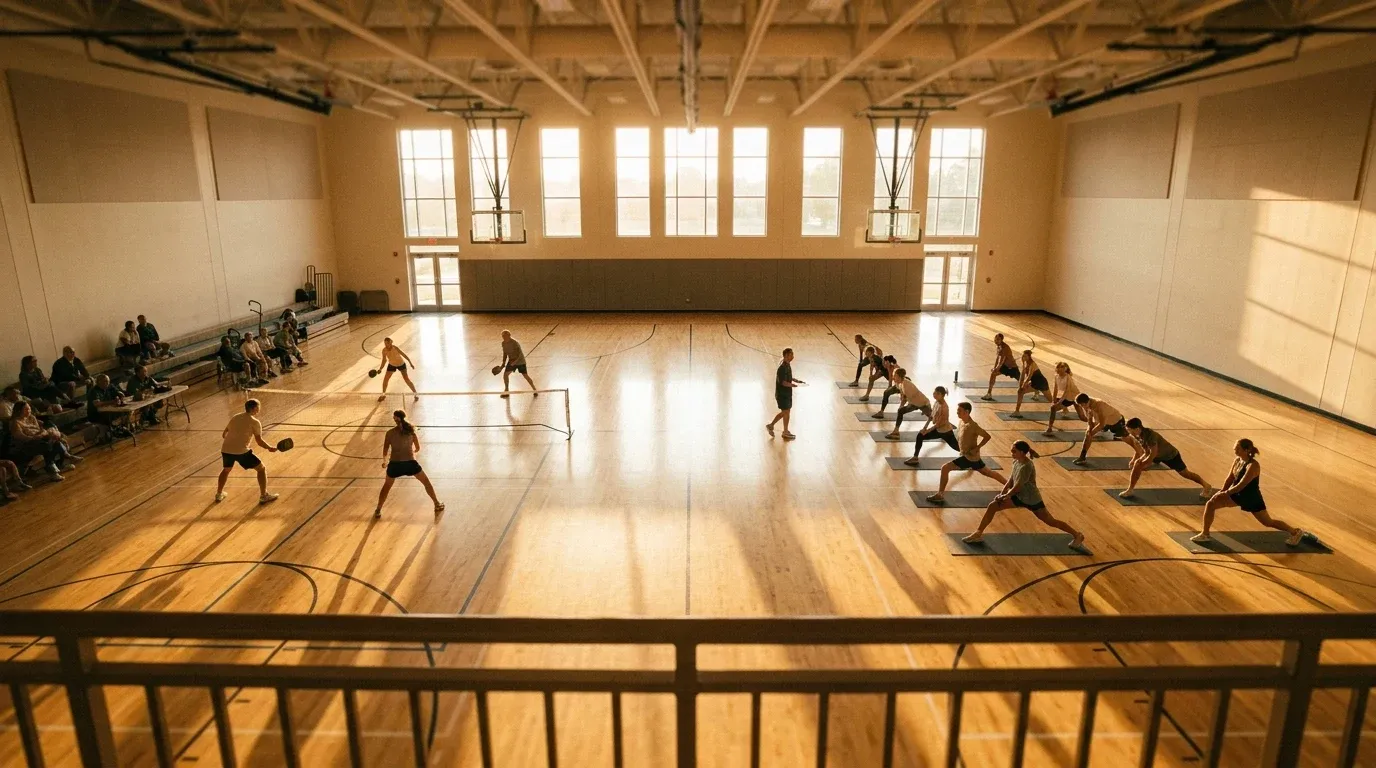
If you're a gym operator watching pickleball courts fill up at the local rec center, run clubs take over your neighborhood on Saturday mornings, and hybrid training sessions sell out faster than your standard memberships, you're not watching a passing fad. You're watching your revenue model get disrupted in real time.
These three formats, pickleball, run clubs, and hybrid training, are not simply popular. They represent a structural change in what fitness consumers expect from an operator, and more importantly, what they're willing to pay for. The operators who recognize this now, before boutique specialists absorb the demand, are the ones who will own the premium tier of their local market in 2027 and beyond.
Why These Three Formats Are Growing at the Same Time
The timing is not coincidental. Post-pandemic fitness behavior shifted hard toward social accountability and coached, structured sessions. Solo access to equipment declined as a primary motivator. What replaced it was a demand for community formats where showing up is the point, and where a coach or group structure provides the external accountability that most people can't generate alone.
Pickleball participation in the US crossed 36 million players by mid-2026, according to Sports and Fitness Industry Association data. Run clubs have become infrastructure in major and mid-tier US cities, with organized road and trail running groups growing their paid membership tiers at double-digit annual rates. Hybrid training, combining strength, conditioning, and sport-specific work in coached group formats, is now the dominant programming model at premium boutiques charging $40 to $60 per session.
These three formats share a common engine: capability-based motivation. Consumers in these programs are not training to look different. They're training to perform better, move farther, compete, and belong to something. That shift has deep implications for how you price and package your offer.
From Appearance to Capability: What the Motivation Shift Means for Revenue
The fitness industry spent two decades selling transformation before and afters. That model is losing ground. Consumer research entering 2026 consistently shows that capability-based goals, finishing a 10K, improving pickleball mobility, lifting heavier, recovering faster, outperform appearance goals for both retention and willingness to pay premium rates.
This matters operationally because capability-based consumers don't just want access. They want coaching, progression, and a measurable outcome. That's a product you can charge more for, structure as a recurring tier, and attach retention mechanisms to. A member chasing a performance goal is a member who renews because they haven't hit the goal yet, not because they feel guilty about their gym bag sitting in the trunk.
The coaching side of this equation is worth understanding in depth. Effective structured programming, the kind that drives capability gains, relies on well-designed progressions that address how the body actually adapts. For example, understanding why your nervous system drives strength before muscle does is the kind of insight that separates a credible coached program from a generic group class, and members in premium tiers notice that difference.
The Premium Upsell Layer Already Exists in Your Footprint
Here's what most traditional gym operators miss: they already have the physical assets to run these programs. Court space, outdoor parking lots, flexible studio areas, turf zones. The bottleneck is not real estate. It's programming design and coach credentialing.
A well-structured pickleball programming tier can run at $80 to $150 per month above a base membership, depending on session frequency and market. Organized run clubs with coached training plans and weekly group sessions are generating $50 to $120 per month in supplemental recurring revenue at gyms that have formalized the format. Hybrid training blocks, positioned as a specialty tier with measurable performance outcomes, consistently command $200 to $350 per month at mid-market operators.
These are not hypothetical price points. They're what consumers in these formats are already paying at boutique competitors who often have less equipment, less space, and fewer qualified coaches than your facility. The boutiques are winning on positioning and community structure, not on resources.
The operational infrastructure question is increasingly solvable. As fitness equipment suppliers shift from hardware to turnkey project models, operators have more access to pre-designed specialty programming environments that reduce the design and procurement burden significantly.
What the M&A Market Is Telling You About Differentiation
The Health and Fitness Association's 2026 M&A report is direct about where capital is flowing. Differentiated specialist concepts are attracting disproportionate acquisition interest and valuation premiums compared to undifferentiated access-model gyms. Investors are not paying multiples for square footage and equipment. They're paying for recurring revenue quality, member retention rates, and defensible programming formats that competitors can't easily replicate.
If you're building toward a future sale, a recapitalization, or simply want to be the operator in your market who doesn't get undercut by the next boutique that opens, specialty programming is no longer optional. It's a valuation input. A gym with a credible run club tier, a structured pickleball program, and a hybrid training track is a different business than a gym with treadmills and free weights, even if the membership base is similar in size.
The broader market pattern supports this. As one recent analysis noted, Crunch's third-location expansion in Las Vegas signals how large-format operators are thinking about market density and format differentiation, not just footprint. Even at scale, the signal is the same: differentiation drives retention and acquisition economics.
The Addressable Market Is Already Activated
One of the strongest arguments for launching run club programming specifically is that the audience is not theoretical. The US has approximately 17 million active trail and road runners according to Running USA's most recent survey data. A meaningful portion of that population is already paying for structured training resources: apps, race entry fees, coach-led plans, and group memberships.
A gym-anchored run club that offers coached sessions, a structured training plan, access to a strength and conditioning facility for injury prevention work, and a community of local runners is not competing with RunKeeper. It's offering something the app cannot: a coach, a group, and a physical home base. That's a premium product that justifies a premium price.
The physical preparation component of run programming is also where gym operators have a natural advantage. Plyometric-based strength work, for instance, has measurable impact on running economy. Research confirms that 10 weeks of structured plyometrics meaningfully improves running efficiency, particularly for masters-age runners who represent a significant and high-spending segment of the run club market.
Low Capex, High Retention: Running the Numbers
The capex profile of these formats is favorable relative to the return. A structured run club launch, including coach recruitment or upskilling, a basic scheduling and tracking system, and marketing to your existing member base, can get started for under $5,000 at most mid-size facilities. Pickleball programming, if you have court access through a partnership or existing space, follows a similar profile.
Hybrid training requires more investment if you're retrofitting a zone, but operators who already have functional training space, turf, rigs, or open floor areas can launch a credible hybrid program with coach hiring as the primary cost.
Against those costs, the retention math is compelling. Specialty programming members consistently churn at lower rates than general access members. A member paying $250 per month for a hybrid training tier is significantly less price-sensitive and less likely to cancel than a member paying $40 per month for equipment access. The lifetime value gap between those two customers is the business case.
Where to Start If You Haven't Already
The practical starting point for most operators is an honest audit of three things: your physical assets, your coaching staff capability, and your current member base's interest signals. You don't need to build all three programs at once.
- Audit your space. Do you have court access, turf space, outdoor areas, or a flexible studio? Each of these maps to a specific format opportunity with minimal retrofit.
- Assess your coaches. Strong coaches who understand structured progression and can lead group formats are the core product. If your coaching staff is primarily floor-based personal trainers, upskilling one or two into group specialty formats is achievable and high-ROI.
- Survey your members. Pickleball players, runners, and hybrid training enthusiasts are almost certainly already inside your membership base. A simple interest survey can quantify latent demand before you commit resources.
- Price it as a premium tier from day one. Don't launch these formats as free add-ons or upsells you're embarrassed to charge for. Build the price into the positioning from the first session. Members in capability-based formats expect to pay for coaching quality.
The window for early-mover advantage in these formats at the local market level is not permanent. Boutique specialists are already identifying underserved suburban and mid-market areas where gym operators haven't moved on this yet. The operators who build credible specialty programming now, before that competition arrives, are building retention infrastructure that's genuinely difficult to dislodge.
The demand is real, the addressable market is activated, and the capital markets are already rewarding differentiated operators. The question isn't whether pickleball, run clubs, and hybrid training represent a revenue opportunity. It's whether your facility captures it or watches someone else do it first.