
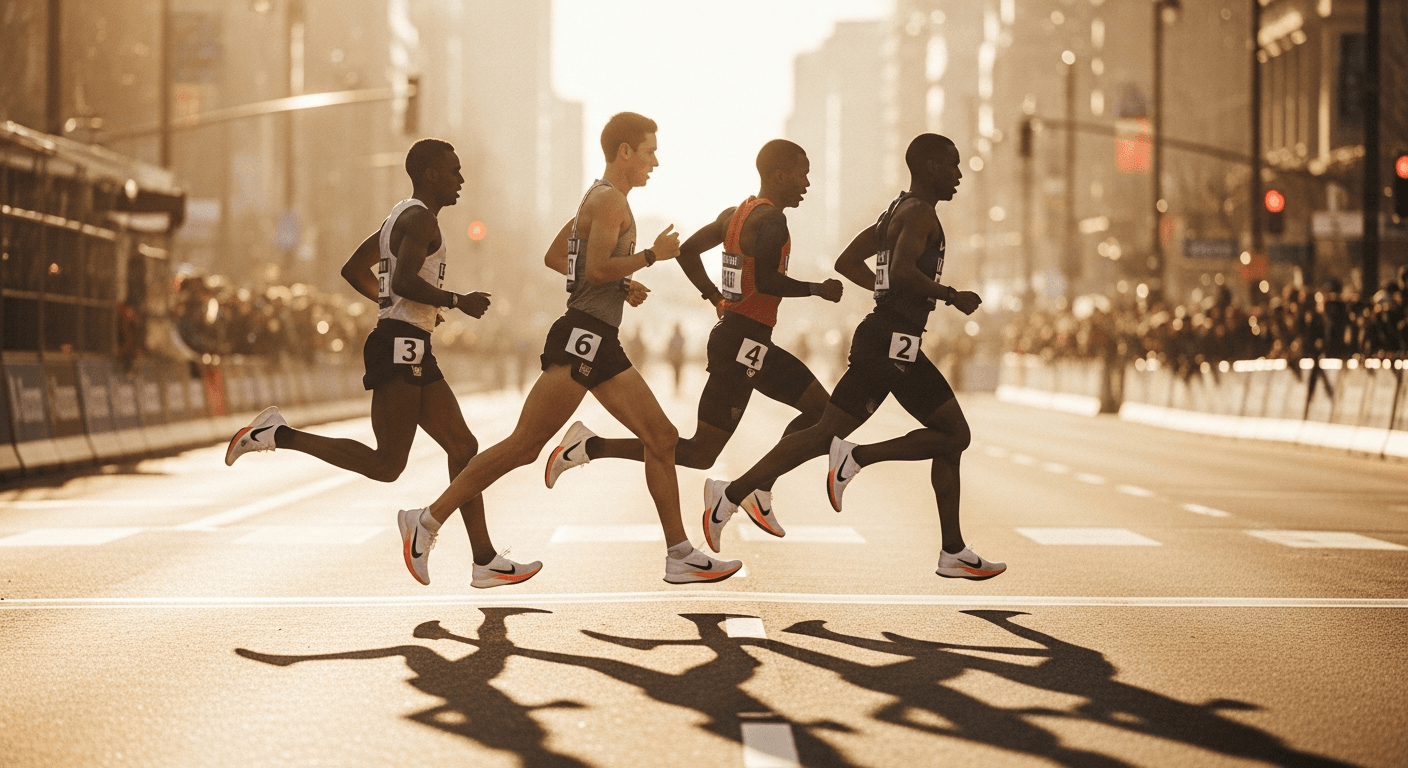
A Field That Redefines Marathon Excellence
On April 21, 2026, Boston's 130th marathon will host what many are already calling the deepest elite field in the race's history. Not just Boston's history. Marathon history, period.
Twenty-four men with sub-2:07 personal bests. That's a number that would have seemed impossible a decade ago, when breaking 2:07 was already a world-class benchmark. This starting line is a testament to how far marathon performance has come in ten years.
On the women's side, the competition is just as sharp. Course record holder Sharon Lokedi returns to defend her 2:17:22 mark set in 2024 on a course that's anything but a flat expressway.
Men's Race: Kipruto Is the Logical Favorite
Benson Kipruto arrives in Boston with the fastest personal best in the field: 2:02:16. The 33-year-old Kenyan has already proven he can race fast on challenging courses. His marathon résumé is one of the strongest of his generation.
But Boston doesn't reward the fastest PR alone. The course, with its iconic hills and Heartbreak Hill hitting at the 32nd kilometer, rewards runners who can manage their effort across the full 42.2 kilometers. Flat-course specialists who dominated in Berlin or Dubai sometimes find themselves in trouble in Newton Hills.
Defending champion John Korir returns with clear ambitions. His 2:04:45 makes him a serious contender, and he now knows the course's traps from navigating them successfully last year. Course knowledge at Boston isn't a footnote — it's a significant advantage.
Watch the Ethiopian and Kenyan contingent too. They form the backbone of the elite pack and know how to handle the rhythm variations that Boston's profile demands. The real race won't start until around kilometer 30.
Women's Race: Lokedi Faces an Ambitious Pack
Sharon Lokedi set the course record in 2024 with 2:17:22, a performance that put Boston back on the map for world-class women's marathon racing. She returns with course knowledge and defending-champion motivation.
But the 2026 women's field isn't here to fill spots. Several athletes have personal bests in the 2:18-2:21 range and have the tools to put serious pressure on Lokedi from Newton's hills onward.
The key question on the women's side: can Lokedi improve her own course record? Weather on April 21 will be decisive. Boston is famous for unpredictable April conditions — a headwind can be the difference between a historic performance and a tactical race.
Why Boston Remains Unique
What separates Boston from the other World Marathon Majors is its profile. Starting at elevation in Hopkinton and finishing at Back Bay creates a net downhill that can fool inexperienced runners. You descend in the first half, then face consecutive hills in the second. By the time you hit Heartbreak Hill, your legs have already absorbed serious mileage.
This explains why Boston times typically run slower than Berlin or Chicago for the same caliber of runner. It's not a flaw — it's the course's identity, and it's what makes winning here mean something different.
With 24 men under 2:07, the competition level guarantees a hard, fast, unforgiving front pack from the opening miles. The question isn't whether the pace will be quick. It's who still has legs at kilometer 40.
The Three Race-Deciding Factors
Three things will likely decide the men's winner. First: how they handle the first half. Going out too fast on the downhill opening is Boston's classic trap. The best runners hit halfway with something still in reserve.
Second: absorbing Heartbreak Hill. It's not the steepest or longest climb on the course, but it arrives exactly when glycogen stores are running thin. That's where races break open.
Third: condition on the day. With a field this dense, any weakness gets exploited. There's no room for an off day when 24 rivals are running under 2:07.
The 130th Boston Marathon looks like a landmark moment for world marathon racing. April 21 can't come soon enough.