
Boston Marathon 2026: Your Race Week Guide, Two Weeks Out
The 130th Boston Marathon runs on April 20, 2026. You've trained for months, you're two weeks out, and the work is essentially done. What's left isn't fitness. It's execution. This guide covers everything you need to get to the start line in Hopkinton and cross the finish on Boylston Street without blowing up somewhere on Commonwealth Avenue.
This isn't a training overview. If you need that, the Boston Marathon 2026 complete preparation guide covers the full build. This is the tactical briefing for right now: taper management, race-day pacing, weather decisions, expo logistics, and the gear calls you'll need to make in the next 14 days.
What's Happening in Your Body Right Now (And Why It Feels Wrong)
Two weeks out from a goal marathon, most runners feel flat, heavy, and undertrained. Your legs feel like concrete. You're second-guessing your fitness. You might be sleeping worse than usual. This is taper madness, and it's physiologically normal.
During a taper, training volume drops sharply while intensity stays relatively high. Your glycogen stores are replenishing. Muscle tissue is repairing. The body is essentially preparing to peak. The paradox is that all of this feels terrible in the short term. Fatigue doesn't clear linearly.
The worst thing you can do right now is add extra miles to "check" your fitness. A few easy shakeout runs and one short workout at marathon pace are all your body needs. Trust what's already in the tank. Research on deload protocols and the evidence behind them consistently shows that performance gains from reduced-load periods take 10 to 14 days to fully express. You're right on schedule.
Common taper symptoms reported by marathon runners include irritability, phantom tightness in the legs, disrupted sleep, and sudden hypochondria about old injuries. None of these are signals to panic or train through. They're signals to stay off your feet and eat well.
BAA Expo: Pick Up Your Bib Without Losing Half a Day
The BAA Health and Fitness Expo takes place at the Hynes Convention Center, near Boylston Street, from Thursday April 16 through Saturday April 18. Bib pickup is mandatory in person. You cannot delegate it, and race-day pickup is not available.
Friday afternoon is the worst time to go. Expect queues of 45 minutes or more at peak hours (roughly noon to 6 p.m.) on Friday, when working runners from out of town typically arrive. Thursday morning or Saturday before 10 a.m. are your best windows if your schedule allows it.
Bring your government-issued photo ID and your confirmation email or QR code. The venue is large, and the merchandise hall is designed to keep you spending money. Budget the time and the temptation accordingly. If you're traveling from outside the US, confirm that your passport matches your registration name exactly.
One practical note: don't buy new shoes at the expo. Don't wear new socks on race day. Every year, runners make these decisions at the expo and regret them somewhere around mile 20.
The Opening 6 Miles: Slower Than You Think
Boston starts on a net downhill. The course drops roughly 140 feet in the first 6 miles, from Hopkinton to Framingham. On race day, with adrenaline running high and 24,000 runners around you, that downhill will feel easy. It is not easy. It is a trap.
Running downhill at pace loads the quadriceps eccentrically. Your muscles are working hard to control the descent even when it doesn't feel that way. The cumulative damage from miles 1 through 6 will not announce itself until miles 17 through 21, when the Newton Hills arrive and your quads have nothing left.
The data on this is consistent: runners who go out 20 or more seconds per mile faster than goal pace in the first 10K at Boston have significantly higher rates of blowup after mile 20. The fix is mechanical. Run the first half 10 to 15 seconds per mile slower than your goal pace. Not just the first mile. The first half.
The Wellesley scream tunnel arrives around mile 13. The crowd noise is genuinely remarkable and it will feel like a good moment to surge. It is not. It is another trap. Bank the energy. The race doesn't start until mile 16.
Newton Hills: Strategy Over Myth
The four Newton Hills run from approximately mile 16 to mile 21, with Heartbreak Hill the last and most famous of them. Here's the honest truth about the hills: they're not that steep. Heartbreak Hill has a grade of around 3.3 percent and climbs roughly 88 feet over half a mile. On fresh legs, it's manageable.
The problem is never the hills themselves. The problem is arriving at mile 16 with quad damage from the downhill opening. Runners who've paced the first half correctly will find Newton uncomfortable but survivable. Runners who went out too fast will find it a death march.
The tactical approach to Newton is to shorten your stride on the uphills and let your effort stay consistent rather than your pace. Don't try to maintain your goal pace up the climbs. Run by perceived effort. You'll conserve more energy than you lose by slowing slightly, and the downhill after Heartbreak will allow you to recover before the final push into Boston.
From mile 21 to the finish on Boylston, the course is mostly downhill. If you've run the first 21 miles with discipline, you can run the last 5 miles hard. That's where your race lives.
Weather Contingency: Don't Ignore the Forecast
Boston on Patriots Day can be almost anything. Historically, race-day temperatures at the start have ranged from around 4°C (39°F) to 22°C (72°F) or higher. Wind direction matters almost as much as temperature: a headwind from the east in the final miles is a common and miserable feature of bad-weather editions.
Check the forecast seriously at 72 hours out, not earlier. Longer-range forecasts for Boston in April are unreliable. At 72 hours, you'll have enough accuracy to make real decisions.
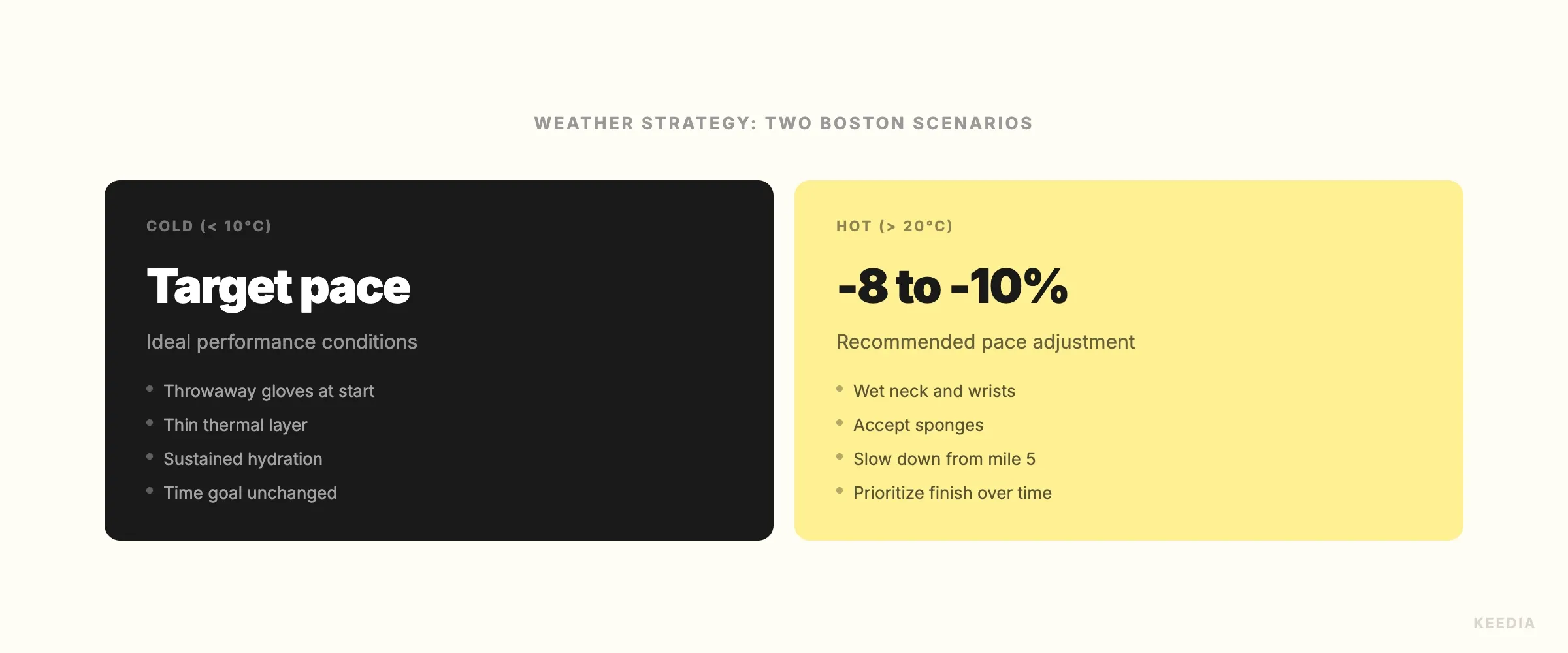
The general adjustment framework: for every 5°C above 15°C (59°F) at race start, expect to adjust your goal pace by 5 to 10 percent slower. At 20°C (68°F), a 3:30 goal becomes a 3:41 to 3:51 realistic target. Heat affects runners' performance more severely than most anticipate, and Boston's combination of humidity and direct sun exposure on parts of the course amplifies this.
For cold conditions (under 10°C at start), the bigger issue is the wait in Hopkinton before the corrals open. You'll be standing outside for up to 90 minutes. Bring throwaway layers you're prepared to leave on the course. Gear bags are checked to a different location than the finish area, so plan your logistics carefully.
Runners interested in longer-term heat adaptation should review heat training protocols and performance research for runners, though at two weeks out, you're not adapting. You're managing.
Gear Bag Decisions
Boston uses a gear check system where bags are transported by bus to the finish area. The bag must be loaded before you board the athletes' village buses in Hopkinton. You will not see it again until after you cross the finish line.
What goes in the bag: dry clothes, shoes, a warm layer, your phone charger, and any post-race nutrition you want. What does not go in the bag: your race nutrition, your race shoes, anything you need before mile 26.2.
Race nutrition should be carried on you or sourced from the course. Boston's official course has Gatorade Endurance and water stations roughly every mile from mile 2 onward, plus PowerBar gels at miles 17 and 24. If you've trained with different products, carry your own. GI distress from unfamiliar fueling is a predictable and avoidable problem.
For runners managing joint load concerns through the race and recovery period, current research on collagen and joint health suggests timing collagen intake around training and key sessions. Two weeks out, recovery nutrition still matters.
On sleep during taper week: many runners report disrupted sleep in the final 10 days before a goal race. This is normal and the research suggests one or two poor nights before a race has minimal performance impact. If you've been supporting sleep quality during training, magnesium supplementation protocols for athletes are worth reviewing for the taper period specifically.
The Week Before: What to Actually Do
The week before Boston should look like this:
- Sunday April 12 to Tuesday April 14: Easy running only. 20 to 40 minutes at a genuinely easy pace. No heroics.
- Wednesday April 15: Optional short shakeout with 2 to 3 miles at marathon pace. If your legs feel dead, skip the pace work entirely.
- Thursday April 16: Expo pickup, easy 20-minute shakeout, early dinner, early bed.
- Friday April 17: Rest or 15-minute walk. Stay off your feet as much as possible. Hydrate.
- Saturday April 18: 20-minute easy jog, strides. Prep your gear. Confirm your race nutrition. Eat carbohydrate-dense meals starting at lunch.
- Sunday April 19: Rest completely. Short walk only. Sleep as early as you reasonably can.
- Monday April 20: Race day. Patriots Day. Boston.
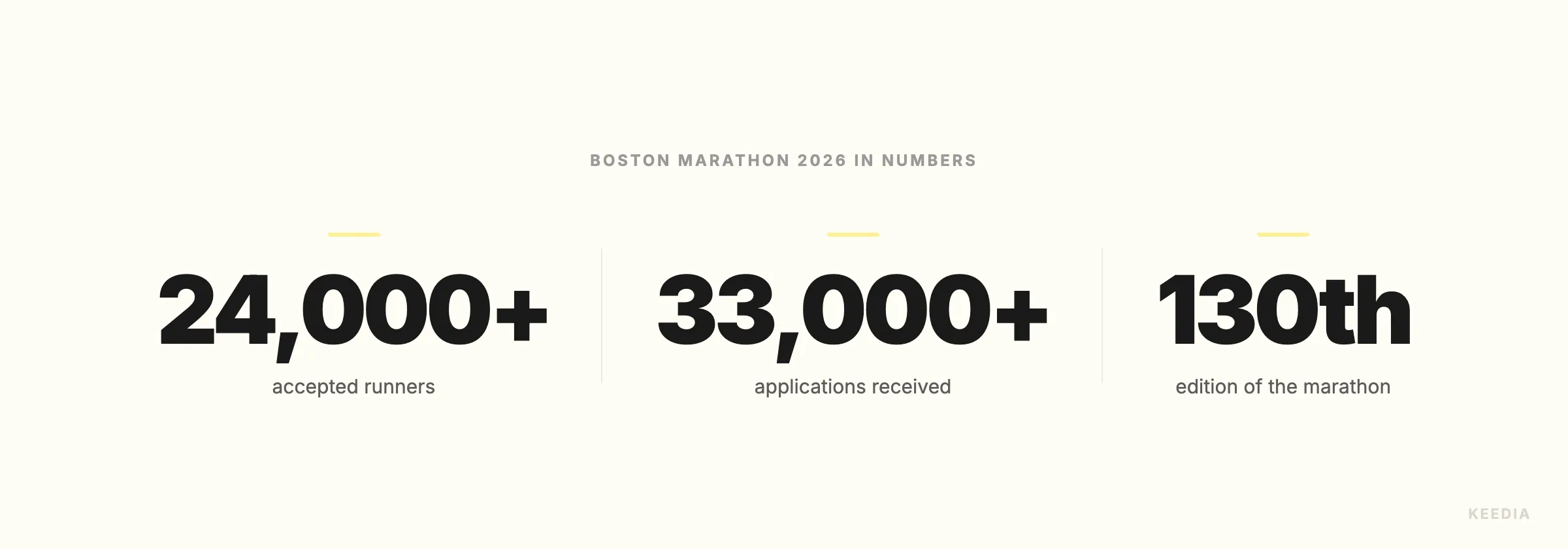
Among the 24,000 accepted runners this year is NASA astronaut Suni Williams, one of the more unusual entries in the field. The elite field is covered separately in the keedia preview. Your job on April 20 isn't to watch the race. It's to run your race, from Hopkinton to Boylston, with the discipline you've earned over months of preparation.
The fitness is already there. The next two weeks are about protecting it.