
Carbon-plated running shoes have dominated race day since Nike's Vaporfly first broke into the mainstream. But for every runner convinced the technology transformed their marathon, there's a skeptic arguing it's marketing dressed up as science. A 2026 meta-analysis published in Frontiers in Sports and Active Living by Kobayashi et al. finally gives us enough pooled data to cut through both camps.
The study aggregated 14 crossover trials covering 271 runners. The findings are real, but they're also conditional. Here's what the evidence actually shows, and what it means for your next shoe purchase.
The Core Finding: A Real but Modest Gain
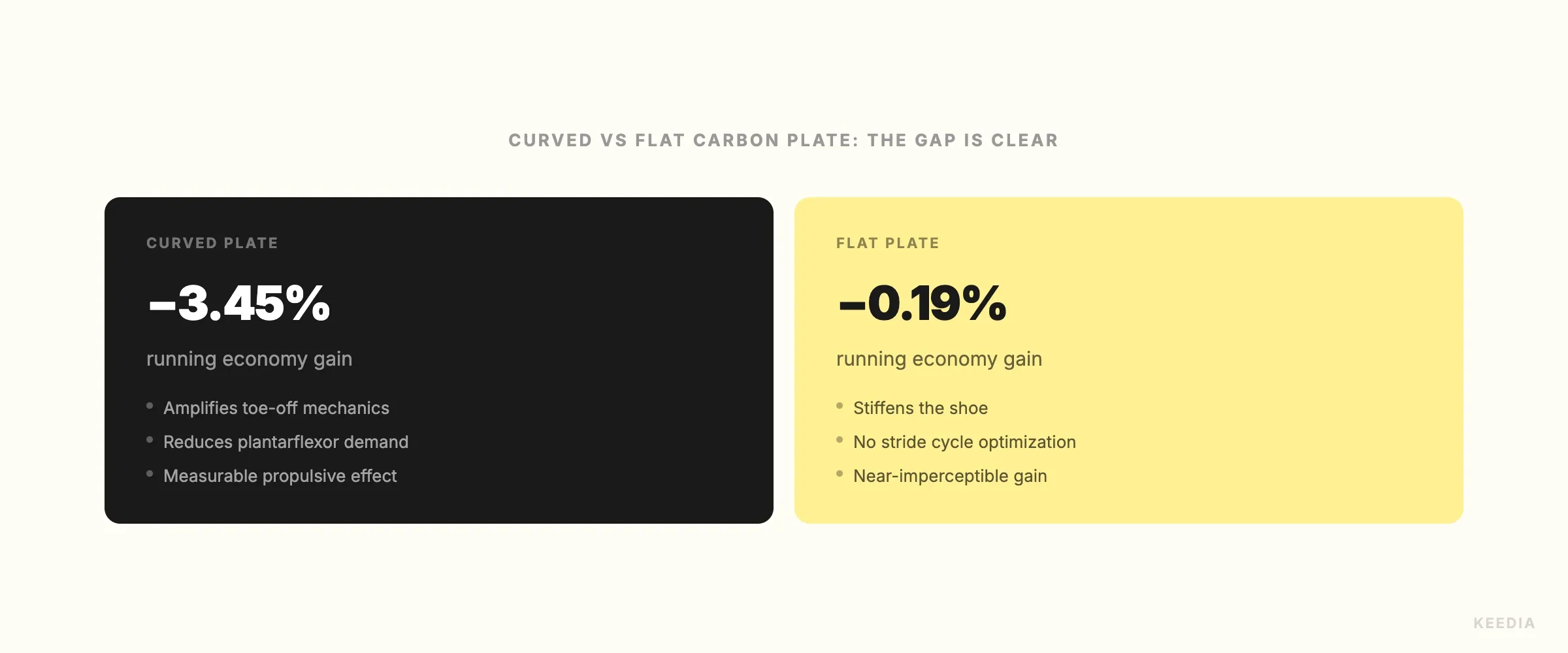
Across 14 studies, carbon-plated shoes reduced metabolic demand by an average of 2.75% on flat road terrain. That's a statistically robust signal. When you translate that running economy improvement into race performance, you get approximately a 1% improvement in marathon finishing time.
For most runners, that's not abstract. A 1% gain means roughly 1.5 to 3 minutes off a marathon between 3 and 4 hours. If you're chasing a sub-3:30 or trying to crack four hours, that's meaningful. It won't carry you across a fitness deficit, but it's not placebo either.
What the meta-analysis confirms, perhaps more importantly, is that the benefit is consistent. It's not a handful of outlier studies pulling the average up. The signal holds across recreational and trained athletes, across male and female runners, and across a range of paces.
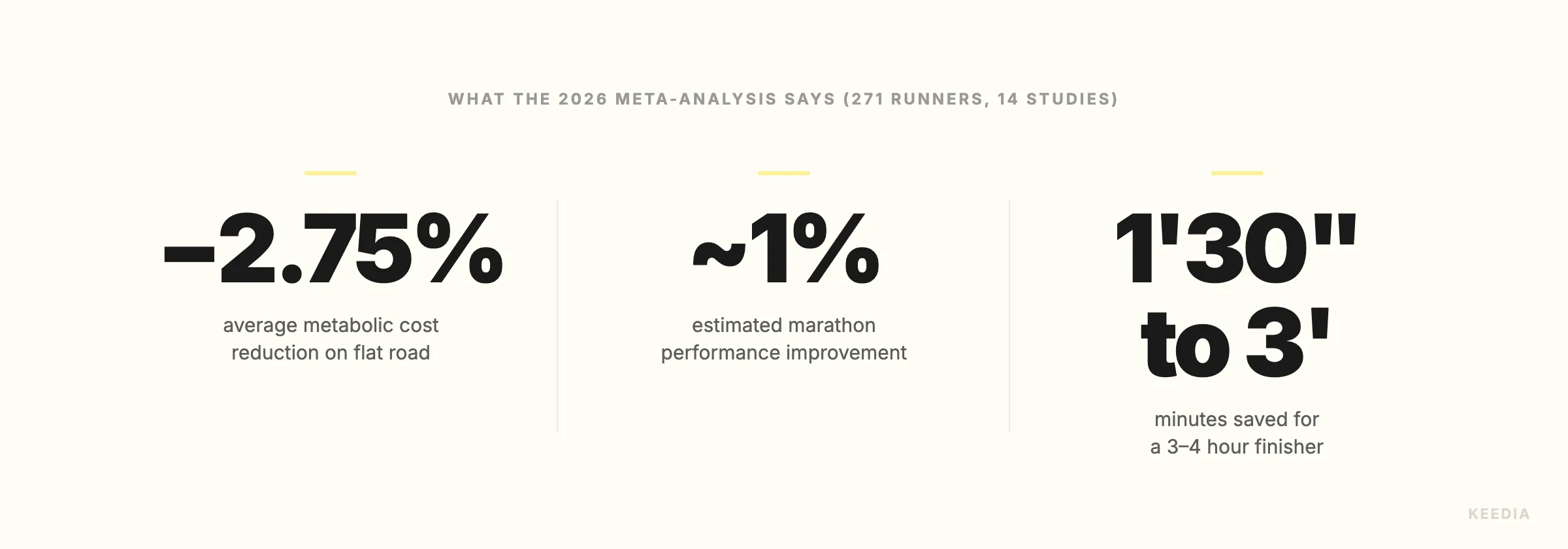
Plate Shape Is the Variable Most Runners Ignore
Here's where the data gets genuinely interesting. Not all carbon plates are built the same, and the geometry matters far more than most shoe marketing suggests.
The meta-analysis separated outcomes by plate design. Shoes with curved carbon plate geometry delivered an average running economy gain of 3.45%. Shoes with flat carbon plate construction delivered just 0.19%. That's not a small difference. That's functionally the difference between a tool that works and one that barely registers.
The curved plate acts as a lever, working with the natural propulsive mechanics of toe-off. A flat plate adds stiffness without the same mechanical advantage. If you're evaluating carbon-plated shoes, looking at plate geometry isn't obsessive, it's the right question to ask.
This also explains why certain shoes in the category have consistently outperformed others in independent testing, while some cheaper carbon-plate options haven't delivered on their implied promise.
Foam Type Amplifies or Limits the Effect
The plate doesn't work in isolation. The meta-analysis reinforces what biomechanics researchers have argued for several years: the foam surrounding the plate is equally critical to the overall system.
PEBA-based foams, used in shoes like the Nike Vaporfly and Adidas Adizero families, show the strongest synergy with curved plate geometry. PEBA foam combines high energy return with low stiffness at compression, which means it loads and unloads efficiently with each stride. The plate and the foam work together as a propulsive system rather than two separate components.
EVA and TPU-based foams, even when paired with a carbon plate, show weaker energy return properties. The plate can still provide some stiffness benefit, but the full metabolic saving seen in the top-tier shoes requires both elements working in concert.
This matters when you're comparing a $160 carbon-plate trainer to a $260 race day shoe. The price gap often reflects the foam formulation more than the plate itself. You're not always paying for a gimmick. Sometimes you're paying for PEBA.
On Trails, Carbon Plates Can Make You Slower
The 2.75% running economy gain applies specifically to flat, consistent road surfaces. Change the terrain and the picture shifts significantly, sometimes in the wrong direction.
On trails and uneven ground, the rigid plate geometry that creates propulsive efficiency on roads becomes a liability. The shoe can't adapt to surface variation, which forces compensatory movements through the ankle and knee. The meta-analysis found that trail running with carbon-plated shoes can impair performance by disrupting natural foot mechanics and increasing instability.
This has practical consequences beyond race day. If you're running trail ultras or even regular mixed-terrain training, a carbon super shoe is the wrong tool. The instability introduced on uneven surfaces also raises injury risk, particularly around ankle stability and lateral foot loading.
For a deeper look at what the current data says about trail-specific injury patterns, the analysis in Trail Running Injuries: The 2025 Data and Prevention Protocols That Work breaks down where trail runners actually get hurt and what structural differences in footwear influence those outcomes.
The takeaway is straightforward. Carbon-plated super shoes are road-specific performance tools. Using them outside their design context doesn't just fail to help. It can actively work against you.
Who Benefits, and by How Much
One of the more useful outputs of the meta-analysis is the breakdown across runner types. The 2.75% average economy gain is consistent across both recreational runners and trained athletes. But the relative impact differs.
Elite runners tend to show smaller percentage gains because their baseline running economy is already highly efficient. Their mechanics are optimized through years of high-volume training, which means there's less inefficiency for the shoe to correct or amplify. A 0.5 to 1% gain in running economy for an elite athlete is still significant at the margins of world-class competition, but it's a narrower window than recreational runners experience.
Recreational runners with less mechanically efficient strides tend to see gains at the higher end of the range. If your form breaks down over the back half of a marathon, the propulsive assistance of a curved carbon plate with PEBA foam helps sustain turnover at a reduced metabolic cost.
If you're currently training for a target race, understanding how shoe selection fits into your broader preparation is worth considering alongside your training block structure. The Boston Marathon 2026: The Complete Preparation Guide addresses race-specific preparation in full, including gear decisions within the context of a complete build.
What This Means for Your Shoe Decision
The meta-analysis doesn't make the purchase decision for you, but it does sharpen it considerably. Here are the practical implications.
- Curved plate geometry is non-negotiable if you want the full benefit. Flat carbon plate shoes show almost no measurable running economy improvement. Don't assume a carbon plate label means the same thing across all products.
- PEBA foam matters as much as the plate itself. If the shoe uses a lower-grade foam compound, the plate effect is significantly reduced. Check the foam specification, not just the plate claim.
- These shoes are for road racing and road long runs. Using them on trails or mixed terrain introduces instability that can cost you performance and increase injury risk.
- Your running volume and terrain should drive the decision. If most of your training miles are on trails or varied surfaces, the application window for carbon super shoes is narrower than you might think. Reserve them for target road races and road-specific sessions.
- The 1.5 to 3 minute marathon gain is real but not a substitute for fitness. A well-structured training block delivers far greater performance returns. The shoe is a legitimate marginal gain, not a shortcut.
The Bigger Picture on Marginal Gains
Carbon plate shoes are genuinely useful. The 2026 meta-analysis settles that. But they sit within a hierarchy of performance variables where training, recovery, and nutrition carry substantially more weight.
If you're investing in performance optimization, the gains from better sleep quality, appropriate fueling strategies, and training structure dwarf the 1% you can reasonably attribute to footwear. Runners who obsess over super shoe selection while underinvesting in recovery tend to leave more time on the table than they gain at the shoe rack.
For runners using structured training cycles, understanding how to manage fatigue and recovery phases appropriately compounds every other performance input, including footwear. The evidence on deload protocols and what the research actually says is worth reading alongside any race preparation plan.
And if heat adaptation is part of your training toolkit heading into a summer race, heat training for runners: protocol and performance gains outlines a structured approach that produces measurable aerobic adaptations that exceed the effect size of any single piece of equipment.
The carbon plate meta-analysis tells a clear story. The gains are real, they're specific to road terrain and curved plate geometry, and they're consistent across runner types. Use that information to make a sharper decision, not a more expensive one.