

Most road marathons end the same way. You cross a timing mat somewhere on a city street, collect a foil blanket, and limp toward the nearest fence. The Eugene Marathon does something different. It sends you through a stadium tunnel and onto one of the most storied tracks in the world. That alone is worth the entry fee.
The 2026 edition, scheduled for the final weekend of April, just dropped its official medal design. The motif is a rolling wave representing the Willamette River, which threads through the course itself. It's a small detail that signals something bigger: Eugene takes its running identity seriously, and this race is built to match it.
Why Hayward Field Changes Everything
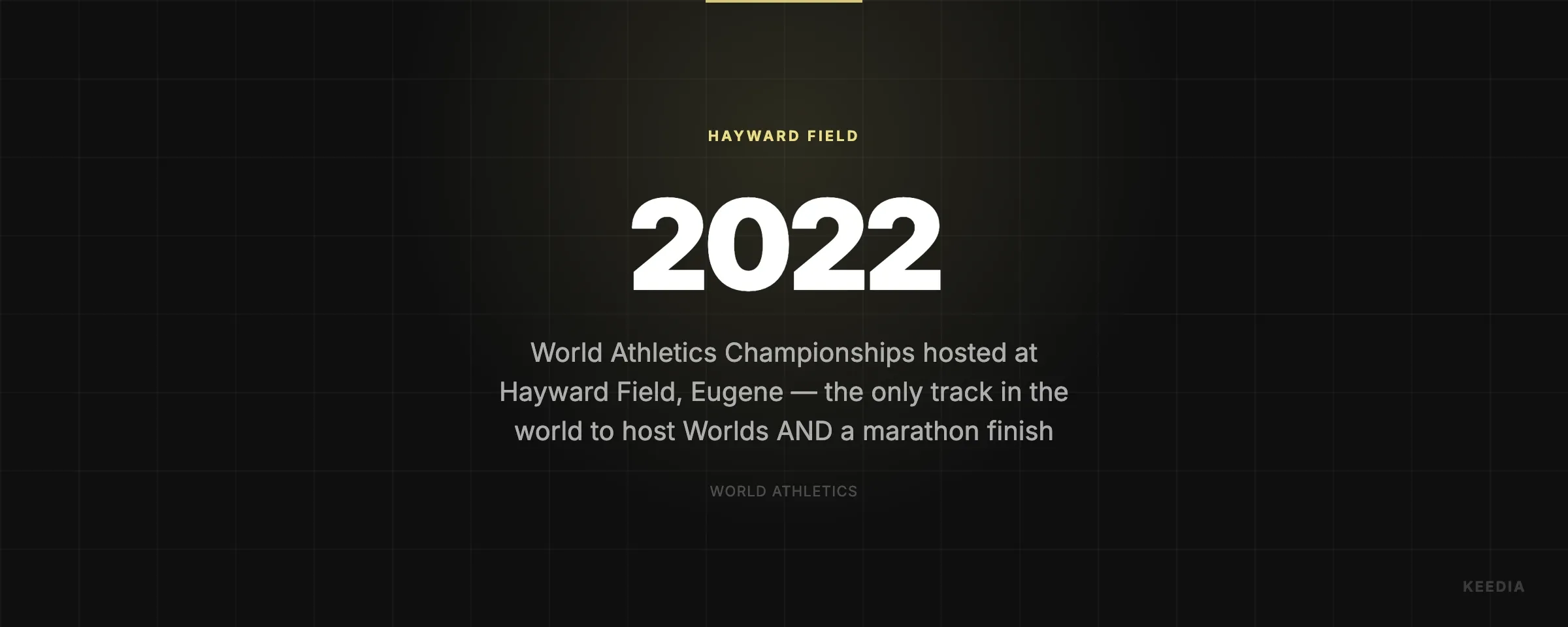
Hayward Field at the University of Oregon isn't just a college track. It's the venue that hosted the 2022 World Athletics Championships, the first time that event came to the United States in decades. The facility was completely rebuilt before those championships at a cost exceeding $200 million, funded in large part by Nike co-founder Phil Knight, a former Oregon Ducks runner himself. The result is a 12,500-seat stadium built entirely around the act of running fast.
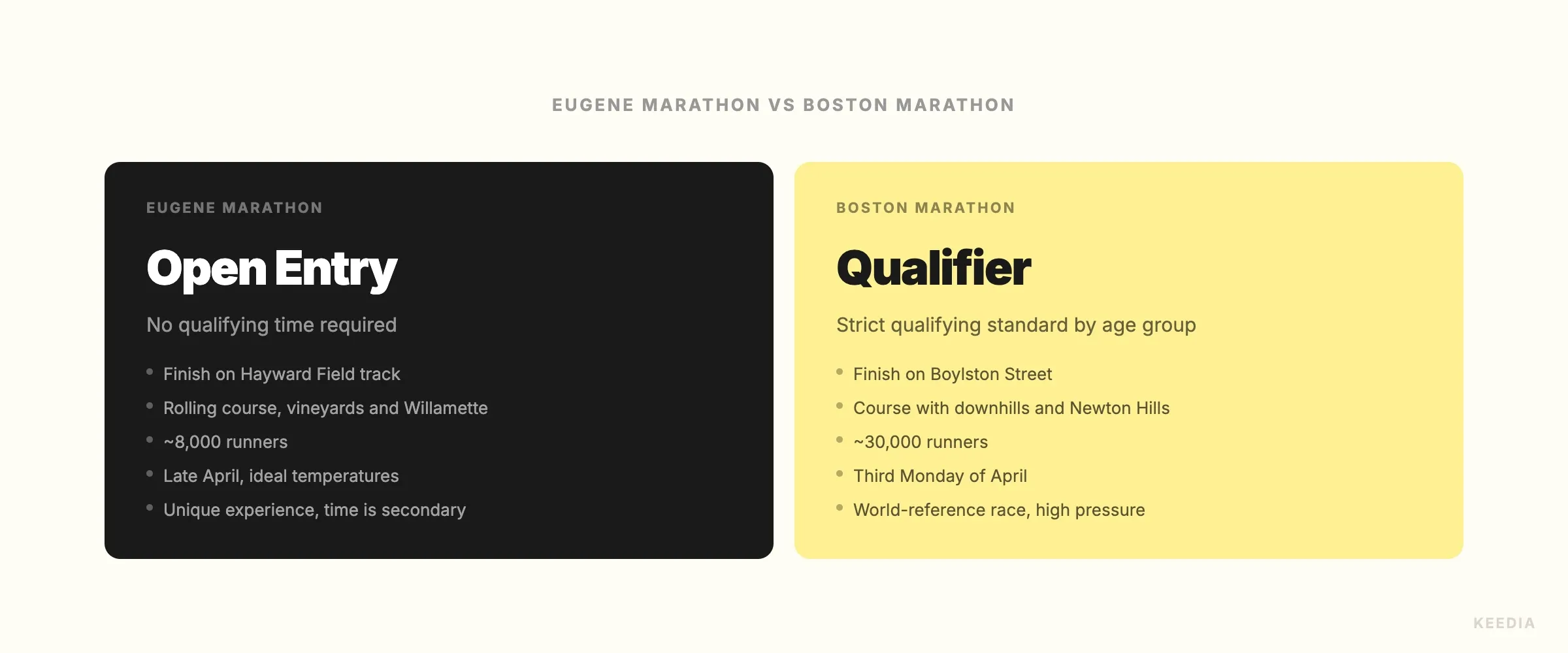
When you run the final 200 meters of the Eugene Marathon, you're running on the same track surface where Noah Lyles and Sydney McLaughlin-Levrone competed at a world championship level. No other major road marathon in the United States offers that. Boston ends on Boylston Street. Chicago ends on Columbus Drive. Eugene ends inside a stadium, with the crowd wrapping around you and the finish line painted directly on the track.
If you've been weighing US marathons for your spring 2027 calendar, this finishing experience is the clearest reason to put Eugene at the top of the list. For a broader look at how spring marathons stack up for preparation logistics, the Boston Marathon 2026: The Complete Preparation Guide covers the comparison in detail.
Track Town USA: The Running Culture Behind the Race
Eugene earned the nickname "Track Town USA" over decades, not through marketing. Steve Prefontaine trained and raced here through the early 1970s, turning Hayward Field into a kind of outdoor theater. His aggressive front-running style and his refusal to run for anything but the win made him a figure that transcended the sport. He died in Eugene in 1975 at 24, and the city has never quite let go of him.
Phil Knight sold his first running shoes out of the trunk of a car at Hayward Field before Blue Ribbon Sports became Nike. The connection between this track, this university, and the global running industry is direct and traceable. Running in Eugene doesn't feel like tourism. It feels like visiting a place where the sport actually happened.
The Oregon Ducks track program remains one of the most decorated in NCAA history, and the training culture that produces those athletes bleeds into the local running community. Eugene has more running clubs per capita than almost any comparably sized US city. The Eugene Marathon taps into that culture by design.
The Course: Honest, Rolling, and Worth Every Meter
Let's be direct. Eugene is not a personal best course. If your goal is a qualifier time or a new PR, the rolling terrain will work against you. But that's not what this race is selling, and serious runners who understand the difference between a fast course and a meaningful one will appreciate the honesty.
The route moves through Eugene's Willamette Valley wine country, along the river paths that locals use year-round, and through neighborhoods that actually show up to watch. The Willamette River sections are particularly well-designed, giving runners extended flat stretches alongside water before the terrain picks up again. The wave motif on the 2026 medal is accurate. You feel the river throughout the race.
Elevation gain is moderate but consistent. There are no single brutal hills, just a course that keeps asking questions. Runners who train on flat surfaces exclusively will find the legs more taxed than expected by mile 18. That's worth building into your preparation.
Given the cumulative stress on joints that rolling courses produce, it's worth reviewing the evidence on connective tissue support during marathon training. The piece on collagen and joint health: what the 2025 research actually tells athletes is a useful resource if you're building your nutrition stack for a 16-week block.
Training Timeline: Why Late April Works
The final weekend of April sits at a useful point in the spring racing calendar. A standard 16-week marathon training block starting in early January brings you exactly to race day with a full winter of base work behind you. If you're targeting the 2027 edition, you're looking at a January start with registration typically opening the preceding fall.
Late April weather in Eugene is mild by most standards. Average temperatures sit in the mid-50s Fahrenheit at race start, with low humidity. Rain is possible, as it always is in the Pacific Northwest in spring, but the conditions rarely become extreme. This is a forgiving weather window compared to summer marathons or unpredictable fall editions in harsher climates.
One element often underestimated in a 16-week build is recovery structure. Training hard through January and February without planned recovery weeks leads to accumulated fatigue that shows up late in long runs. If you're building your periodization plan, the research reviewed in deload protocols: what the research actually says gives you a framework for building those weeks into your cycle without losing fitness.
Who This Race Is For
The Eugene Marathon draws a specific type of runner. Not the runner chasing a Boston qualifier on a fast course. Not the first-time marathoner looking for a flat, logistically simple event. Eugene attracts runners who know running history, who care about the culture behind the sport, and who want a finishing experience that means something beyond the clock.
That said, it's accessible. Eugene is a mid-sized city with a well-organized race infrastructure. The field size is large enough to create real atmosphere but small enough that the race doesn't feel like a logistics operation. Aid stations are well-stocked, the course is well-marked, and the local volunteer culture is strong.
Entry fees for 2026 are positioned in line with other regional US marathons, typically in the $120 to $160 range for standard registration, with early entry discounts available. Accommodation in Eugene fills up, so booking 6 to 9 months out is the practical standard if you're traveling from outside Oregon.
The Final 200 Meters
Everything about this race builds toward one moment. You've covered 26 miles of wine country roads and river paths. Your legs are carrying the full weight of the distance. Then the course directs you into Hayward Field.
The tunnel entrance drops the ambient noise for a second. Then you emerge onto the track, and the crowd inside the stadium is right there, close, loud, and specific in a way that street-side crowds rarely are. The track curves around toward the finish. You can see the line. You have 200 meters, exactly the distance of a track sprint, to close it out on the same surface where world champions have run.
That experience doesn't show up in your Garmin data. It doesn't adjust your finishing time. But it's the reason runners who have done Eugene describe it differently than other marathons they've completed. The finishing straight at Hayward Field is a category of its own.
If you're building toward Eugene as a spring target and want to maximize your preparation on every front, sleep quality and recovery nutrition become significant variables in a 16-week block. The breakdown of magnesium and sleep for athletes: which form, what dose, what results is a practical reference for that side of training.
Planning Your 2027 Entry
Registration for the 2027 Eugene Marathon will likely open in the fall of 2026, following the standard pattern for regional US marathons. The 2026 edition serves as both a live event and a preview of what the experience looks like. If you're watching this year's race to decide, pay attention to the finishing sequence coverage. That's the part that will answer the question for you.
Eugene is not competing with New York or Chicago on scale. It's competing on identity. For runners who know what Hayward Field means, that identity is a strong argument. For runners who don't know it yet, the Eugene Marathon is a credible way to learn it firsthand.
Put it on the list. Start the training block in January. Run the river. Finish on the track.