
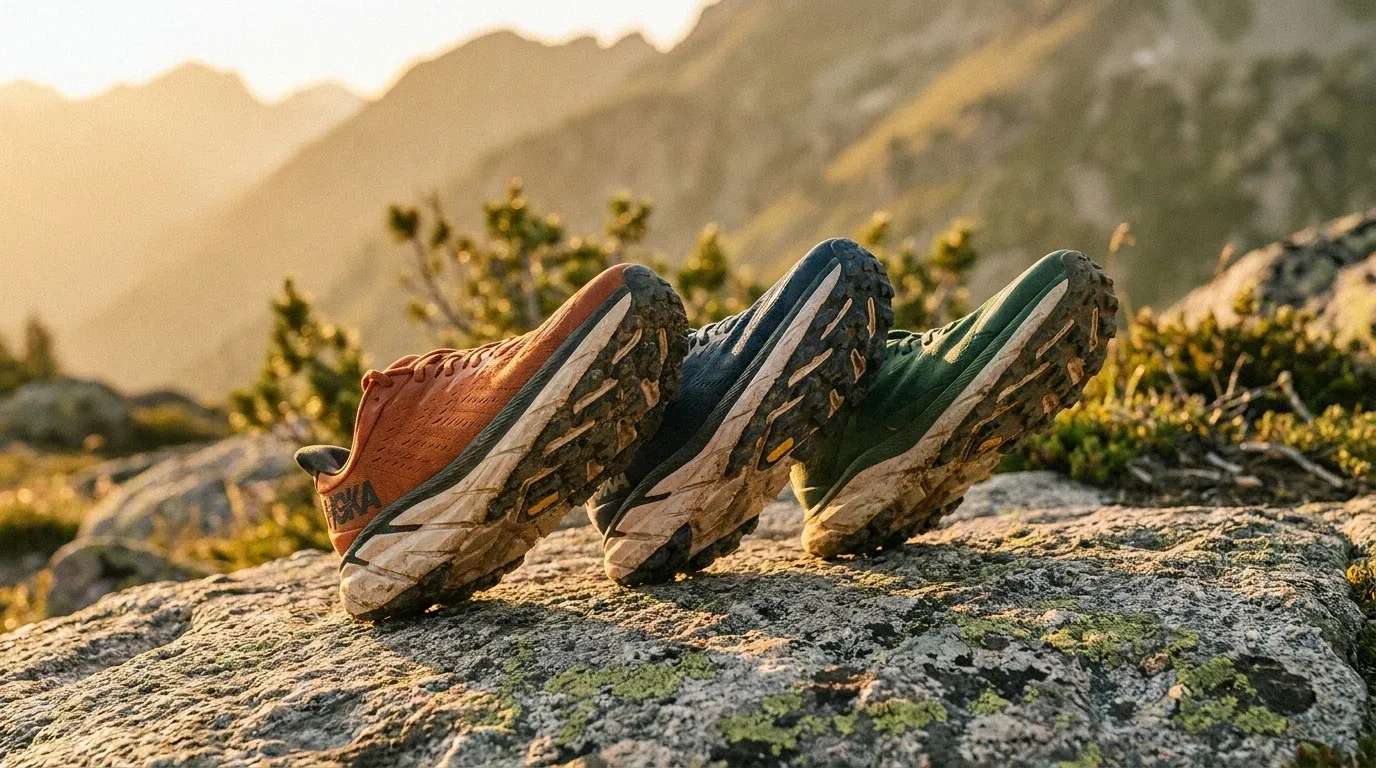
Every August, the Mont-Blanc massif turns into the world's most demanding gear laboratory. UTMB's 171 km course, with more than 10,000 meters of cumulative elevation gain, doesn't care about marketing copy or controlled test tracks. It cares about whether your shoe holds together on wet granite at 3 a.m. That's why the podium data from UTMB 2026 matters far beyond the elite field.
If you're shopping for trail shoes ahead of the fall racing season, this is the most credible real-world filter available. Here's what the front pack wore, what it tells you about the current shoe arms race, and how to translate that into a smarter gear decision.
UTMB as a Gear Stress Test
No lab protocol replicates what UTMB delivers across a single race. Runners transition from compacted fire roads to loose scree, waterlogged singletrack, and technical rocky descents, all within the same 24-to-48-hour effort. Shoe models that survive the podium at Chamonix have passed a multi-surface, multi-temperature, multi-fatigue endurance test that brand testing teams can't fully manufacture.
Stack height matters here in ways it doesn't on a road marathon. Too little cushioning and the relentless rocky terrain degrades your quad function by the final 40 km. Too much and you lose proprioception on technical descents, which is where most mid-race DNFs originate. The elite field in 2026 landed almost universally in the 33-to-38 mm stack range, with a handful of podium finishers on models sitting at the lower end for technical sections.
Carbon plate placement also separated the contenders. Unlike road racing, where a full-length carbon plate consistently delivers energy return, trail geometry demands more nuanced construction. The shoes that showed up across the top-ten in 2026 leaned toward partial or rockered carbon configurations that prioritize forward momentum without compromising lateral stability on uneven ground.
Brand Market Share at the Front of the Race
HOKA continued its dominance among podium finishers in the men's race. The Tecton X 3, with its dual carbon rod system and Vibram Megagrip outsole, appeared on multiple top-five finishers. HOKA's ability to package road-racing energy return into a trail-viable platform has made it the default choice for runners who want performance without sacrificing protection over extreme distances.
Salomon made a strong showing in the women's race. The S/Lab Ultra 3, updated for 2026 with a reconfigured lug pattern and a revised midsole compound, was the most common shoe in the women's top ten. Salomon's grip engineering remains a legitimate differentiator. The brand's investment in outsole chemistry, particularly its partnership with Continental rubber compounds on select models, gives it a defensible edge on wet technical terrain.
Nike's Ultrafly 2 made its presence felt in the mid-pack elite field, with several sub-20-hour finishers wearing it. Nike is still building trail credibility after years of road dominance, but the 2026 UTMB showing suggests the brand is closing the gap faster than most analysts expected. The Ultrafly platform uses a ZoomX-adjacent foam that sacrifices some durability for a measurable energy return advantage on runnable sections.
The most notable challenger story came from Adidas Terrex. The Agravic Speed Ultra, built around a Lightstrike Pro midsole and a new lug geometry designed specifically for European Alpine terrain, appeared on three top-ten finishers across both races. That's a significant shift from previous years, when Adidas struggled to convert road racing momentum into elite trail results.
It's worth noting that ASICS took a different strategic path entirely. Rather than chasing podium placements through raw shoe performance alone, the brand has leaned into athlete psychology and training methodology. ASICS Is Chasing the Runner's High to Win Trail Running breaks down how that strategy is playing out as the brand attempts to build loyalty in the trail category without the same hardware legacy as HOKA or Salomon.
The Three Variables That Decided the Podium
Across every shoe that showed up in the top ten at UTMB 2026, three technical variables consistently separated the contenders from the field.
- Outsole grip compound and lug geometry. Wet limestone and shale exposed clear differences between brands. Vibram Megagrip and Continental-derived compounds outperformed proprietary rubber on the descent sections that make up roughly a third of the UTMB course. Lug depth in the 4-5 mm range proved optimal. Deeper lugs accumulated mud and added rotational instability on hard-packed sections.
- Midsole stack and zonal cushioning. Flat, uniform stack heights underperformed against zoned or rockered configurations. The front-runners wore shoes with enhanced forefoot cushioning relative to heel, which aligns with the forward-lean mechanics that efficient downhill running requires. This wasn't a marginal difference. Post-race runner feedback cited forefoot fatigue as the primary differentiator between shoes in the final 30 km.
- Upper structure and containment. Foot swelling at altitude and over ultra distances is significant. Shoes with rigid overlays showed higher rates of mid-race complaints. The podium shoes in 2026 consistently featured engineered mesh uppers with targeted reinforcement zones rather than full synthetic overlays, a construction philosophy that prioritizes adaptive fit over fixed structure.
What This Means for Your Fall Shoe Decision
The fall trail season runs hard from September through November, and if you're building toward a 50K or beyond, your shoe selection deserves the same scrutiny you'd apply to your training block. UTMB podium data gives you a credibility filter that cuts through the noise faster than any brand comparison article.
Here's how to use it practically. When a brand claims grip superiority, check whether its outsole compound appeared on a finisher in the top 20 at a major 2026 ultra, whether UTMB, Western States, or Hardrock 100. If the compound is new to market and unproven at the elite level, treat performance claims with the same skepticism you'd apply to supplement marketing. The same logic that governs verifying a supplement's quality before you buy applies cleanly to trail shoe claims: look for independent real-world validation, not just in-house testing data.
Stack height is your most personal variable. The podium range of 33-38 mm is a useful anchor, but your foot strength, running mechanics, and race terrain will pull you toward the high or low end of that window. If you're running technical mountain races, lean toward the lower end and prioritize outsole grip. If your fall race includes significant runnable fire road or hardpack, a higher stack with a rocker geometry will pay off over the back half of the distance.
Budget is also a real factor. The top UTMB models in 2026 retail between $200 and $280 in the US market. That's a meaningful investment, and it's worth knowing that the performance gap between a $240 HOKA Tecton X 3 and a $170 mid-tier trail shoe is measurable on technical terrain but marginal on groomed trails. If your fall race is a local course with well-maintained singletrack, you don't need podium hardware to run your best. The distance running community is growing fast and race options are multiplying at every level, as the surge in local marathon and trail race participation in 2026 makes clear.
If you're still deciding which race to target before committing to a shoe category, choosing the right fall race for your fitness level and goals should come first. Your race profile, technical versus runnable, short versus ultra, wet versus dry, is the variable that should anchor your shoe decision more than any podium preference.
The Limits of Podium Data
There's one honest caveat to all of this. Elite athletes at UTMB are running in shoes that are often prototypes or lightly modified production models. The Salomon S/Lab Ultra 3 that topped the women's podium may share a name with the shoe you can buy at REI, but outsole rubber compounds, midsole foam densities, and upper construction tolerances are frequently adjusted between the elite version and the retail release. Brand transparency on this point varies significantly.
What podium data reliably tells you is which platforms and technologies are credible under the most demanding conditions on earth. It validates the design philosophy, not necessarily the exact production unit you'll receive. Use it as a directional filter, not a guarantee.
The shoe arms race at UTMB isn't slowing down. HOKA, Salomon, Nike, and Adidas are all investing heavily in trail-specific material science, and the gap between road and trail shoe performance is narrowing in ways that benefit recreational runners directly. The technology developed for elite 100-mile finishers reliably filters down into mid-tier models within two to three product cycles. That's a compelling reason to pay attention to the podium, even if the podium feels like a different sport from your weekend long run.
Pick your race. Study the terrain. Then use what the fastest runners in the world put on their feet as your starting point, not your finish line.