
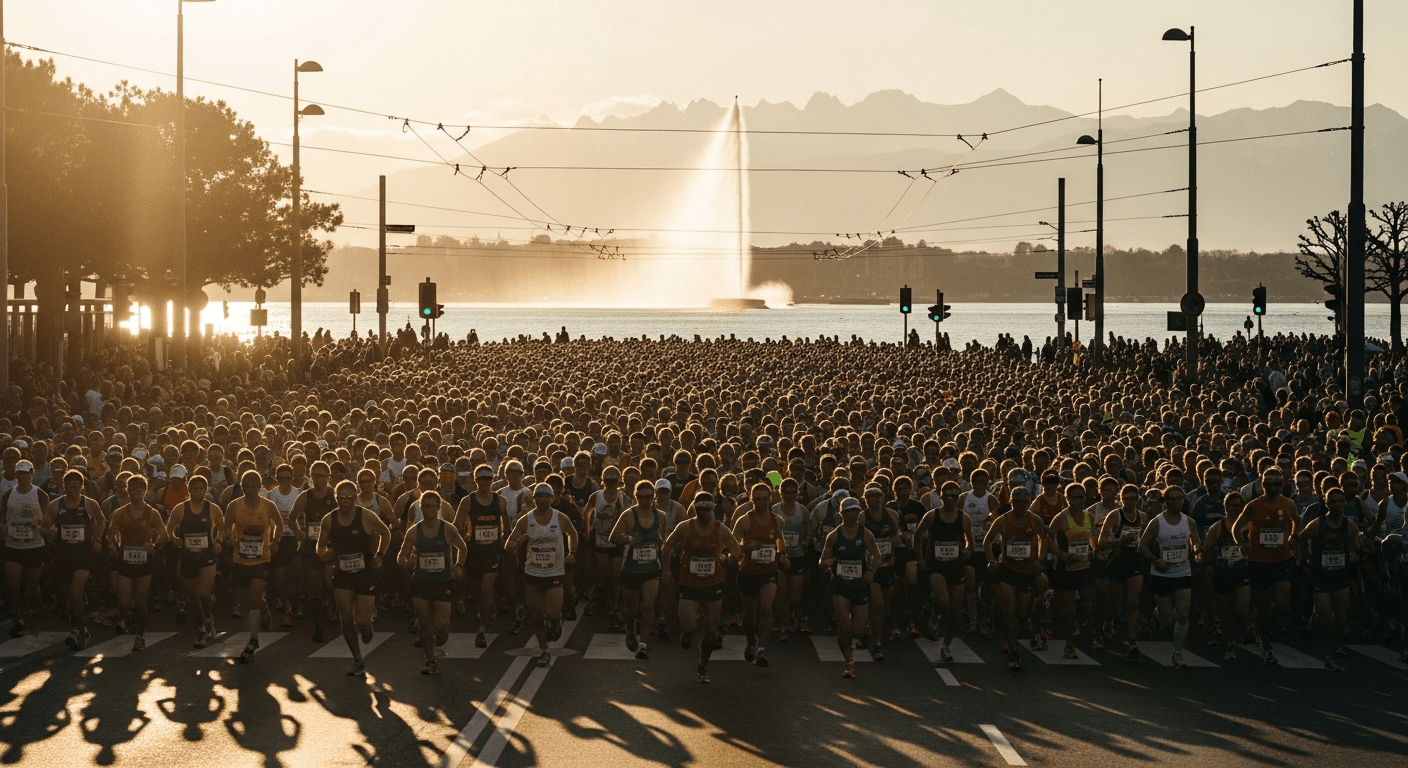
The 2026 edition of the Geneva Marathon has officially become the largest in the race's history. Registration numbers surpassed every previous edition, with organizers confirming a new all-time high for participants across all distances. It's a milestone that speaks to more than local enthusiasm. It reflects a fundamental shift in who runs, why they run, and how European road racing is evolving.
If you've been watching the global marathon calendar closely, Geneva's record doesn't come as a surprise. But the scale of it does.
A Record That Rewrites the Race's History
The Geneva Marathon for Unicef, held each spring along the shores of Lake Geneva, has long been one of Switzerland's flagship road races. In 2026, it crossed a threshold that organizers had been tracking for years. Across the full marathon, half marathon, and shorter relay formats, total participation reached a new peak, drawing runners from across Europe and well beyond.
Registration windows closed faster than any previous year. Waitlists opened for the first time in certain categories. For a race that has historically operated with room to grow, that kind of demand signals something structurally different in the market for road racing.
The race also posted strong international representation, with a notable uptick in runners traveling from outside Switzerland. That's consistent with a broader pattern: major European marathons are increasingly functioning as destination events, where the race is only part of the draw.
A Younger Field Is Reshaping the Start Line
One of the most significant stories in Geneva's 2026 data is demographic. The share of runners under 35 grew meaningfully compared to prior editions, continuing a trend that race directors across Europe have been watching with real interest.
Road running spent years carrying the image of a middle-aged sport. That reputation has eroded quickly. The generation that grew up with fitness content on social media, access to GPS watches at entry-level price points, and communities built around running clubs and group training is now showing up on start lines in force.
This isn't unique to Geneva. It mirrors what's happening with youth-oriented fitness competition more broadly. The explosive growth of events like HYROX Youngstars: The Global Youth Competition Is Here shows how younger audiences are actively seeking structured athletic challenge, not just casual participation. Marathon running is absorbing a share of that same energy.
Training culture has shifted alongside the demographic. Younger runners tend to be more deliberate about periodization, recovery, and building base fitness before targeting race times. That methodical approach to endurance, anchored in concepts like zone 2 aerobic conditioning, reflects the kind of structured thinking covered in The HYROX Aerobic Base Phase Everyone Rushes and Regrets. The principles apply directly to marathon prep.
European Marathons Are Selling Out Faster Than Ever
Geneva is part of a wider surge. Across Europe in 2026, major city marathons have reported earlier sellouts, expanded waitlists, and record registration volumes. London, Berlin, Paris, Amsterdam, and Stockholm have all posted strong growth figures. The demand for entry slots has become its own story, separate from race-day performance.
Some context on scale: Berlin Marathon 2025 received over 130,000 applications for approximately 50,000 spots. London has operated a ballot system for years with hundreds of thousands of applicants competing for general entry places. Geneva, while smaller in absolute terms, is now operating with the same supply-and-demand dynamics that once only applied to the World Marathon Majors.
What's driving this? Several forces are converging. Post-pandemic participation in endurance events has continued to climb rather than plateau. The social dimension of running has strengthened, with club membership and group training growing in cities across Europe and North America. Fitness culture has normalized ambitious athletic goals for people who don't identify as competitive athletes.
And increasingly, how marathon running became a cultural force in 2026 has as much to do with identity and community as it does with performance. Finishing a marathon carries real social weight. It's a shared experience that draws people in independent of their pace.
What This Means for Runners Targeting European Races
If you're planning to race in Europe in the coming years, the logistical landscape has changed. Entry strategies that worked five years ago may not be sufficient now. Here's what the current environment looks like:
- Register early. General entry windows for major European marathons are closing weeks or months faster than they did before 2020. Checking registration opening dates has become as important as training block planning.
- Consider charity or travel entry. Charity guaranteed entry spots and tour operator packages are increasingly common ways to secure a bib when general registration is closed. These options typically carry a fundraising minimum or a premium on race fees, which can run $250 to $500 or more above standard entry costs.
- Look at regional races with growing profiles. Geneva's trajectory suggests that second-tier European marathons are delivering high-quality experiences without the same lottery friction as the Majors. Races in Zurich, Valencia, Seville, and Edinburgh have built strong reputations with more accessible entry processes.
- Plan travel well in advance. As destination racing grows, hotel inventory around major race weekends tightens early. For Geneva specifically, accommodation along the lake fills quickly once registration opens.
The broader lesson is that the barrier to entry is now as much about logistics as it is about physical preparation. You can train perfectly and still miss the race if you don't navigate registration correctly.
The Training Implications of Running in a Bigger Field
A larger, more diverse field changes the experience of racing, and it should inform how you prepare. Congestion in the early kilometers is real in high-participation events. If you're chasing a time goal, seeding yourself correctly matters more than it did when fields were smaller and pacing was less compressed.
It also means that race-day execution requires more patience. Running the first five kilometers at your goal pace is harder when you're navigating thousands of runners finding their rhythm. Building that awareness into your race plan, rather than treating it as a nuisance, is part of running smartly in a modern mass participation event.
Performance-focused runners will find value in studying what elite pacing strategies actually look like at scale. The analysis in 5 Lessons Every Runner Can Steal From the Sub-2 Marathon translates directly to how amateurs should think about even pacing, energy management, and the cost of going out too fast.
Nutrition on race day deserves the same attention you give to training. With longer finish times and more varied conditions, fueling decisions that work for a 3:30 marathon may look different from what a 4:30 or 5:00 finish requires. If budget is a factor in how you approach training nutrition, protein bar alternatives that cost half as much and actually work is worth reading before you commit to expensive race-week fueling strategies.
Switzerland as a Barometer for European Running Culture
It would be easy to treat Geneva's record as a local story. It isn't. Switzerland has a running culture with high participation rates and strong institutional support for endurance sports, but it doesn't typically lead global trends. When a Swiss marathon sets an all-time participation record in a year when demand across the continent is surging, it's a data point in a much larger pattern.
European road running is not just recovering from a pandemic disruption. It's expanding into new demographics, new geographies, and new motivations. The sport is absorbing people who came to running through gym culture, through social communities, through a desire for structured challenge in an otherwise unstructured fitness landscape.
That expansion is good for the sport. It creates more races, more routes, more infrastructure, and more community. It also means that the experience of racing, particularly at well-known events like Geneva, will continue to feel more competitive at the entry stage even as it becomes more inclusive at the participation stage.
If you've been sitting on the idea of registering for a European marathon, the trend line is clear. The races you want to run are filling faster every year. Train well, plan early, and get your name on the list before the window closes.