
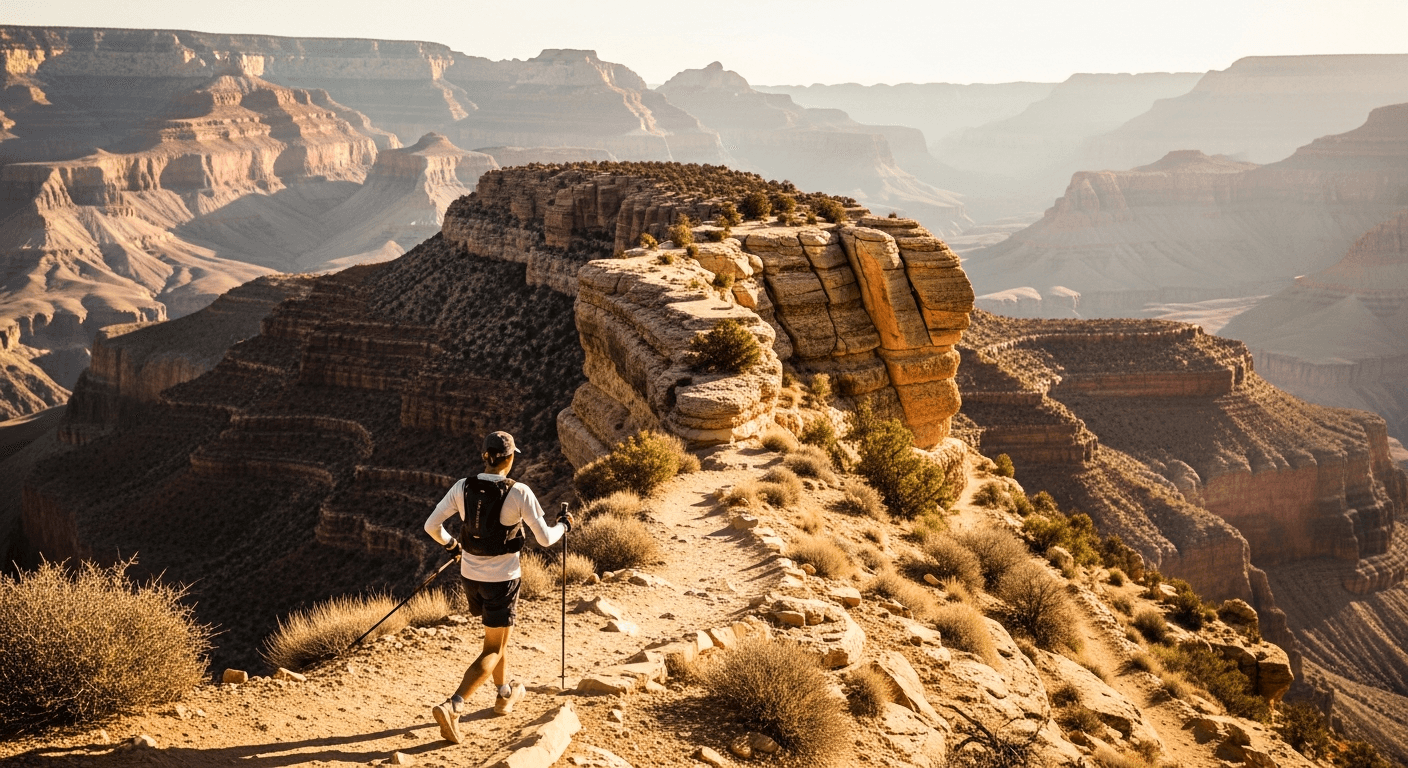
There are races, and then there are challenges that exist entirely outside the race format. The Grand Canyon rim-to-rim-to-rim sits firmly in the second category. No bibs, no finish-line medals, no aid stations stocked with gels and electrolyte drinks. Just you, the canyon, and somewhere between 42 and 50 miles of terrain that has a way of exposing every weakness in your preparation.
In 2026, more ultra runners are treating the R3 not as a bucket-list stunt, but as a genuine benchmark. A proving ground. The kind of effort that tells you something true about yourself that no organized race quite can.
What the R3 Actually Involves
The classic route runs from the South Rim down Bright Angel or South Kaibab Trail to the Colorado River, across to the North Rim via the North Kaibab Trail, and then back the same way. The South Rim sits at roughly 6,860 feet. The North Rim climbs to about 8,241 feet. The canyon floor drops to approximately 2,480 feet near Phantom Ranch.
The cumulative numbers are serious. Depending on your exact line, you're covering 42 to 50 miles with around 9,000 feet of total elevation gain. That puts it in the same physical weight class as many certified 50-mile ultramarathons, but without the course markings, timing mats, or crew access that races provide.
Most runners aiming to complete the R3 in a single push target a window of 12 to 20 hours. Elite attempts have come in under 6 hours, a figure that requires a level of fitness that very few humans will ever touch. For the rest of the ultra-running community, a successful, safe completion in daylight is the real goal.
The Conditions Are the Point
What separates the R3 from a difficult trail race isn't just the distance or the elevation. It's the environmental whiplash.
The inner canyon in summer routinely reaches 110 to 115 degrees Fahrenheit at the floor. The rims can be 20 to 30 degrees cooler, sometimes cold enough for frost early in the morning. You'll move through multiple climate zones in a single outing, shifting from desert heat to alpine chill and back again. Your gear has to account for both extremes simultaneously.
The National Park Service issues explicit warnings against attempting to hike rim-to-rim in a single day, let alone running it twice. That's not bureaucratic caution. It's based on a documented history of heat-related evacuations, hyponatremia cases, and worse. Understanding how heat affects your performance before you ever set foot on the trail is non-negotiable. If you haven't already thought carefully about how to adjust your pace when running in heat, the canyon will do the adjusting for you, and not gently.
Water is available at specific points along the route, but those sources can be seasonal or temporarily offline. You're expected to carry filtration capacity and the cognitive discipline to track your intake obsessively. Sodium management matters just as much as hydration volume. Research consistently shows that endurance athletes underestimate sodium loss during prolonged efforts in extreme heat, which is one of the primary drivers of performance collapse and medical emergencies in remote settings. Understanding the science behind water versus electrolytes for sustained efforts could be the difference between finishing strong and getting evacuated.
Self-Sufficiency Is the Whole Game
Standard ultras, even demanding ones, offer a safety net. There are checkpoints. There are crews. There are race directors who can pull you from the course if something goes wrong. The R3 offers none of that.
You carry your calories, your emergency supplies, your navigation, your decision-making. If your stomach turns at mile 30 and you can't hold down food, there's no aid station captain to hand you broth and crackers. You problem-solve or you turn around.
This self-sufficiency requirement changes how you need to train, not just physically but logistically. Runners who have successfully completed the R3 consistently recommend several preparation steps:
- Train on significant elevation. Cumulative climbing matters more than single-climb height. Your legs need to handle repeated descents, which are often more damaging than the uphills.
- Practice eating and drinking on the move. Your gut's ability to process calories under physical stress is trainable. Build it deliberately.
- Simulate heat exposure. If you live in a cooler climate, sauna sessions and heat-adapted training runs in the weeks before your attempt have measurable physiological benefits.
- Know your turnaround criteria before you start. Decide in advance what conditions will make you stop. Making that call mid-effort, when your judgment is compromised, is far harder.
- Time your start strategically. Many experienced R3 runners begin at 3 or 4 a.m. to reach the canyon floor before peak heat and return to the South Rim before afternoon temperatures climb again.
Gear weight is a genuine tension. You need enough to be safe, but every extra pound compounds across 50 miles. Most experienced runners settle on a vest in the 12 to 18 liter range, carrying two soft flasks plus a filtration system, a light layer for the North Rim, sun protection, a headlamp, and enough calories for the full duration plus a meaningful buffer.
The Mental Dimension Nobody Talks About Honestly
Ask someone who has finished the R3 what surprised them most, and the answer is rarely about the physical difficulty. It's usually about the mental terrain.
The canyon is isolating in a way that trails closer to civilization simply aren't. Cell service is non-existent for most of the route. The landscape is so vast and so indifferent that it reframes your sense of what you're doing. You're not an athlete conquering terrain. You're a small creature moving through something ancient, and it has zero interest in your training log.
Runners consistently report that the R3 creates a particular kind of mental clarity, or mental crisis, depending on how prepared they are. The monotony of the inner canyon stretch, combined with heat and fatigue, can produce a state that some describe as meditative and others describe as genuinely frightening. There are no crowds to carry your energy. No other runners to pace off. No finisher's arch to pull you forward. You're running toward something you've already seen, the rim you started from, and the motivation has to be entirely internal.
This is why experienced ultra runners treat the R3 as a different kind of benchmark than a 50-mile race. The external structure of an organized event does real psychological work on your behalf. Strip it away and you find out quickly what your base layer of motivation actually is.
That mental dimension is also what makes proper physical preparation so critical. Arriving undertrained means you're battling your body and your mind simultaneously, and the canyon gives you nowhere to hide. Runners who've built their base through structured programs, even those who come from road racing backgrounds, tend to handle the R3 significantly better than those who show up on fitness borrowed from shorter efforts. There's a reason the hybrid fitness community has observed that athletes with strong aerobic engines handle multi-hour physical challenges more effectively, the R3 is a direct illustration of that principle at its most extreme.
Permits, Regulations, and Respect for the Canyon
The R3 is not a sanctioned race. You don't need a special permit to run it, but you do need to understand and respect the regulations that apply to Grand Canyon National Park. Camping at Phantom Ranch requires advance reservations, which are notoriously difficult to secure. Day-use of the corridor trails, including running through, is permitted without a permit, but rangers monitor the inner canyon actively.
The Park Service's concern is real and legitimate. The canyon generates hundreds of search-and-rescue operations annually, a significant portion of them involving people who underestimated the physical demands. Attempting the R3 responsibly means not adding to that number.
Respect also means leaving no trace, yielding to mule trains, and understanding that in a genuinely remote emergency, help may be hours away. This isn't a place to take risks for social media content. The runners who approach it with that seriousness are the ones who come away with something meaningful from the experience.
Is the R3 Right for You in 2026
If you're building toward your first ultra distance and still deciding on a race format, the R3 is not a starting point. It's a destination you work toward. Choosing the right first major distance challenge matters enormously for building the base that eventually makes something like the R3 feel achievable rather than reckless.
But if you've got a handful of 50Ks or longer under your belt, you've trained seriously in heat, and you're ready for a challenge that doesn't hand you a medal but hands you something harder to explain, the R3 is worth serious consideration.
It's not a race. It's not an event. It's a conversation between you and one of the most demanding landscapes on earth. The canyon doesn't care about your pace or your PR. It just asks whether you're prepared, honest, and humble enough to meet it on its terms.
Most people aren't. That's exactly why finishing it matters.