
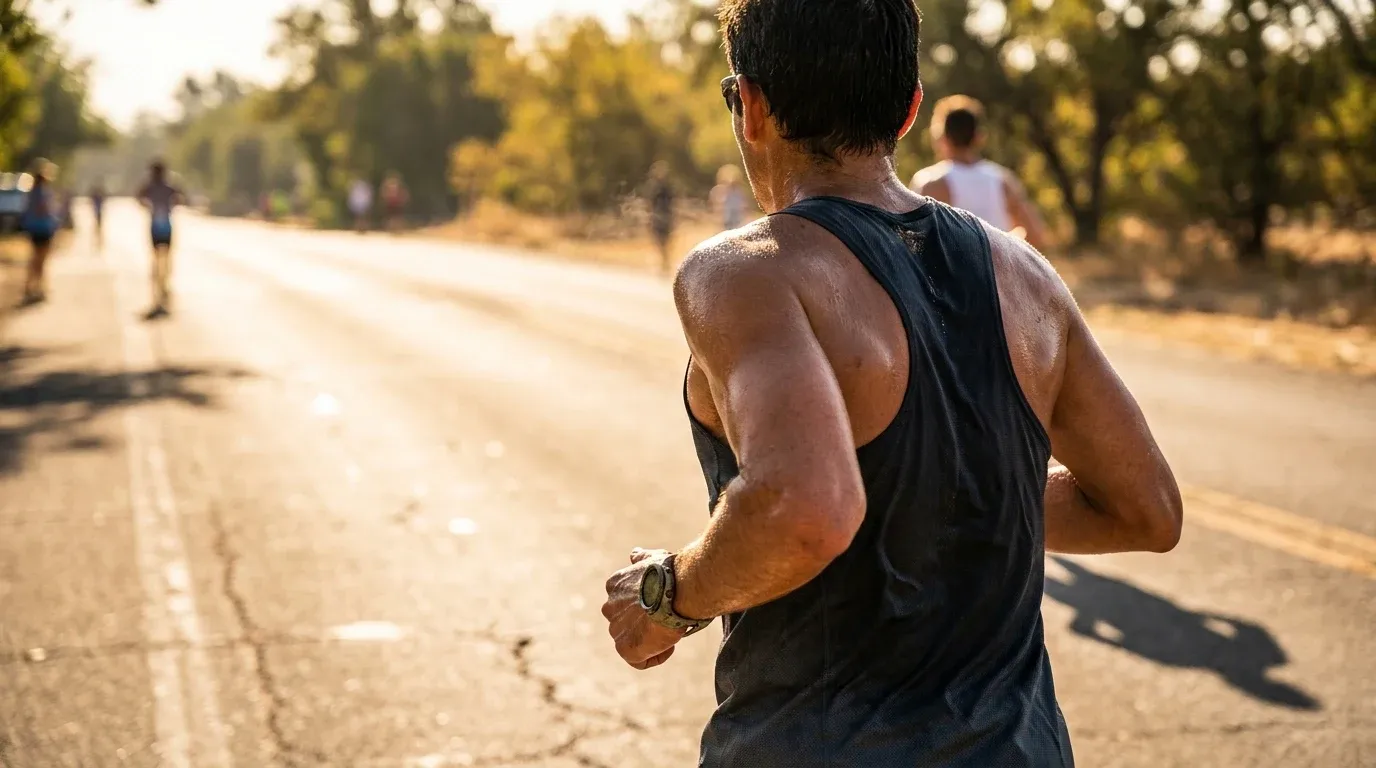
Something is shifting at summer running events, and the numbers are hard to ignore. Heat-related medical interventions at road races have increased significantly over the past five years, and race directors are scrambling to respond. The 10km du Neuf is the latest example: following heat-related incidents during the race, organizers introduced reinforced safety protocols including additional medical stations, revised wave starts, and stricter withdrawal procedures for distressed runners.
It's not an isolated case. The tragedy at HYROX Lyon, where a participant died during competition in extreme heat, forced a broader conversation across the endurance community. That conversation is overdue. Whether you're training for a fall marathon or toeing the line at a local 5K this summer, the heat is no longer a background variable. It's a primary risk factor.
Why Heat Hits Harder Than You Think
Most runners mentally prepare for heat by planning to "go a bit slower" or "drink more water." That's not wrong, but it dramatically understates the physiological pressure your body is under when temperature and humidity combine.
The key metric isn't air temperature. It's the wet-bulb globe temperature (WBGT), which accounts for heat, humidity, solar radiation, and wind. When WBGT climbs above 28°C (82°F), the risk of exertional heat illness rises sharply even for fit, experienced runners. Above 32°C WBGT (90°F), many sports medicine organizations recommend canceling or significantly modifying endurance events entirely.
Here's the mechanism: your working muscles generate heat. Your body dissipates that heat primarily through sweat evaporation. When humidity is high, sweat doesn't evaporate efficiently. Your core temperature climbs faster than it should. The cardiovascular system is forced to simultaneously deliver oxygen to working muscles and pump blood to the skin for cooling. At some point, something gives.
Research consistently shows that runners underestimate heat stress, particularly on overcast or breezy days, when the perceived temperature feels more manageable than actual thermal load. Overcast conditions reduce solar radiation but don't reduce humidity. Breezy conditions help, but not as much as runners assume.
The Warning Signs Most Runners Miss
Heat illness exists on a spectrum. Heat cramps and heat syncope (fainting) are early-stage events. Heat exhaustion is the critical intervention point. Heat stroke is a life-threatening emergency. The problem is that the progression from heat exhaustion to heat stroke can happen in minutes, not hours.
The early warning signs you need to recognize in yourself, and in the runners around you, include:
- Unusual fatigue disproportionate to your pace or effort
- Headache or a feeling of pressure behind the eyes
- Nausea or a sudden loss of desire to drink
- Chills or goosebumps despite the heat (a particularly underappreciated warning sign)
- Confusion, irritability, or difficulty concentrating
- Skin that stops sweating or becomes hot and dry
If you notice chills or goosebumps during a hot race, stop immediately. That response indicates your thermoregulatory system is failing to keep pace, not that you're about to cool down. Many runners mistake this signal for a second wind. It is not.
Heat stroke is distinguished from heat exhaustion primarily by central nervous system dysfunction: confusion, slurred speech, inability to walk a straight line, loss of consciousness. At that stage, the priority is immediate cooling by any means available (ice water immersion is the most effective) and emergency medical care. Do not wait and see.
Practical Race-Day Protocols That Actually Work
The good news is that heat illness at races is largely preventable. The following protocols are drawn from sports medicine consensus guidelines and are used by elite athletes and military institutions managing heat exposure in operational environments.
Adjust your pace from the start, not when you feel bad. Research on thermoregulation in runners shows that voluntary pacing adjustments made in the first quarter of a race significantly reduce peak core temperature compared to adjustments made reactively mid-race. A rough benchmark: for every 5°C rise above 10°C ambient temperature (50°F), expect roughly a 1.5 to 2 percent decline in sustainable race pace. In practical terms, on a 28°C (82°F) day, your 10K race pace should be 3 to 5 percent slower than your cool-weather benchmark before you even take your first step.
Hydrate with a plan, not on instinct. Thirst is a lagging indicator of dehydration. By the time you feel thirsty in a race, you may already be 1 to 2 percent dehydrated, which measurably impairs performance. For races over 30 minutes in heat, aim to drink 150 to 250ml (5 to 8oz) every 15 to 20 minutes. For longer efforts, sodium matters. Plain water alone during extended sweating can lead to hyponatremia (dangerously low blood sodium), which produces symptoms that mimic heat exhaustion and can be equally dangerous.
Pre-cooling is one of the most underused tools in amateur racing. Studies show that pre-cooling strategies, including wearing ice vests in the 30 minutes before a race, immersing arms and legs in cold water, or consuming ice slushies before the gun, can delay the point at which core temperature reaches critical thresholds. Elite athletes in heat-heavy events like triathlon and marathon have used these methods for years. For most amateur runners, a practical version is as simple as wearing a cold wet towel around your neck at the start and consuming an ice slushy 20 minutes before the race.
Use aid stations strategically. At races with water stations, pour water over your head and neck in addition to drinking. Cooling the skin directly reduces the cardiovascular strain of thermoregulation. If ice is available, hold it in your hands or place it at the back of your neck. These tactics seem minor but have measurable effects on sustained core temperature.
Heat Acclimation: The Training Edge You're Probably Skipping
If you're racing in the summer and training primarily in air-conditioned environments or cooler morning windows, you're leaving a significant adaptation on the table. Heat acclimation, the process of deliberately exposing yourself to heat during training, produces physiological adaptations that substantially reduce heat illness risk and improve performance in warm conditions.
After 10 to 14 days of regular heat exposure during exercise, the body adapts by increasing plasma volume, reducing resting heart rate in the heat, beginning to sweat earlier and at lower core temperatures, and reducing the sodium concentration of sweat. These are the same adaptations elite athletes target before competing at hot-weather championships.
You don't need exotic equipment. Running at midday two or three times a week for two weeks, at a controlled effort, is sufficient to initiate meaningful acclimation. Keep effort aerobic, monitor for warning signs, and build gradually. This is particularly relevant if your target race is in a warmer city or climate than where you train. For a deeper look at how training load interacts with nutrition timing, the June 2026 running roundup on training in the heat covers current approaches from elite programs.
What Race Organizers Are Responsible For. And What They're Not.
Following incidents like those at the 10km du Neuf and the HYROX Lyon tragedy, the question of race organizer responsibility has become more urgent. Many events are now adopting WBGT thresholds as formal decision triggers for modifying or canceling races. Medical station density is being increased at summer events. Some races are issuing explicit heat warnings in pre-race communications and requiring runners to acknowledge conditions before the start.
That's the right direction. But you cannot outsource your safety entirely to event management. Race directors are managing hundreds or thousands of runners simultaneously. Medical staff at most amateur events are stretched. The assumption that someone will notice you struggling and intervene in time is not a safety plan.
Your preparation before the race, your pacing decisions in the first kilometer, your willingness to slow down or withdraw without treating it as failure. Those are the variables you actually control.
It's also worth examining your broader training and nutrition foundations. Runners who are well-fueled, well-rested, and not in a caloric deficit heading into a hot-weather race are meaningfully more heat-resistant than those who arrive depleted. For context on how meal timing affects performance and recovery, this practical guide to meal timing around workouts is a useful reference. And if you're interested in how gut health intersects with endurance performance, the research covered in the science behind fibermaxxing and gut microbiome health is directly relevant to how efficiently your body manages physiological stress.
The Bigger Picture
Heat incidents at races aren't a fluke. Climate data shows that the number of extreme heat days in the Northern Hemisphere during traditional racing season has increased steadily. Events that were once reliably temperate are now routinely hot. The races aren't going anywhere. The heat isn't retreating.
The runners who adapt their approach, who treat heat management as a skill rather than an inconvenience, are the ones who will race consistently and safely for decades. The research on running's long-term health benefits is compelling: as little as 30 minutes of hard running per week is linked to a 50 percent reduction in disease risk. Protecting your ability to keep doing this, through smart heat management, is simply good training.
Slow down. Hydrate properly. Recognize the signs. And if your body tells you to stop, that's the race-winning decision.