
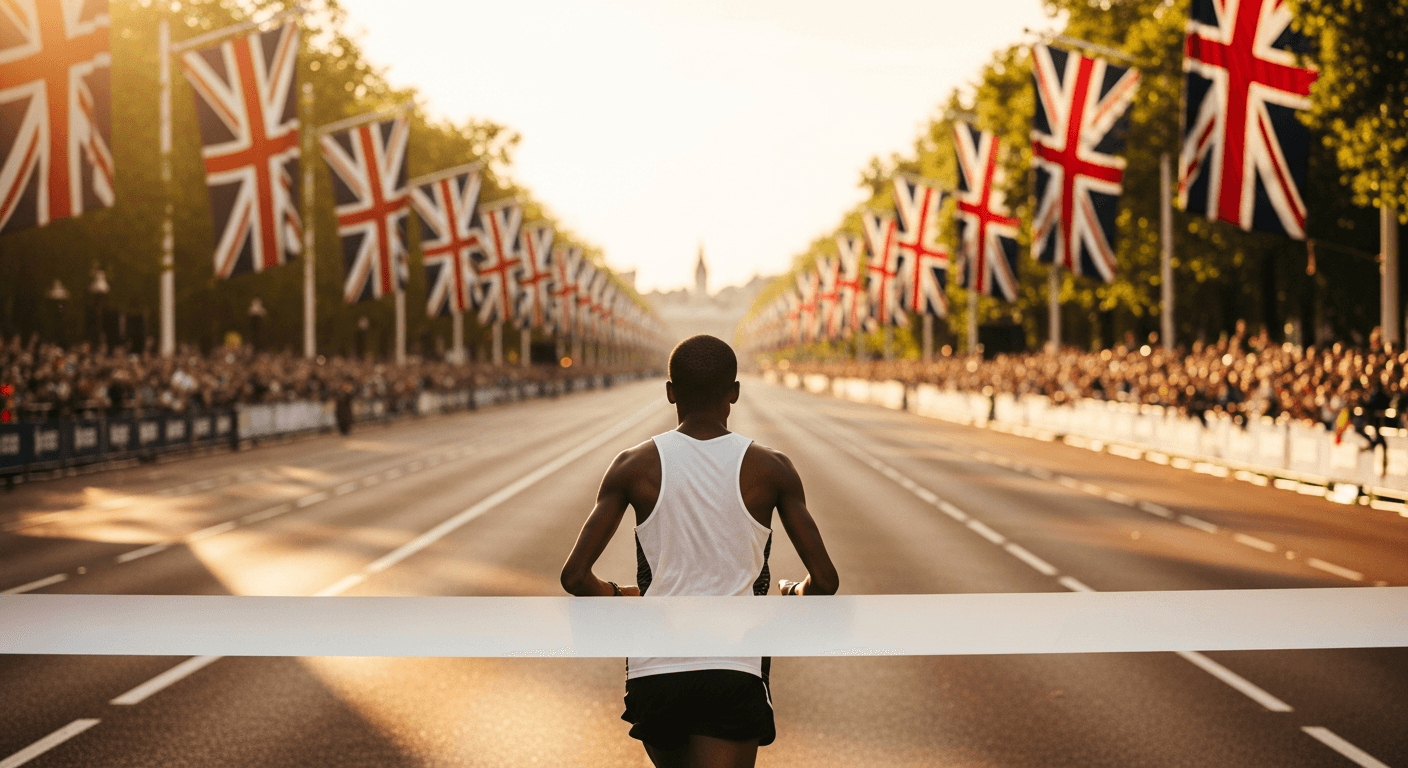
April 26, 2026 will be remembered as the day marathon running changed forever. On a cool, overcast morning in London, Sabastian Sawe crossed the finish line in 1:59:30, becoming the first athlete in history to break the two-hour barrier in an official, mass-participation marathon. Then, within minutes, Yomif Kejelcha crossed the same line in 1:59:48 on his marathon debut. On the same day, Tigist Assefa defended her London title and set a new women's-only world record of 2:15:41.
No controlled time trial. No closed highway. No specially selected pace group operating outside the rules. This happened at the London Marathon, one of the six Abbott World Marathon Majors, with thousands of other runners on the same course. The sport will never look at a finish clock the same way again.
What Sawe Did and Why It Matters
Sabastian Sawe, the Kenyan who won Chicago in 2024 and has been climbing rapidly through the marathon ranks, ran an almost perfectly even race. He went through halfway in approximately 59:40 and held his pace with remarkable consistency through the brutal final 10 kilometers. His 1:59:30 is not just a number. It's the answer to a question the sport has been circling for a decade.
Until today, sub-2 had only been achieved once before, by Eliud Kipchoge in the 2019 INEOS 1:59 Challenge in Vienna. That effort, while extraordinary, was ineligible for world record consideration because it used rotating pacers, a closed course, and conditions specifically engineered for the attempt. London 2026 had none of those concessions. Sawe ran it clean, in a race, against other humans, with a finish tape at the end.
That distinction matters enormously. The official marathon world record, held by Kipchoge at 2:00:35 set in Berlin in 2023, has now been obliterated. Sawe's run is expected to be ratified by World Athletics as the new world record, subject to standard review processes. If confirmed, it represents a 65-second improvement on the existing mark, one of the largest single jumps in marathon world record history.
Kejelcha's Debut Changes the Conversation Immediately
If Sawe's run was the headline, Kejelcha's was the subplot that made the story even harder to process. The 27-year-old Ethiopian, a two-time indoor 3,000-meter world champion and one of the most decorated track athletes of his generation, ran his very first marathon in 1:59:48. On debut. Alongside the man who just broke one of sport's most celebrated barriers.
Two sub-2 performances on the same day, on the same course, sends a clear signal. This isn't a one-off. The two-hour barrier hasn't just been broken. It's been broken twice simultaneously, suggesting that a cohort of athletes may be capable of running at this level under the right conditions. The question of depth is suddenly very real.
Both Sawe and Kejelcha competed with adidas support, wearing the latest iteration of the Adizero Adios Pro Evo. The shoe, which has been at the center of the super-shoe revolution since the mid-2020s, continues to be positioned alongside rival Nike's Alphafly line as one of the primary technological factors in elite marathon performance. The adidas-backed performance is another chapter in the ongoing super-shoe and pacing-strategy arms race that has defined the sport since the late 2010s.
Tigist Assefa: The Women's Story That Deserves Equal Billing
In a day packed with history, Tigist Assefa's performance risks being undersold. The Ethiopian defended her London title while running 2:15:41, smashing the previous women's-only world record of 2:16:16 set by Brigid Kosgei in Chicago in 2019. Her previous world record of 2:11:53, set in Berlin in 2023, was set in a mixed race with male pacers, meaning it stood as the overall record but not the women's-only mark.
The women's-only record is run in a women's-exclusive field without male pace assistance, a distinction that World Athletics has maintained as a separate category. Assefa's 2:15:41 in a competitive women's race reframes what's possible without that assistance. At 27 years old, she has now produced three of the fastest women's marathon performances in history. She is, by any measure, the greatest female marathoner alive.
Course Legality and the Questions That Follow
The celebrations are real. The records will almost certainly be ratified. But the running world is already asking hard questions, and you should expect those conversations to intensify over the coming weeks.
The London course meets World Athletics eligibility criteria. The start-to-finish displacement is within the permitted limit, and the net elevation drop falls within the legal threshold. But some within athletics have raised eyebrows at the combination of factors that aligned on race day: near-perfect weather conditions, a deep and strategically organized pacing structure, and the specific course profile through the second half of the race.
None of this invalidates the results. The rules are the rules, and both performances were run within them. But the sport is likely to revisit what "course legality" means at the elite level, particularly as performances continue to accelerate beyond what many physiologists previously thought was biomechanically possible for human beings. For full context on the splits and how the race unfolded technically, see the London Marathon 2026 results and final standings.
The Technology Factor Cannot Be Ignored
Shoe technology is no longer a footnote in elite marathon results. It's a structural variable. Studies published between 2020 and 2025 consistently estimated that carbon-plated super-shoes improve running economy by between 4% and 6% compared to traditional racing flats. At marathon pace, that kind of improvement is physiologically significant.
Both Sawe and Kejelcha were in the latest adidas hardware. Assefa, also an adidas athlete, ran in the same family of footwear. This level of coordination between footwear technology, pacing strategy, and race-day execution is increasingly the difference between a fast time and a historic one. The marathon is still a test of the human body, but it's also now a test of the technical ecosystem around that body.
This matters for you as a runner too. The trickle-down effect of elite super-shoe development has already reached the consumer market. Many of the carbon-plated shoes available to recreational runners today are meaningfully faster than what elite athletes were wearing a decade ago. If you're training for your next race and haven't reviewed your footwear choices recently, the gap between old-generation and current-generation shoes may be larger than you think.
What This Means for the Sport Going Forward
The sub-2 barrier held a special psychological power precisely because it seemed so close yet so unreachable for so long. Now that it's gone, the sport shifts into a different phase. The question is no longer whether someone can break two hours in a real race. The question is how fast the marathon can ultimately go.
Physiologists have debated theoretical human performance limits for decades. Some models, based on maximal oxygen uptake, running economy, and lactate threshold data, have suggested that a barrier closer to 1:57 or 1:58 may represent a practical ceiling for human performance even with optimal technology. Others argue the floor is still unknown. With Kejelcha running 1:59 on debut, the sport may find out sooner than anyone expected.
The pressure on other elite marathoners is immediate. Kelvin Kiptum's world record of 2:00:35, set in Chicago in 2023, was already the sport's most closely watched number. If Sawe's London performance is ratified, the record books rewrite themselves completely. Athletes currently ranked in the top ten in marathon history will need to go sub-2 just to remain relevant at the highest level of competition.
For context, the kind of training, nutrition, and recovery protocols that underpin performances like these are increasingly accessible to informed amateur athletes too. Understanding how to fuel for long-distance performance, particularly around protein intake and carbohydrate periodization, is something every serious runner should be thinking about. The 2025-2030 Dietary Guidelines on protein recommendations offer a useful evidence-based starting point if you want to align your nutrition with current science.
What Everyday Runners Should Take From This Day
You're not Sabastian Sawe. That's fine. But the same day that rewrote marathon history is also a reminder that human performance limits, at every level, are softer than we assume. Athletes are running faster because they're training smarter, fueling more precisely, and using better equipment. The principles behind those gains scale down to recreational running.
If you're building toward a marathon, half marathon, or even your first 10K, the lessons from elite performance are transferable. Pacing strategy, carbohydrate loading, and recovery protocols all make measurable differences at any fitness level. The gap between a good race and a personal best is rarely just about fitness. It's about preparation.
If you're thinking about expanding your racing calendar beyond road events, the growth of multi-discipline formats is worth exploring. Events like HYROX have attracted a significant number of runners looking for a new kind of challenge alongside their road racing. And if trail running appeals to you after watching the depth and drama of today's road performance, the road to trail transition guide for 2026 covers everything you need to know about making that shift safely and effectively.
April 26, 2026. Write it down. The two-hour marathon barrier is gone, broken twice on the same morning on the streets of London. The sport has crossed a threshold it spent a decade approaching. What comes next is genuinely unknown, and that's exactly what makes it worth watching.