
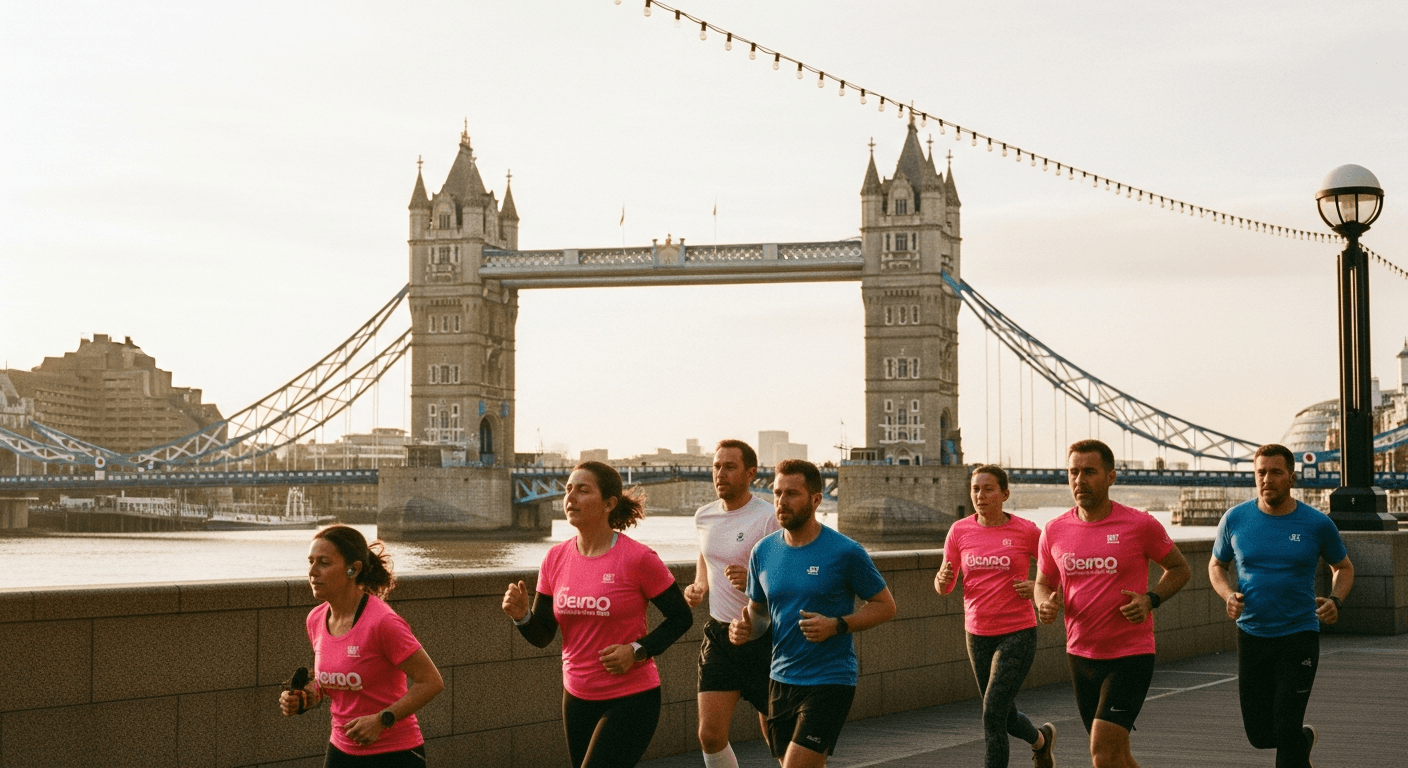
The 2026 TCS London Marathon has already earned a place in the record books, and not just for the elite performances that dominated headlines. From the starting line in Blackheath to the finish on The Mall, this edition delivered something rare: a race that raised the bar across every category, from wheelchair athletes to age groupers running their first 26.2. If you're planning a big-city marathon for the autumn, London 2026 gave you a playbook worth studying.
A Record-Breaking Edition Across Every Category
The headline results were extraordinary. The men's and women's open races both produced sub-2:02 performances, with the men's podium featuring three runners who broke the two-hour-two-minute barrier in the same race. That level of depth hasn't been seen before at a major. The women's race was equally historic, with the winning time placing the victor among the fastest marathoners in recorded history.
Age group records fell across multiple brackets. Several masters runners posted times that would have won outright national championships a decade ago. These aren't numbers to admire from a distance. They're evidence that the combination of course, conditions, and crowd support at London creates a genuine performance environment at every level.
For context on what the elite results mean for recreational training, three sub-2 marathons at London and what it actually means for you breaks down how the new benchmarks shift thinking around effort, pacing, and what's physiologically achievable when conditions align.
Course Conditions and Logistics That Set the Global Standard
London's course management is consistently cited as the most athlete-focused of any World Marathon Major. The 2026 edition continued that reputation. Corrals were organized with precision, reducing the bottlenecking that plagues even well-run major events in the opening miles. Water stations were spaced at approximately every mile after the 5K mark, staffed with volunteers who held bottles at arm height. Simple, but effective.
Weather conditions on race day landed close to ideal: temperatures in the low to mid-50s Fahrenheit, low humidity, and minimal wind. That combination is rare in London in April and it contributed directly to the record volume of personal bests across the field. Race organizers have refined their contingency planning over more than four decades, and it shows in how smoothly even the largest field in the event's history moved through the city.
What organizers at other events can take from London is the attention to the final 10 kilometers. Spectator density along the Embankment and into St. James's Park creates a psychological lift that most races can't replicate. But the practical lesson is that communities and local running groups can generate that same energy at a smaller scale. You don't need 750,000 spectators on a course. You need people stationed at the hard miles.
The Atmosphere Effect: Why Community Runners Perform Better at Majors
Survey data from participant feedback consistently shows that runners at major international marathons outperform their predicted finish times compared to equivalent performances at smaller local events. The margin varies, but runners frequently report running three to six minutes faster than their training suggested. London 2026 reinforced this pattern at scale.
Community runners who took part described the section through Canary Wharf and the final stretch into Westminster as genuinely transformational. Several reported holding a faster pace than planned through miles 20 to 24, driven entirely by crowd noise. One sub-4-hour first-time marathoner described it as running on a different energy source entirely. That's not hyperbole. It's a neurological response to social facilitation, and it's real.
If you've been debating whether to target a major international marathon rather than a local event for your goal race, London 2026 makes the case clearly. The entry cost is higher, the logistics are more complex, and the commitment to training is non-negotiable. But the performance ceiling at a well-organized major is genuinely higher than what most runners can access in a smaller field.
The global marathon calendar is shifting in interesting ways. The Paris Marathon's recent split from its longtime organizer and what changes for runners is worth tracking if you're building a multi-year race calendar, particularly if London or another World Major isn't your only target.
Pacing Strategy: What London 2026 Confirmed
The race data from 2026 adds to a growing body of evidence around even-split and slightly negative-split strategies. Among runners finishing under 3:30, the overwhelming majority ran their second half within 90 seconds of their first. Among runners who blew up in the back half, the most common pattern was a first 10K that came in 45 to 90 seconds per mile faster than their target pace. London's flat course and fast start corrals make this a persistent trap.
Here's what this means practically. If your goal is 3:45, your first mile should feel almost embarrassingly slow. The crowd energy, the adrenaline, and the slight downhill on the A207 out of Blackheath will push you faster than you realize. Trust your GPS. Trust your training pace. The runners who ignored it in 2026 paid for it at mile 18.
If you're building toward an autumn race, now is the time to train your pace discipline. Summer heat training is not just about building fitness. It forces you to run by effort rather than pace, which is exactly the skill you need on a cold, fast race day when everything tells you to go harder early. Using summer heat to run faster in the fall explains how the adaptation works and how to structure it across a training block.
Gear Selection: What Worked and What Didn't
The carbon-plated shoe category continued to dominate at every level of the field. Among runners finishing under 4:00 at London 2026, the adoption rate of advanced footwear was higher than at any previous edition. The performance data supports the investment: studies consistently show a three to four percent energy return advantage over traditional trainers, which translates to roughly five to eight minutes over a full marathon at recreational paces.
What's more notable is the growing gap between runners who train in their race shoes and those who don't. Several runners reported blisters and calf cramping consistent with underuse of their carbon plates in training. If you're racing in a shoe you've worn fewer than 50 miles in preparation, you're introducing a variable that no taper can fix.
Clothing choices at London 2026 also reflected the maturing of the community runner market. Compression socks saw high adoption among runners in the 3:30 to 4:30 bracket. A single layer on the upper body proved optimal for the race day temperature. Arm sleeves, which can be removed and pocketed, outperformed base layers that couldn't be adjusted mid-race.
Pre-Race Routine: The Protocol That Held Up
Among runners who reported their strongest marathon performance relative to training, several common pre-race habits emerged from post-race community discussion. Carbohydrate loading began 48 hours out, not 24. Sleep was prioritized aggressively in the final week, even if race anxiety made the night before difficult. A 20-minute shakeout run on Saturday morning helped maintain muscle activation without adding fatigue.
Nutrition on race morning followed a consistent pattern among strong performers: a carbohydrate-dense meal three hours before gun time, a small top-up snack 60 to 90 minutes before, and no experimentation with anything new. That last point can't be stressed enough. If your gut doesn't know the product from training, race day is not the time to find out.
Female runners in particular have strong reasons to pay attention to protein timing in the weeks leading up to a goal race. the practical guide to protein for women in training outlines how needs shift across a training block and why pre-race week isn't the time to cut back on protein despite the focus on carbohydrate loading.
Recovery protocols post-race also drew significant discussion. The shift toward whole-food recovery meals over processed recovery products reflects a broader awareness of how nutrition quality affects bounce-back time. Understanding how ultra-processed food affects muscle and strength is relevant not just for peak training weeks but for the recovery period that follows a major race effort.
What You Should Actually Do Next
London 2026 confirmed that the major marathon experience delivers on its promise. It's not nostalgia or marketing. The combination of course design, crowd density, organizational precision, and competitive depth produces measurable performance outcomes that recreational runners can access. But they have to show up prepared.
If you're targeting an autumn marathon, your training block starts now. Pacing discipline, gear familiarity, and nutritional preparation aren't race-week decisions. They're built over months. London 2026 gave you the evidence. What you do with it is your call.