
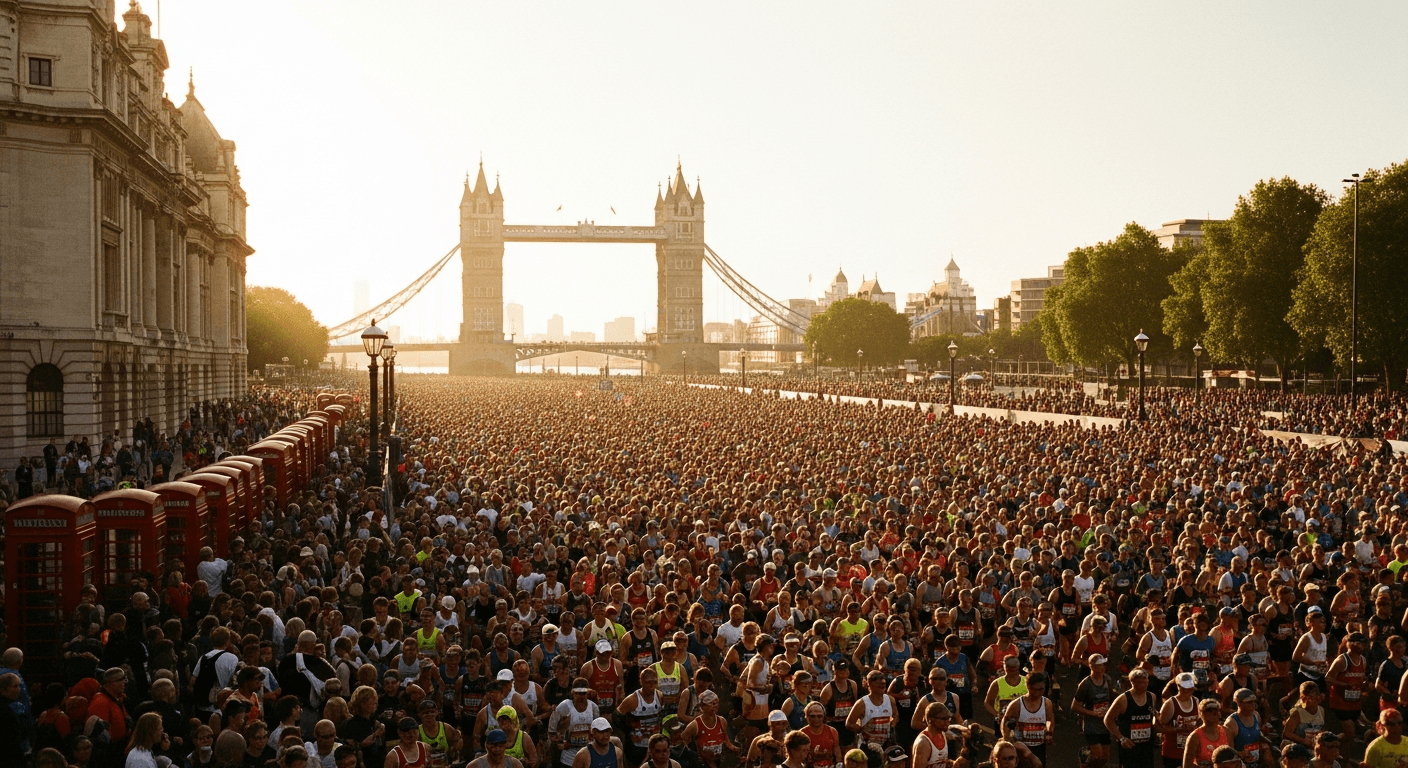
The London Marathon has always operated at a scale most city races can only dream about. Now, it's going further. Race organizers have confirmed that the 2027 edition will span two full days. Saturday April 24 and Sunday April 25 will together host 100,000 runners, doubling down on what's already one of the most iconic mass participation events in global sport.
It's a bold structural shift, and it raises real questions about what a modern marathon weekend can look like when ambition meets logistics. Here's what you need to know about the change, why it's happening, and what it means for runners planning their next major event goal.
Why Two Days?
The short answer is demand. The London Marathon ballot has become one of the most competitive in the world, with hundreds of thousands of applicants chasing a fraction of available spots each year. The current format, a single Sunday race, simply can't stretch to meet that appetite without compromising the experience on the course or the safety of participants.
Spreading the field across two days is the most practical solution organizers have identified. Rather than cramming 100,000 runners onto the same streets at the same time, the two-day format allows for staggered starts, more manageable crowd volumes, and a cleaner race environment for everyone involved. You still run the same iconic course through Greenwich, Tower Bridge, and the Mall. The date on your bib just depends on which wave you're assigned to.
This isn't a decision made in a vacuum. Registration pressure has been building for years. The 2025 ballot drew record-breaking application numbers, and the trend shows no sign of slowing. Expanding to two days is a structural answer to a structural problem.
100,000 Runners: What That Number Actually Means
To put 100,000 in context, the current London Marathon fields around 50,000 finishers. New York City Marathon sits at roughly 55,000. Chicago and Berlin are typically in the 40,000 to 45,000 range. At 100,000 participants across a single weekend, London 2027 would become the largest marathon weekend on the planet by a significant margin.
That scale brings opportunities and complications in equal measure. More runners means more charity fundraising. The London Marathon is already the world's largest annual fundraising event, generating hundreds of millions of dollars for charitable causes over its history. A doubled field would accelerate that further.
But 100,000 runners also means a dramatically expanded logistical footprint. Bag drop coordination, water station resupply, finisher medal distribution, medical coverage across multiple days. Every operational element of the race has to scale, and race organizers will need to demonstrate they can deliver a premium experience at twice the current volume.
Where London Sits in the Global Marathon Landscape
London is already one of the six Abbott World Marathon Majors, alongside Tokyo, Boston, Berlin, Chicago, and New York. The World Marathon Majors system has long defined prestige in mass participation running, and London has competed at the top of that table since its first edition in 1981.
The expansion to two days signals that London isn't content to simply hold its position. It wants to define the ceiling. While other majors have largely maintained their existing formats, London is making a structural bet that bigger is better when it's done right. That's a meaningful competitive statement, especially as the major series itself continues to evolve. Cape Town's addition as the 8th Abbott World Marathon Major signals that the appetite for large-scale marathon events is genuinely global, and London's expansion fits neatly into that momentum.
It also arrives in the context of a broader surge in marathon participation worldwide. Marathon season 2026 saw strong participation numbers across major events, with fields recovering fully from pandemic-era disruptions and registration demand continuing to outpace available spots across almost every top-tier race.
What the Format Change Means for You
If you're targeting London 2027, the two-day format will likely change how you think about your race weekend. Here's what to expect based on the announced plans.
- Ballot entries will be allocated across both days. You won't choose your race day. Organizers will assign participants to either Saturday or Sunday based on wave logistics and entry category.
- Charity and club entries will span both days. If you're running for a charity place or through a running club allocation, your race day will be determined as part of that entry process.
- The course remains unchanged. Both days run the full 26.2-mile route. There are no shortened alternatives or split distances involved in the expansion.
- Elite racing remains on Sunday. The professional field and championship races are confirmed for Sunday April 25, preserving the traditional elite race day and its broadcast profile.
- Spectating becomes a weekend commitment. If you're planning to cheer on a friend or family member, you'll need to know their race day well in advance to coordinate travel and viewing spots along the course.
Training and Preparation: No Shortcuts at This Distance
Whether you're in the ballot for 2027 or already locked into a charity place, the preparation demands don't change because the race now spans two days. A marathon is still 26.2 miles, and the physiological challenges remain exactly what they've always been.
One of the most consistent issues runners face in long races is the deterioration of running economy in the final miles. Research into marathon fatigue consistently shows that neuromuscular fatigue, glycogen depletion, and mechanical breakdown compound as distance increases. Understanding why your stride shortens in the last 10K of a marathon is genuinely useful knowledge when you're structuring your long runs and race-day pacing strategy.
Nutrition planning matters just as much. Getting your fueling right in the weeks before a marathon, not just on race morning, is something a lot of runners underinvest in. The science around meal timing and performance has become more nuanced in recent years, and it's worth revisiting assumptions you might have carried from earlier training blocks.
Hydration strategy is another area worth taking seriously. Many runners overcomplicate it, others ignore it entirely until something goes wrong. The evidence on pre-workout hydration and whether it's actually necessary is more interesting than most training plans let on, and understanding the research can help you build habits that hold up over a full training cycle and into race day.
The Bigger Picture for Mass Participation Running
London's two-day announcement will almost certainly prompt other major races to reconsider their own capacity ceilings. When the world's most prominent marathon publicly commits to a format that breaks every existing participation record, it creates pressure on competing events to articulate their own position on scale.
That's not necessarily a race to simply get bigger. Some events will double down on exclusivity and smaller field sizes as a differentiating feature. Others may explore multi-day formats of their own. But London has made the first significant structural move, and the industry will respond.
For runners, this is genuinely good news. More spots at a top-tier event means more people get the experience of running one of the world's great marathons. The London course, the crowd support, the charity energy, the finish on the Mall. Those things don't diminish because more people get to experience them.
What organizers have to prove between now and April 2027 is that the operational execution at 100,000 participants is as impressive as the ambition behind the number. If they deliver, London won't just be the world's largest marathon weekend. It'll set the benchmark for what mass participation in endurance sport can actually look like.
Key Dates and What to Do Now
The 2027 London Marathon ballot is expected to open in the second half of 2026, following the standard post-race ballot launch that typically comes after the 2026 event. If you're serious about a place, here's where to focus your energy right now.
- Register for ballot notifications. Sign up at the official London Marathon website to receive updates when the 2027 ballot opens. Places will go fast, and missing the application window means waiting another year.
- Explore charity entries. Many UK and international charities offer guaranteed London Marathon places in exchange for fundraising commitments. These are often available well before the ballot opens and are a reliable route in for committed runners.
- Start your training foundation now. If London 2027 is a genuine goal, building your aerobic base well in advance gives you a significant advantage over runners who begin preparation closer to the race.
- Plan your travel early. A two-day event in central London across a late April weekend will create significant hotel and transport demand. Early planning will save you considerable cost and stress.
London 2027 is already shaping up to be one of the most significant events in the history of mass participation running. Whether you're a first-time marathon runner or a veteran chasing a personal best, getting in is step one. Everything else follows from there.