
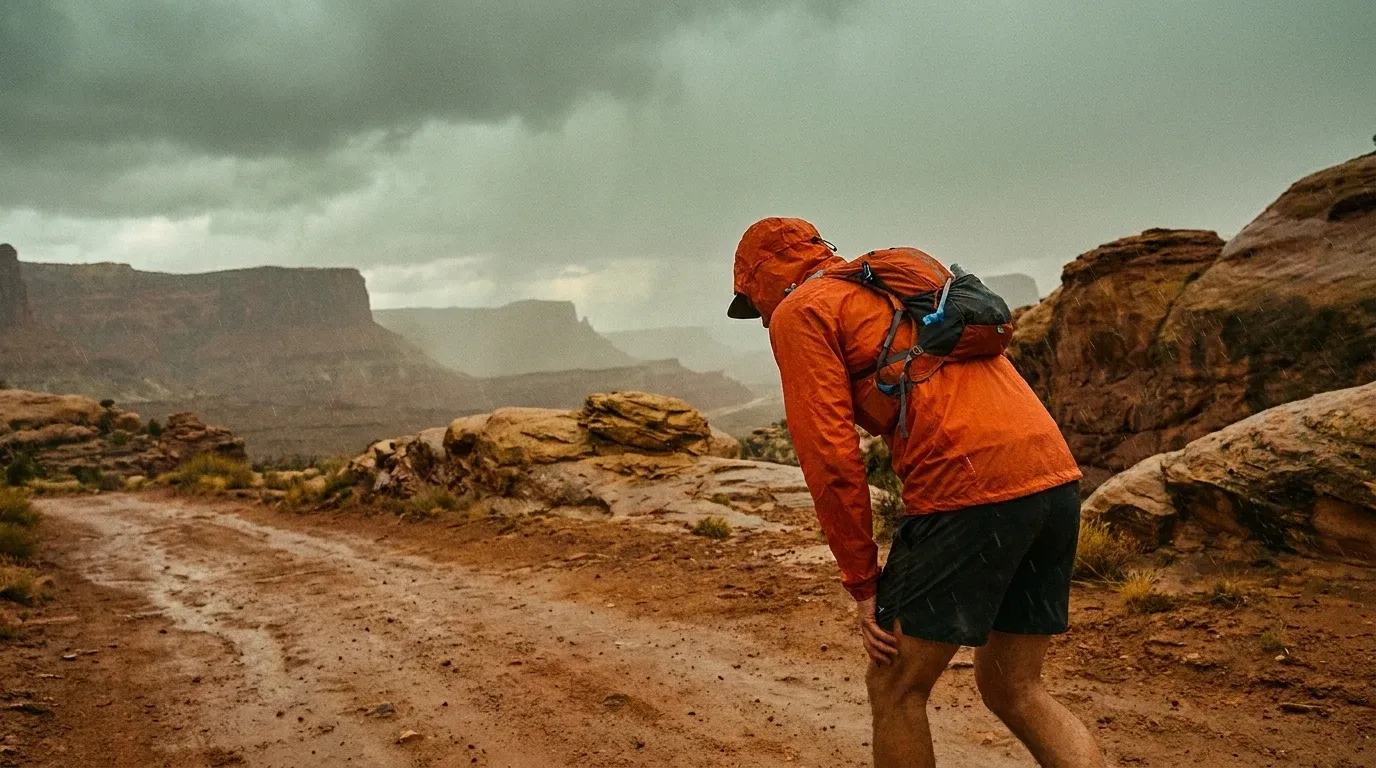
Moab 240 Cancelled Mid-Race: 70 Runners and Volunteers Stranded Overnight
One of ultrarunning's most grueling events came to an abrupt and unprecedented end on October 12, 2026. The Moab 240, a 389-kilometer race through the canyon country of southeastern Utah, was cancelled mid-race after flash flooding, high winds, and falling trees rendered the course unsafe. Approximately 70 runners and volunteers spent the night stranded at an aid station near Bridger Jack Mesa before being evacuated. There are no official finishers for the 2026 edition.
It's a rare outcome for an event of this stature, and it's forcing a broader conversation about how race directors manage real-time safety decisions when weather turns extreme.
What Happened on the Course
The Moab 240 typically unfolds over multiple days across some of the most remote terrain in the American Southwest. Runners navigate canyon systems, mesa tops, and exposed ridgelines that, under normal conditions, represent a serious but manageable challenge. On October 12, those same features became hazards.
Flash flooding swept through sections of the course, cutting off viable routes and making river crossings dangerous. Simultaneously, high winds created falling tree hazards in forested sections. Race officials monitoring conditions in real time made the call to halt the event entirely, directing runners and support crews to consolidate at a designated aid station near Bridger Jack Mesa.
That group, roughly 70 people including runners, pacers, and volunteers, remained at the location overnight. Evacuation was completed safely the following morning. No serious injuries have been reported, which, given the scale of the disruption, is a significant outcome in itself.
A Rare Total Cancellation
The Moab 240 has built a reputation over the years as one of the defining events in the ultramarathon calendar. At 389 kilometers, it sits at the extreme end of what's possible in foot racing. Finishers typically take between four and six days to complete the course. The race attracts elite ultrarunners from around the world alongside strong age-group athletes who have often spent years preparing for it.
A mid-race cancellation with no official finishers is genuinely unusual at this level. Most major ultramarathons, even those dealing with difficult weather, find ways to modify courses, reroute sections, or impose time extensions. A full stop, with active rescue of stranded participants, is a different category of event entirely.
If you're familiar with the ultra calendar, you know that race directors carry significant responsibility during events that unfold across days and hundreds of kilometers. The global ultra calendar has grown substantially in recent years, with dozens of events running simultaneously on any given weekend. The scrutiny on safety decisions has grown with it.
The Safety Decision and What It Signals
Race organizers were direct in their public communications. Runner and volunteer safety was the overriding reason for the cancellation. There was no ambiguity in the statement, and no attempt to frame the decision as anything other than a necessary response to dangerous conditions on the ground.
That directness matters. In a sport where toughness is often celebrated to the point of romanticizing suffering, race directors who pull the plug on events face pressure from multiple directions. Some participants invest years of training, significant travel costs, and emotional energy into a single race. The pressure to find a way to continue, even when conditions deteriorate, is real.
The 2026 cancellation suggests that the calculus is shifting. When the hazards include flash floods, wind-driven tree falls, and participants stranded overnight in remote terrain, continuing becomes indefensible. The Moab 240 organization made that call cleanly, and the absence of serious injuries suggests the timing was right.
Extreme Weather and the New Normal for Race Directors
This cancellation doesn't exist in isolation. Across trail and ultrarunning events globally, race directors are reporting more frequent and more severe weather disruptions. Flash flooding, extreme heat, wildfire smoke, and unseasonable storms are appearing with greater regularity in race windows that previously offered reliable conditions.
The challenge is structural. Events like the Moab 240 require permits, course marking, aid station logistics, and crew coordination that are planned months in advance. Weather forecasting has improved significantly, but the window between a forecast and a fast-moving weather event is often too short to reorganize a course that spans hundreds of kilometers of backcountry terrain.
What's emerging, out of necessity, is a more formal approach to mid-race decision-making. Some race organizations are now building explicit weather cancellation protocols into their race rules, with defined thresholds that trigger mandatory holds or course closures. Others are investing in dedicated safety officers and real-time communication systems that allow course marshals to report conditions directly to race headquarters as events unfold.
For runners, this has practical implications. If you're preparing for a multi-day ultra, understanding a race's safety protocols before you register is now a reasonable part of your due diligence. Knowing who makes the call, under what conditions, and what the evacuation plan looks like is no longer a niche concern.
Recovery and What Runners Should Know
For the 70 runners and volunteers who spent the night at Bridger Jack Mesa, the immediate physical and psychological recovery matters. A multi-day ultra creates a specific physiological load, and an abrupt stop, particularly one involving stress, cold exposure, and disrupted sleep, has real recovery implications.
The body's response to prolonged exertion combined with environmental stress isn't simply a matter of rest. Research into endurance recovery increasingly points to the value of compression garments and nutritional support in the hours and days following intense effort. Evidence suggests that wearing compression socks during a race produces better recovery outcomes than using them only afterward, a finding that's relevant for anyone logging serious mileage across multiple days.
On the nutrition side, the disrupted food and hydration patterns that come with an unplanned evacuation are worth managing deliberately. Athletes coming off extended efforts benefit from prioritizing protein and carbohydrate intake in the recovery window, even when appetite is suppressed, which is common after high-stress exertion.
Staying consistent with easy movement in the days following an event like this, rather than complete rest, tends to support better recovery outcomes. Maintaining a light running routine through fall, even after a disrupted race, helps preserve fitness and mood during what can be a psychologically difficult reset period.
The Broader Ultra Community Response
Reactions across the ultrarunning community have been largely supportive of the race organization's decision, though there's genuine disappointment among the athletes who were competing. For many, the Moab 240 represents a years-long goal. Some will have traveled from outside the US specifically for this event. The financial and logistical costs of a cancelled race are not trivial.
The conversation that's opening up is constructive, though. Runners, coaches, and race directors are asking questions that the sport has sometimes avoided. How should race organizations communicate mid-event decisions to athletes still on course? What's the obligation to runners who have paid entry fees when weather forces a cancellation? And how should the sport weigh the cultural emphasis on finishing against the real and growing risks of extreme weather in backcountry terrain?
These aren't questions with simple answers, but the fact that they're being asked openly is a sign of a maturing sport. The Moab 240's 2026 cancellation, however unwelcome, has created a moment for that conversation to happen at scale.
Looking Ahead
No announcement has been made about a 2027 edition of the Moab 240 or whether the organization will implement new weather protocols before the next race cycle. What's likely is that the event's safety framework will be reviewed carefully, both internally and under scrutiny from the broader ultrarunning community and permitting agencies that oversee events in public lands.
For runners already planning their 2027 race calendar, the Moab 240 situation is a useful reference point. Events in remote, technically demanding terrain carry weather risk that no amount of training can fully mitigate. Building flexibility into your race schedule, understanding cancellation and refund policies before you register, and following organizations that demonstrate clear safety communication are all reasonable responses to a landscape that's changing.
The outcome here, 70 people stranded overnight and evacuated safely with no serious injuries, is actually the best possible version of a worst-case scenario. That's a credit to the race organization and the emergency response. It's also a reminder of what's at stake when conditions deteriorate faster than anyone plans for.