

Rotterdam Marathon 2026: Everything You Need to Know Before April 12
One week out. If you're registered for Rotterdam on April 12, 2026, your training is done. What's left is execution: managing the taper, dialing in nutrition, and showing up to the start line in the best possible shape. This guide covers the race itself, the elite field, the course, and exactly what you should be doing between now and Sunday morning.
Why Rotterdam Produces Fast Times
The Rotterdam Marathon holds a World Athletics Label Road Race certification, which means the course, measurement, and timing all meet the highest international standards. But the label alone doesn't explain the times. The course does.
Rotterdam is as flat as road racing gets. The total elevation gain sits under 40 meters across the full 42.195 kilometers. There are no significant climbs, no technical descents, and no tight chicanes that break rhythm. The route moves through the city and its surrounding areas in wide, predictable arcs that let runners settle into pace early and stay there.
Sea-level racing also matters more than most runners account for. At altitude, even modest elevation above sea level reduces oxygen availability enough to affect performance in events lasting over two hours. Rotterdam sits at approximately sea level, removing that variable entirely. Combined with typically cool April conditions averaging 8 to 12°C, the race consistently offers conditions where the human body can work near its aerobic ceiling without the added stress of heat or humidity.
For runners targeting specific finishing times, particularly the sub-3:00 barrier that motivates a significant portion of the field, Rotterdam offers something rare: a course where the conditions themselves don't fight you.

2025 Results: The Benchmarks to Beat
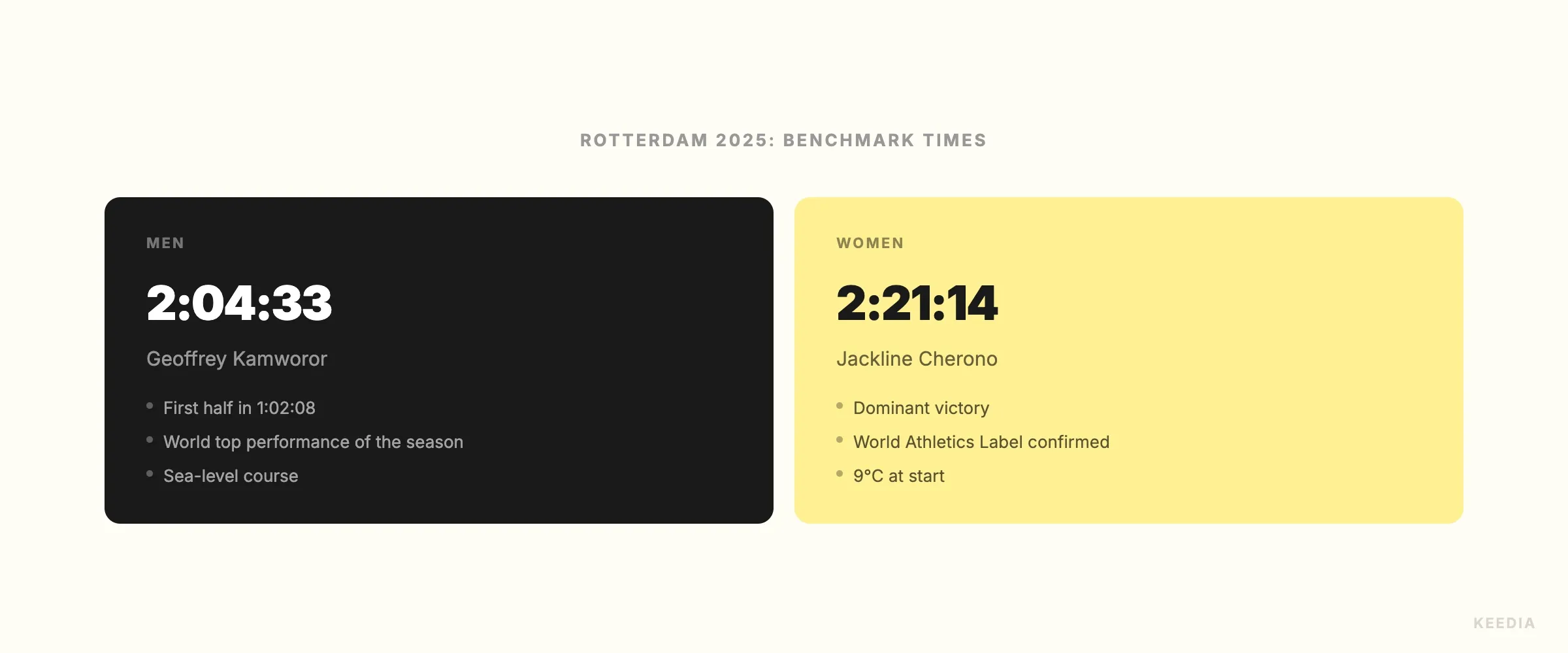
Geoffrey Kamworor won the 2025 men's race in 2:04:33. That time ranks among the fastest ever recorded on Dutch soil and reflects what this course is capable of producing when elite athletes are in shape. Kamworor, a multiple world cross-country champion, has the aerobic base and tactical discipline to exploit a flat course fully, and Rotterdam gave him exactly the platform to do it.
On the women's side, Jackline Cherono crossed the line in 2:21:14. That performance placed Rotterdam firmly in the conversation for top-tier women's marathon racing. Cherono's time reflects the same pattern: a flat course, consistent pacing, and cooperative weather producing a result that would have been competitive at nearly any major race in the world that year.
These performances set the unofficial targets for 2026. The elite field announcement for next Sunday's race is expected this week. What's already clear is that race organizers have historically used 2025 results as leverage to attract depth in the following year's field, so expect competitive pacing from the front groups through the first half.
Rotterdam as a Championship Qualifier
For mid-pack elites and high-level age-group runners, Rotterdam carries weight beyond the time on the clock. The race serves as a qualification opportunity for the 2026 European Athletics Championships and World Athletics Championships for runners from several European nations. That changes the race dynamic in a specific and useful way.
When a significant portion of the faster competitive field is chasing qualification standards rather than just finishing times, the early pacing groups tend to be disciplined and steady. Athletes on qualification missions don't go out too fast. They run the tangents properly. They draft efficiently. If you're chasing a personal best, positioning yourself near a qualification-focused group in the first 30 kilometers can be tactically smart, provided you've done the homework on their target pace.
This is a different race culture from something like Boston Marathon 2026, where the course profile, the history, and the crowd dynamic push runners toward an emotional rather than purely tactical experience. Rotterdam is a time race. Everyone on the start line knows it.
Final Week Taper Protocol
If your peak training weeks were hitting 70 to 90 kilometers, you should be at 35 to 45 kilometers this week. Cutting weekly mileage to 40 to 50 percent of peak volume is standard taper practice backed by consistent evidence across endurance sports. The goal isn't to lose fitness. It's to let your neuromuscular system recover from accumulated fatigue so that power output per stride is maximized on race day.
Keep two short quality sessions in the week, but don't make them hard. One session of 15 to 20 minutes at marathon goal pace on Monday or Tuesday is enough to keep your legs calibrated. A short stride session on Thursday, nothing longer than 10 x 100 meters, reminds your legs what turnover feels like. After Thursday, easy running or rest only.
Sleep is where most runners leave performance on the table in taper week. Your body's hormonal repair processes are most active during deep sleep, and insufficient sleep in the 48 to 72 hours before a race has measurable negative effects on pace maintenance in the later kilometers. Research on magnesium supplementation for athletes shows meaningful improvements in sleep quality and recovery markers. If you're not already using it, starting the night before a race isn't the time to experiment. But if it's already in your protocol, keep it consistent through Saturday night.
Carbohydrate loading should begin Thursday evening, not Saturday. You're aiming to top off muscle glycogen stores over two to three days rather than stuffing one large pasta meal the night before. Target 8 to 10 grams of carbohydrate per kilogram of body weight daily from Thursday through Saturday, with low fiber and low fat options to keep gut load manageable. On Friday, if you're considering a caffeine reset to maximize race-day sensitivity, the strategy outlined in how to restore your caffeine sensitivity is worth reviewing, though at this stage you're better off maintaining your current protocol than disrupting it.
The taper also applies to your deload mindset. If you want a deeper look at what the evidence actually says about managing volume reduction without losing fitness, the research on deload protocols is a useful reference for post-race planning when you're building toward the next block.
Race-Day Conditions: What to Expect April 12
Check the 72-hour forecast Thursday morning. That window is when meteorological accuracy becomes reliable enough to make gear decisions. Rotterdam's April climate sits between 8 and 12°C on average, with low humidity and manageable wind. These are close to ideal conditions for distance running. The physiological sweet spot for marathon performance in trained runners falls in the 6 to 10°C range, so you're likely to race in friendly weather.
Plan for layers at the start and nothing by kilometer 5. A disposable jacket or old long-sleeve layer at the start corrals costs almost nothing and means you're not shivering for 20 minutes before the gun goes off while trying to stay warm. If the forecast shows wind above 20 kilometers per hour, adjust your pacing expectations modestly for exposed sections of the course, particularly along the waterfront portions in the second half.
Rain is possible in April. Race in kit you've tested in wet conditions. Wet shoes that you've never trained in are a blister risk over 42 kilometers. Your race-day kit should have zero surprises.
Nutrition on Race Morning
Eat two to three hours before your wave start. A carbohydrate-dominant meal of 80 to 120 grams of carbs with moderate protein and low fat is the standard approach. Oatmeal, white rice with banana, toast with peanut butter, or a bagel with jam all work. What doesn't work is experimenting with something new because you read about it this week.
Caffeine 45 to 60 minutes before the start, at a dose of 3 to 6 milligrams per kilogram of body weight, has consistent performance evidence behind it. At marathon intensity, it blunts perceived effort and helps maintain pace in the final 10 kilometers, which is where Rotterdam races are usually won and lost.
Plan your gel or fuel strategy around one unit every 30 to 45 minutes from kilometer 15 onward. Rotterdam has aid stations with water and sports drink at regular intervals. Know the course and match your intake timing to the station locations rather than guessing mid-race.
The Rotterdam Runner Profile
What makes Rotterdam distinct in the global marathon calendar isn't just the course. It's who shows up and why. The race draws a high concentration of time-focused runners: athletes who have structured months of training around a specific finishing time, who have analyzed their threshold and lactate data, and who are running Rotterdam because it gives them the best possible environment to execute.
That's a different population from trail ultramarathon participants or obstacle course athletes. If you're interested in how fitness disciplines compare and overlap, the HYROX World Championships 2026 in Stockholm represent the other end of the competitive fitness spectrum for that same European spring window.
Rotterdam is for the runner who wants to know exactly how fast they can go when conditions are optimal. April 12 is your answer.
Key Race Details at a Glance
- Date: April 12, 2026
- Location: Rotterdam, Netherlands (sea level)
- Course profile: Flat, under 40m total elevation gain
- Classification: World Athletics Label Road Race
- 2025 men's winner: Geoffrey Kamworor, 2:04:33
- 2025 women's winner: Jackline Cherono, 2:21:14
- Historical April temperature: 8 to 12°C
- Championship role: Qualifier for 2026 European and World Athletics Championships
- Ideal for: Personal best attempts, sub-3:00 targets, mid-pack elites