
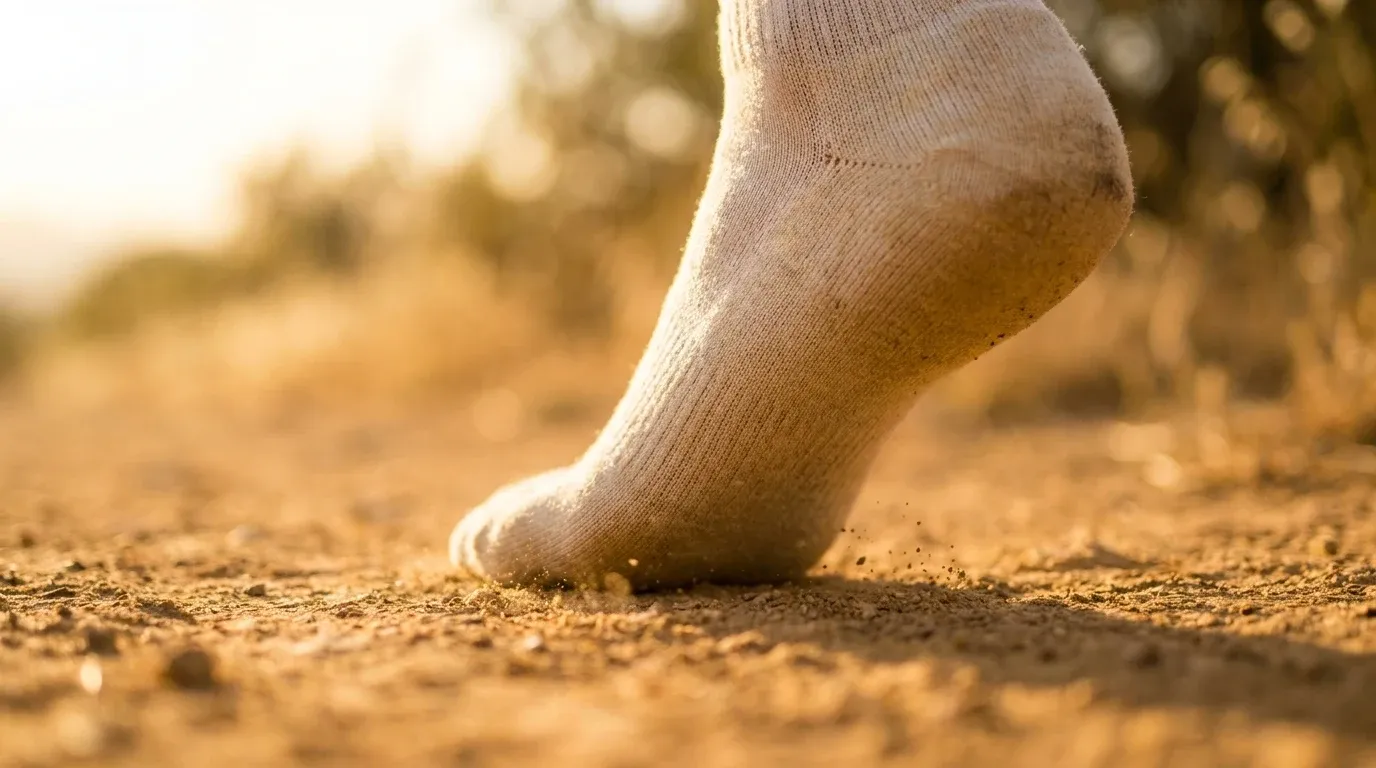
Most runners will spend hours researching their next pair of shoes. Stack height, heel drop, carbon plates, foam compounds. They'll read reviews, visit specialty stores, and spend $150 to $250 without hesitation. Then they'll grab a three-pack of generic athletic socks at the checkout counter and never think about it again.
That's a mistake. The interface between your foot and your sock is where blister formation actually begins. And the science behind preventing it is more specific, and more interesting, than most brands want you to know.
Why Blisters Form in the First Place
A blister is a friction injury. Repeated mechanical stress separates the upper layers of skin, and fluid fills the gap as a protective response. But the key variable isn't how hard your foot hits the ground. It's how much the skin moves relative to the material pressing against it.
Moisture is the accelerant. Research consistently shows that wet skin has a significantly higher coefficient of friction than dry skin. When your foot sweats inside a sock, the outer skin layer softens and becomes more susceptible to shear forces. A sock that keeps moisture away from the skin surface doesn't just feel better. It physically reduces the mechanical conditions required for a blister to form.
This is why moisture management is the primary mechanism behind blister prevention, not cushioning thickness. A thicker sock may feel more comfortable on a short run, but if it traps heat and moisture against your skin, it's working against you over anything longer than 45 minutes.
The Two Features That Actually Matter
Strip away the marketing language and two sock features have the strongest evidence for reducing friction-related blisters: fiber blend and seam placement.
Fiber blend determines how well a sock wicks moisture away from the skin and how quickly it dries. Merino wool and synthetic fibers like polyester, nylon, and CoolMax-type blends consistently outperform standard cotton in moisture transport. Cotton absorbs sweat and holds it against the skin. That retained moisture is exactly what accelerates blister formation. Even a small percentage of cotton in a running sock is enough to degrade its moisture management performance under sustained effort.
Merino wool has the added advantage of temperature regulation and natural moisture-wicking properties, which is why it performs well across a range of conditions. Synthetic blends tend to dry faster and are often more durable through repeated washing. Both are valid choices. Cotton is not.
Seam placement matters because any seam creates a ridge that presses against the skin during repetitive motion. Traditional toe seams positioned across the top of the toes have been linked to blisters and irritation on longer runs, particularly on the tops and tips of toes. Seamless construction or seams that are moved to the back of the toe box significantly reduce this point of friction. If you're training for a half marathon or beyond, this detail alone can change how your feet feel at mile 10.
Double-Layer Construction: The Physics Behind the Design
One of the more credible innovations in running sock design is the double-layer sock. The concept is straightforward: two thin layers of material sit between your foot and your shoe, and when shear forces are applied during running, those layers move against each other rather than against your skin.
This is a genuine physiological insight, not a marketing invention. The friction that causes blisters has to go somewhere. In a single-layer sock, it's absorbed entirely at the skin-fabric interface. In a double-layer design, that friction is distributed between two fabric layers, sparing the skin. Studies measuring blister incidence in military recruits, ultramarathon runners, and general athletic populations have found meaningful reductions in blister rates when double-layer socks were used compared to standard single-layer alternatives.
The tradeoff is weight and warmth. Double-layer socks run slightly heavier and can feel warmer, which matters in summer training or in hot race conditions. If you're running high-intensity summer sessions to build speed for fall races, a lighter single-layer sock with excellent wicking might actually serve you better on short, fast workouts, while a double-layer option is better reserved for long runs and race day.
What the Premium Price Tag Is Actually Paying For
Running socks now range from around $5 a pair to $30 or more. The higher end of that market is full of features that sound compelling but have limited impact on whether you finish your run without blisters.
Antimicrobial treatments are a good example. Silver-infused fibers and similar technologies genuinely reduce odor-causing bacteria over time, and they can extend the wearable life of a sock between washes. That's a real benefit. But antimicrobial properties have no meaningful effect on acute blister formation during a single run. If you're buying a $28 sock primarily because it's antimicrobial, you're paying for long-term foot hygiene, not blister prevention.
Arch compression panels are another common premium feature. The evidence that arch compression in socks specifically reduces blisters is thin. It may improve proprioception or reduce sock bunching for some runners, but it's not a reliable blister prevention mechanism across the board.
Targeted cushioning zones, particularly around the heel and forefoot, can improve comfort and reduce impact fatigue on long runs. But as with overall cushioning thickness, more padding doesn't automatically mean fewer blisters. It can, in fact, mean more heat and moisture retention if the cushioning fibers don't wick effectively.
How to Actually Choose a Sock That Works
Here's a practical framework for evaluating running socks without getting lost in the feature list:
- Check the fiber content first. Look for merino wool, polyester, nylon, or specialty synthetic blends. Any significant cotton content is a disqualifier for long-run use.
- Look at the toe seam. Seamless construction or seams placed at the back of the toe box are preferable to traditional cross-toe seams, especially if you're prone to blisters on your toes.
- Consider double-layer construction for races and long runs. Single-layer is fine for short training runs where breathability is the priority.
- Match sock weight to your training environment. Lightweight socks for hot weather and high-intensity sessions. Midweight for cooler conditions and long distances where some cushioning adds value.
- Don't ignore fit. A sock that bunches, slips, or is too loose creates its own friction points. The sock should fit snugly across the arch and sit flat against the foot with no excess material.
It's also worth rotating your socks the same way serious runners rotate their shoes. Elastic and fiber structure degrade with repeated use and washing. A sock that performed well when new may no longer manage moisture or maintain its fit after 80 or 100 washes. Replacing socks regularly is a lower-cost intervention than most people expect, given that even quality pairs typically fall in the $12 to $22 range.
The Lubricant Question
Some runners use anti-chafe balms or petroleum-based lubricants on high-friction areas in addition to quality socks. This is worth mentioning because it works. Lubricants reduce friction directly at the skin level and can be particularly useful during ultramarathon-length efforts or in wet racing conditions where even the best sock eventually becomes saturated.
For most runners logging under 20 miles on a given day, a well-chosen sock should be sufficient. But in trail events, where conditions can change dramatically over the course of a race, combining quality socks with targeted lubrication on known problem areas is a reasonable strategy.
The Bottom Line on Sock Science
The blister prevention hierarchy is clearer than most brands want to admit. Moisture management comes first. After that, seam placement and fiber blend are your two highest-leverage variables. Double-layer construction offers real protection for longer efforts. Everything else, the antimicrobial treatments, the compression panels, the branded foam inserts, is either a comfort feature, a longevity feature, or a marketing feature.
Your shoes matter. But your socks are the last line of defense between your foot and the conditions that cause blisters. Treating them as an afterthought is the most common, and most fixable, mistake recreational runners make.
If you're building toward a goal race this fall, dialing in your sock choice is one of the lowest-cost, highest-return adjustments you can make. The elites competing at events like the Angkor Empire Marathon don't leave foot care to chance. There's no reason you should either.