
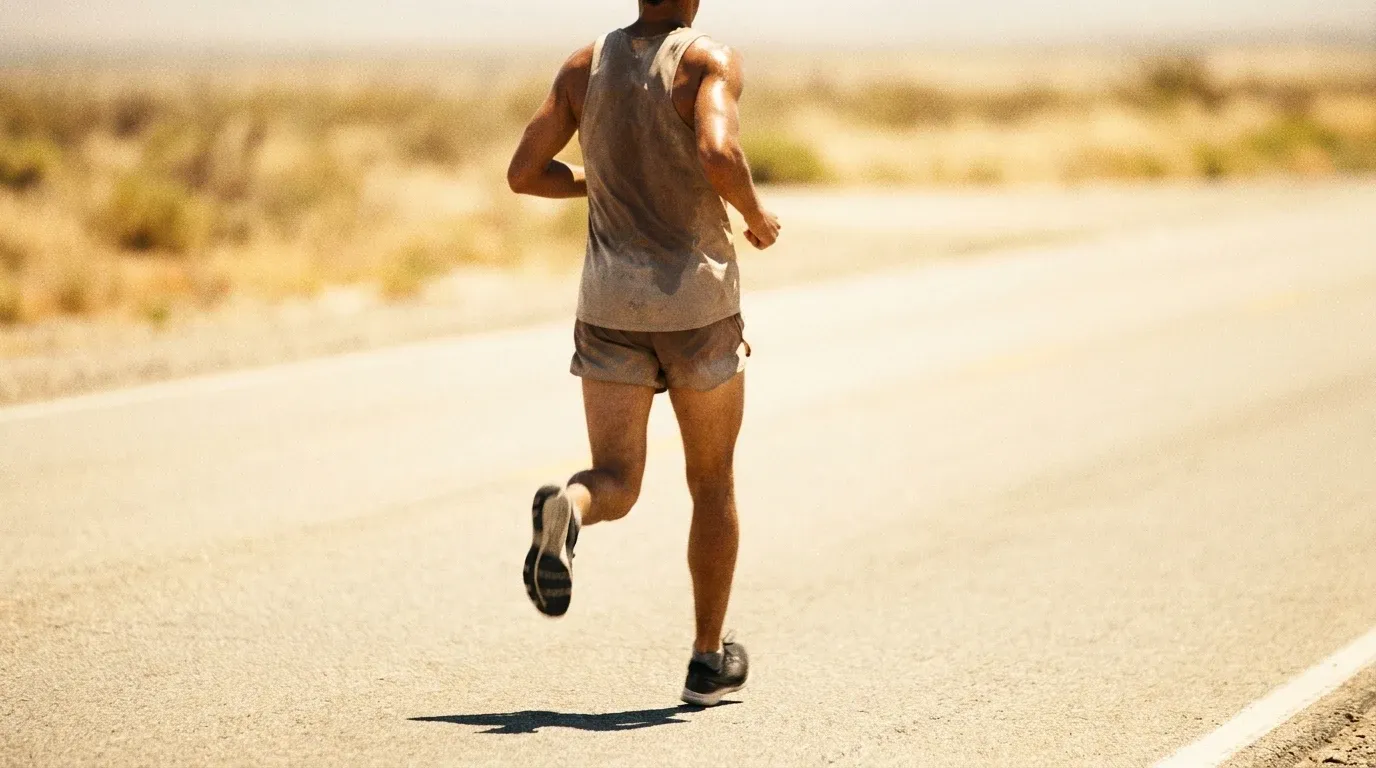
Every summer, the same advice circulates: run early in the morning, stay hydrated, go slower. That's not wrong. But it's not enough to understand what's actually happening and adapt your training intelligently.
Here's what the physiology of exercise in heat actually explains.
What happens in your body in the heat
When temperature rises, your body faces two simultaneous demands: fuel your working muscles AND dissipate the heat produced by that effort. Sweating is the primary cooling mechanism — but it comes at a cost in blood volume.
Result: your heart has to work harder to deliver oxygen to muscles AND maintain blood flow to skin for sweating. This is called cardiac drift — your heart rate rises progressively during sustained effort at constant pace, because stroke volume decreases with dehydration.
In practice: at 86°F (30°C), your heart rate may be 10-15 bpm higher than at 65°F (18°C) for the same pace. If you're training in heart rate zone 2, you're actually running slower than in cool conditions.
Performance loss in heat
Studies on trained runners confirm performance losses of 10-15% compared to optimal conditions (64-68°F / 18-20°C) when temperatures exceed 77-82°F (25-28°C) with moderate humidity. Above 86°F (30°C) with high humidity, losses can reach 20%.
That number says one clear thing: if you run a 10K in 45:00 in cool conditions, expecting 50:00+ in the heat isn't weakness. It's physiology.
Heat acclimatization: the adaptation that changes everything
The good news: your body adapts to heat — and quickly. Heat acclimatization takes 10 to 14 days of progressive exposure. During this period:
- Plasma volume increases (more blood available)
- Sweating begins earlier and is more efficient
- Heart rate at equivalent effort decreases
- Perceived effort at the same intensity improves
These adaptations are durable (4-6 weeks) and transfer to cool conditions too — athletes who regularly train in heat often have better overall aerobic capacity.
How to acclimatize: 30-60 minutes of moderate effort per day during the hot hours, for 10-14 consecutive days. No need to run fast — heat exposure is what drives the adaptation.
Hydration: the real recommendations
The general recommendation of 400-800ml/hour covers most situations. But individual variation is wide: sweat rate can range from 0.5 to 2.5 L/hour depending on body size, intensity, heat, and humidity.
For runs over 60 minutes in the heat, adding electrolytes (primarily sodium) prevents hyponatremia — a dangerous blood sodium dilution that can occur from drinking large amounts of plain water.
RPE over pace
In summer, the most practical advice is to train by perceived effort (RPE) rather than pace or heart rate. If you run at "comfortable moderate effort" (RPE 4-5/10), your body adapts to conditions without overloading thermoregulation mechanisms.
Let the pace go. Use the hot months to build your aerobic base ahead of fall races. When temperatures drop in the fall, you'll see the difference in your times.
Sources: Runner's World — NCBI / Physiology Research