
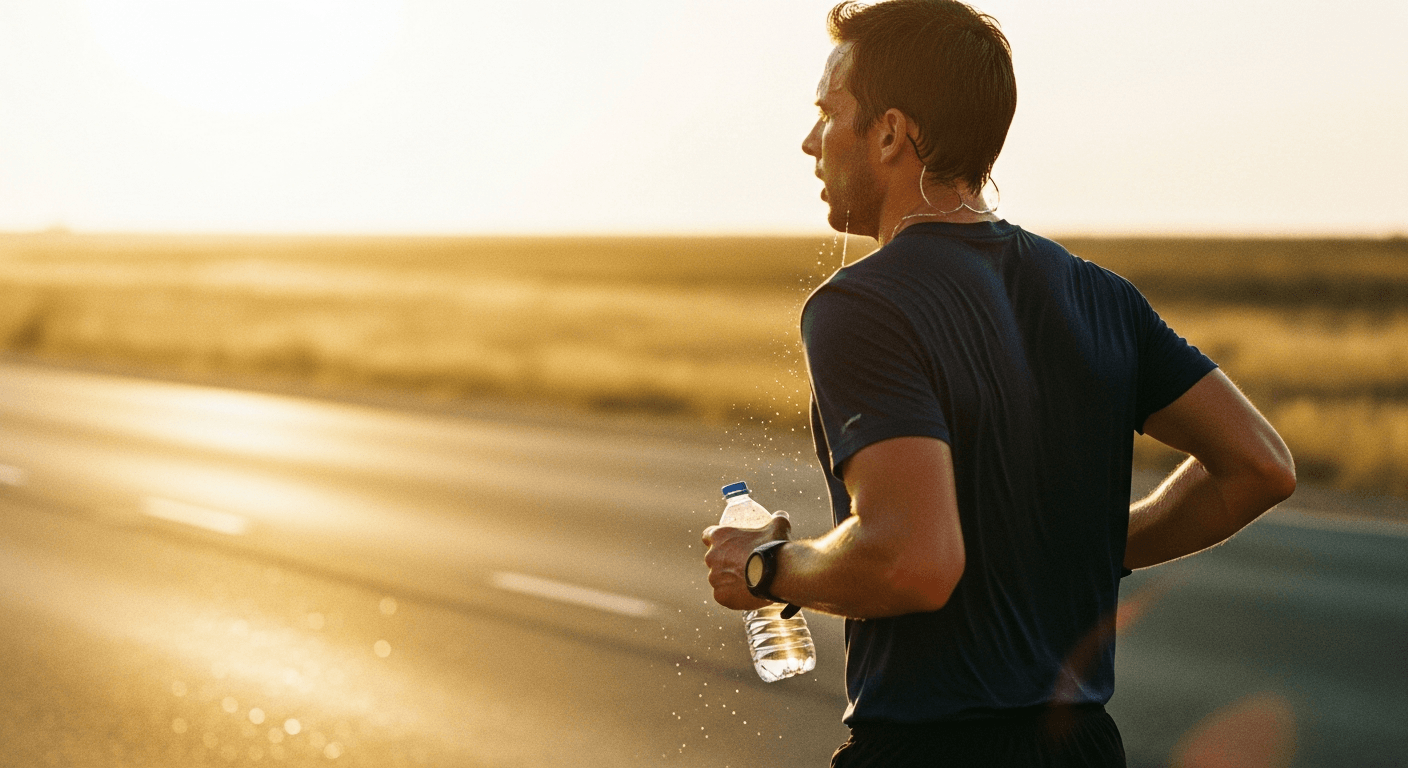
Today, thousands of runners are toeing start lines at summer races across the country — including the famous Foot Traffic Flat Marathon in Oregon, one of the most popular July 4th races. And many of them are going to suffer more than expected. Running in heat isn't just uncomfortable — it's physiologically different. Here's what the science says about summer running performance and how to adapt your training.
Key Takeaways
- Above 68°F (20°C), each additional degree slows running performance by roughly 1-3%
- Heat raises heart rate at the same pace — the same perceived effort requires more energy output
- Heat acclimatization takes 10-14 days of progressive exposure
- Pre-loading hydration (before the run) is more effective than catching up during it
- Race timing matters: running at 6am vs 2pm can mean a 10°F difference in conditions
What heat does to your body during a run
Running generates heat. In cool conditions, your body dissipates it relatively easily: sweating, radiation, convection. In hot conditions, the external heat load makes dissipation harder, and your body has to work harder to maintain stable core temperature.
Direct consequences:
- Higher heart rate at the same pace. A 8-minute mile in 60°F might demand 150 bpm. The same pace in 85°F might demand 165-170 bpm — a meaningfully higher effort level.
- Earlier fatigue onset. Heat exhaustion begins when core temperature exceeds roughly 104°F. That margin shrinks when external temperatures are high.
- Higher sweat rate, meaning greater fluid and electrolyte losses. On a 60-minute summer run, losses can reach 1-2 liters depending on size and intensity.
Adjusting your paces and expectations
The first rule of summer running: abandon your cool-weather reference paces. A runner who holds 7-minute miles at 60°F will likely run 7:30-8-minute miles at 85-90°F at the same perceived effort. That's not regression — it's physiology.
Two practical approaches:
- Run at constant RPE (perceived effort), not constant pace. If you're at a 6/10 effort, accept that pace will be slower. Heart rate monitors help calibrate this.
- Reduce volume or intensity on the hottest days. At 95°F, cutting your usual long run by 30-40% isn't laziness — thermal load counts as training stress in its own right.
86°F (-20 to -30 sec/mile, +14 oz/hr) -->
Heat acclimatization: the process worth understanding
If you know you're racing in heat, prior acclimatization is the most powerful lever. The body adapts to heat in 10-14 days of progressive exposure: increased plasma volume, improved sweating capacity, lower heart rate at equivalent effort.
How to acclimatize:
- Run at the hottest time of day for 10-14 days before your race
- Start with short, low-intensity sessions and build gradually
- Or, if weather won't cooperate: wearing a heat vest during indoor sessions (sauna-running technique) exposes your body to heat without the outdoor conditions
Hydration: the pre-loading strategy
Waiting until you're thirsty to drink is a bad strategy in heat. Thirst appears after dehydration has already begun — at that point, performance is already affected.
Pre-loading: drinking 16-17 oz of water or an electrolyte drink in the 2 hours before running is more effective than trying to catch up during the effort. During the run, target 7-10 oz every 20 minutes depending on conditions and intensity. After: rehydrate with electrolytes (sodium especially) to replace salt losses from sweat.