
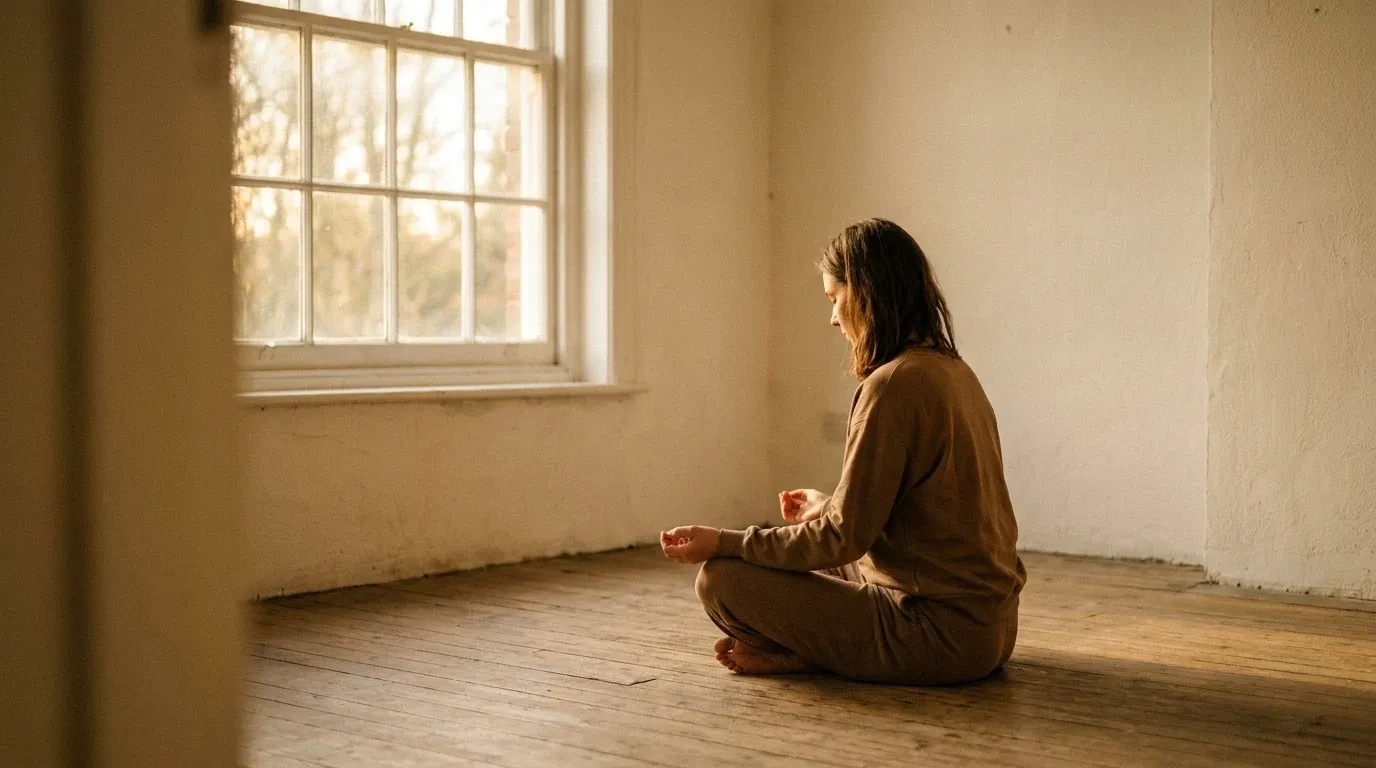
You probably don't have 45 minutes for a meditation retreat today. You might not even have 10. But research now suggests you don't need either. A growing body of neuroscience points to something far more accessible: a deliberate, structured pause of under two minutes that measurably shifts your nervous system out of threat mode and toward recovery.
This isn't motivational language. It's physiology. And understanding the mechanism behind it changes how you think about stress relief entirely.
The Problem With How Most People Handle Stress
When stress builds, the instinct is usually to do something. Go for a run. Put on a podcast. Scroll until the feeling softens. These aren't bad choices, but they share a common feature: they layer new stimulation on top of an already activated nervous system. In some contexts, that works. In others, it delays the actual reset your body needs.
Exercise, for example, is one of the most well-documented stress buffers available. But it works partly by creating a controlled physical stressor that your system then recovers from. That recovery window is where the nervous system recalibration actually happens. Not during the effort itself.
The same logic applies to your daily stress load. The effort isn't the release valve. The structured pause is.
What Neuroscience Actually Found
Research published in the last decade has repeatedly identified brief, intentional stillness practices as capable of producing measurable physiological change. Studies using controlled breathing protocols of 60 to 90 seconds have recorded reductions in self-reported stress, lower cortisol responses, and shifts in heart rate variability that indicate parasympathetic activation. Two minutes is not an arbitrary number. It appears to be roughly the minimum threshold at which the autonomic nervous system begins to respond in a consistent, repeatable way.
The specific mechanism involves the vagus nerve, which runs from the brainstem through the chest and abdomen and acts as the primary communication line between your brain and your body. Slow, controlled breathing, particularly exhales that are longer than inhales, directly stimulates vagal tone. Higher vagal tone is associated with better emotional regulation, lower baseline cortisol, and faster recovery from acute stressors.
Importantly, this isn't passive. It's not simply sitting quietly and hoping for the best. The practice requires deliberate control of breath rate and pattern, which is what distinguishes it from distraction or rest. Your brain is doing something specific. That specificity is what produces the result.
This is also why understanding how your body signals stress before your brain does matters so much. By the time you consciously register tension, your nervous system has already been in a stress response for longer than you realize. The sooner you intervene with a structured reset, the less compounding damage accumulates.
The Parasympathetic Advantage
Your autonomic nervous system runs two competing branches: the sympathetic, which governs fight-or-flight responses, and the parasympathetic, which governs rest, digestion, and recovery. Chronic stress keeps the sympathetic branch overactive, which means your cortisol stays elevated, your digestion is impaired, your sleep quality drops, and your capacity to think clearly narrows.
Short deliberate stillness practices work because they give the parasympathetic branch a direct on-ramp. You're not waiting for it to activate on its own. You're intentionally creating the physiological conditions that make activation possible.
This is a meaningfully different mechanism from distraction-based stress relief. When you watch a video or go for a walk without any breathing structure, you might feel better, but your cortisol and heart rate variability may not shift significantly. The nervous system hasn't been given a signal. It's simply been occupied elsewhere.
This distinction also explains why people who exercise regularly still report chronic stress. Recovery habits matter independently of training volume, especially as you get older and your body's stress tolerance and hormonal recovery capacity changes. Exercise is not a substitute for deliberate parasympathetic activation. Both serve different functions.
The Protocol: What Two Minutes Actually Looks Like
There's no single gold-standard protocol, but the most consistently studied approach involves controlled breath ratios. The most accessible version for beginners is a 4-7-8 pattern: inhale for four counts, hold for seven, exhale for eight. The extended exhale is the critical variable. It's the outbreath that drives vagal stimulation, not the inhale.
An alternative that many people find easier to sustain is box breathing: four counts in, four counts hold, four counts out, four counts hold. This creates a rhythm without requiring breath-hold capacity and can be performed discreetly at a desk or in a car before a meeting.
The practice works best when:
- You're seated or lying with your spine relatively neutral
- You're not multitasking or checking a screen during the two minutes
- You practice at the same point in your day, which helps the nervous system learn to anticipate and enter the state faster over time
- You allow a brief moment of non-stimulation after the breathing cycle ends, rather than immediately returning to activity
That last point matters more than it sounds. Research on mindfulness-based interventions consistently shows that the transition out of the practice, not just the practice itself, is where consolidation happens. Rushing back into stimulus before the nervous system has settled partially negates the effect.
Who This Is For (And Why the Barrier Matters)
The reason two-minute stress resets get attention in neuroscience isn't just efficacy. It's the friction-to-benefit ratio. Longer practices have higher abandonment rates. Apps with gamified streaks create their own performance anxiety. The two-minute protocol sidesteps all of that.
For desk workers whose stress accumulates across a day of back-to-back calls and shallow breathing, this is a tool that fits between meetings. For athletes in taper weeks, when training volume drops and anxiety often spikes without a physical outlet, this offers a structured way to manage that nervous system surplus. For anyone whose sleep has been degrading without an obvious cause, it's worth knowing that sleep quality and the conditions that enable it are shaped heavily by pre-sleep cortisol levels. A two-minute reset before bed isn't a sleep hack. It's basic nervous system hygiene.
The population this benefits most is anyone whose stress compounds without a structured release valve. That includes high performers who believe they're handling pressure well because they're still functional. Functional and regulated are not the same thing. You can maintain output while your baseline cortisol and inflammatory markers quietly climb, and most people do exactly that until something forces a recalibration.
Building the Habit Without Overcomplicating It
The evidence on behavior change suggests that attaching a new micro-habit to an existing anchor behavior significantly improves consistency. You don't need a dedicated time block. You need a trigger. Three practical anchors that work well:
- Before your first meal of the day. Sit for two minutes before you eat. Don't check your phone. Use a breath ratio and let your system settle before it meets the stimulus of the morning.
- At the transition between work and personal time. The commute, the walk from home office to kitchen, the moment you close your laptop. Two minutes before you cross that threshold helps prevent stress from bleeding between contexts.
- Before sleep, not in bed. Doing this in a chair or on the floor first creates a physiological cue that the body learns to recognize. When you then move to your bed, the association is sleep, not practice.
None of these require apps, subscriptions, or gear. That simplicity is a feature, not an oversight.
The Bigger Picture
Stress management is often framed as a lifestyle category, something you invest in with the right tools or routines. But the neuroscience here points toward something more fundamental. Your nervous system has a built-in reset mechanism. It's not broken. It's just chronically under-activated in modern daily life because almost nothing in that environment gives it the signal it's looking for.
Two deliberate, screen-free, distraction-free minutes of controlled breathing provide that signal. Reliably. Without equipment, without expertise, and without carving time out of a schedule that has none to spare.
It's also worth understanding the downstream effects. Chronic stress is one of the most significant suppressors of sleep architecture. If you're not getting deep, restorative sleep, the research on REM sleep's role in reducing disease risk should give you serious motivation to treat your stress load as a medical variable, not a personality trait.
You don't have to overhaul your schedule. You have to give your nervous system two minutes to remember what calm feels like. The evidence says that's enough to start.