
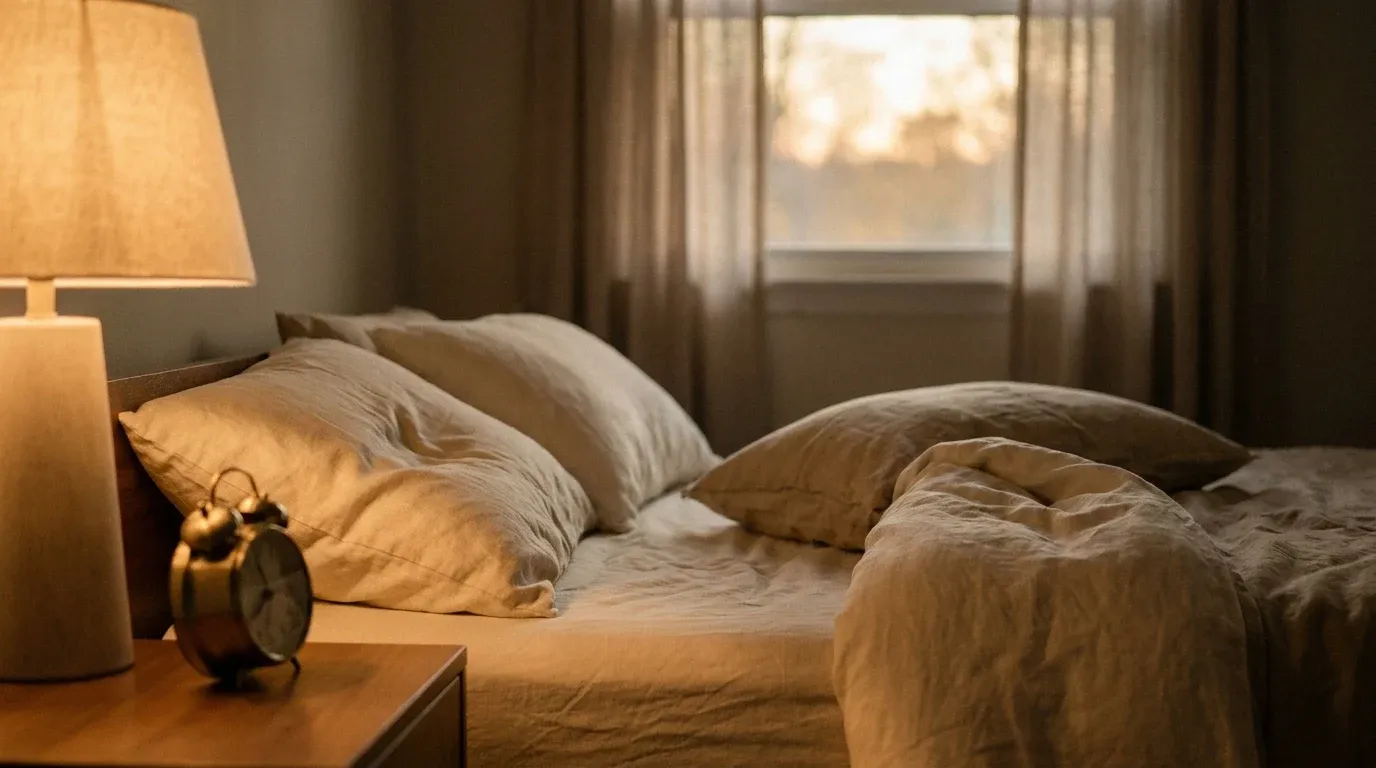
You got seven or eight hours last night. Your tracker confirmed it. So why do you feel like you barely slept at all? A new study from Penn State offers a precise and uncomfortable answer: the number of hours you sleep is only part of the story. What's happening inside your bedroom while you sleep matters just as much, and for most people, it's silently working against them.
The research, published in Sleep Health, followed 372 young adults and measured how light exposure, temperature, and noise in the bedroom affected sleep outcomes. The findings reframe what "good sleep" actually means, and they point to fixes that cost nothing and can be made tonight.
What the Study Actually Found
Researchers tracked participants over multiple nights, correlating objective bedroom conditions with both physiological sleep data and self-reported sleep quality. The results were consistent: bedrooms that were too bright, too warm, or too noisy pushed back sleep onset, increased the number of nighttime awakenings, and left people rating their sleep as significantly worse.
The critical detail is what the study did not find. Total sleep duration was not meaningfully reduced. Participants in poor sleep environments still clocked roughly the same number of hours as those in better conditions. That distinction matters enormously, because it means millions of people are getting a false green light from their sleep trackers every morning.
Standard consumer wearables, whether a smartwatch or a ring, primarily report total sleep time. If that number looks acceptable, most people assume their sleep is fine. This study shows that assumption is wrong. Sleep architecture, the sequence and quality of sleep stages, can be disrupted even when the total duration appears normal.
Why Your Tracker Is Missing the Problem
Sleep quality and sleep quantity are not the same thing. Deep sleep and REM sleep, the stages most responsible for physical recovery, memory consolidation, and emotional regulation, are particularly vulnerable to environmental disturbance. A bedroom that's too warm can suppress slow-wave sleep. Intermittent noise triggers brief arousals, many of which you won't consciously remember, but which interrupt the continuity of restorative sleep stages. Light exposure, even at low levels, suppresses melatonin production and delays the onset of sleep.
The result is a night that looks complete on paper but functions like a night of fragmented, shallow rest. You wake up with a full hours-of-sleep count and genuine fatigue. You assume the problem is stress, diet, or fitness. You're looking in the wrong place.
It's worth noting that sleep disorders can compound these issues significantly. If you've addressed your bedroom environment and still wake up exhausted, it may be worth exploring whether something more structural is at play. Sleep apnea treatment is becoming increasingly personalized in 2026, and newer diagnostic options make it easier than ever to rule out underlying conditions.
The Three Bedroom Variables That Matter Most
The Penn State study organized its findings around three primary environmental factors. Each one is modifiable. None require expensive equipment.
Light
Light is the most powerful external regulator of your circadian rhythm. Your brain interprets light exposure as a signal to stay awake. Even low-level ambient light from streetlamps, electronic standby indicators, or a partially open curtain can delay melatonin onset and reduce sleep depth.
The fix is straightforward: make your bedroom as dark as you can get it. Blackout curtains are the most effective single purchase, typically available for $20 to $60 for a standard window. If curtains aren't an option, a sleep mask achieves the same result. Cover any device indicator lights with electrical tape. The goal is near-total darkness from the moment you intend to fall asleep.
Temperature
Core body temperature naturally drops as part of the sleep initiation process. A bedroom that's too warm interferes with that process. Research consistently identifies a bedroom temperature between 65 and 68 degrees Fahrenheit (18 to 20 Celsius) as the range most conducive to sleep onset and maintenance.
If you can't control the thermostat, there are practical alternatives. A fan improves airflow and lowers perceived temperature. Switching to lightweight, breathable bedding, particularly natural fibers like cotton or linen, reduces heat retention without requiring any change to room temperature. If you run hot, cooling mattress pads are available from around $80 and make a measurable difference.
Noise
Noise disrupts sleep even below the threshold of conscious awareness. Traffic, a partner's movement, plumbing, or neighborhood sounds can trigger micro-arousals that fragment sleep architecture without fully waking you. The issue isn't just loud noise. It's variable noise. Sudden changes in sound level are particularly disruptive because the brain responds to contrast, not just volume.
Masking variable noise with consistent sound is one of the most effective solutions available. White noise machines, available from around $25, produce a steady acoustic background that smooths out disruptive fluctuations. Free apps on your phone accomplish the same thing if you can silence notifications. Earplugs are free and reduce ambient noise significantly, though some people find them uncomfortable over a full night.
Why This Matters More Than Most Sleep Advice
Most sleep guidance focuses on behavior: stop using your phone before bed, cut caffeine after noon, keep a consistent schedule. That advice is valid. But behavioral changes require sustained effort and habit formation over weeks. Environmental changes are immediate. You adjust your curtains tonight and the benefit starts tonight.
That's why the researchers framed environmental factors as one of the highest-leverage interventions in sleep health. The modifications are free or nearly free, the effect is immediate, and the barrier to action is low. There's no supplement to take, no program to follow, no gradual adaptation period.
This also connects to a broader point about how environment interacts with recovery. Exercise is another variable with a strong and often underappreciated connection to sleep architecture. Research shows that as little as ten minutes of daily exercise can meaningfully improve sleep depth, particularly the slow-wave stages that environmental disturbances tend to suppress. Combining better bedroom conditions with regular movement creates a compounding effect on recovery quality.
For older adults, this is especially relevant. Sleep architecture changes with age, with less time spent in deep sleep and greater sensitivity to environmental disruption. If you're navigating training and recovery in your later decades, understanding how your environment affects rest is a practical tool. Managing recovery effectively becomes increasingly important as you train after 30, and sleep quality sits at the center of that equation.
A Practical Checklist You Can Use Tonight
Here's what an optimized sleep environment looks like in practice. Run through this list before you go to bed and address whatever you can immediately.
- Darkness: Close or cover every light source in the room. Streetlamp bleed through curtains, device standby lights, and charging indicators all count. Use blackout curtains or a sleep mask.
- Temperature: Set your thermostat to 65 to 68 degrees Fahrenheit if possible. Use a fan for airflow if the room runs warm. Switch to breathable bedding materials.
- Sound: Identify your primary noise source. If it's variable, mask it with a white noise machine, fan, or app. If earplugs are comfortable for you, use them.
- Electronics: Phones, tablets, and televisions introduce both light and sound risk. Move them out of arm's reach. If your phone is your alarm, place it face-down and enable do-not-disturb from your bedtime onward.
- Clutter and visual stimulation: Research on stress and bedroom environments suggests that cluttered spaces elevate cortisol perception. A clear, calm physical environment supports the psychological transition into sleep. This costs nothing to improve.
The Broader Picture
Sleep science has spent years focused on duration because duration is easy to measure. Eight hours became the target, trackers were built around it, and advice followed. The Penn State study adds important nuance to that framework. Duration is necessary but not sufficient. Quality, continuity, and depth are the variables that determine how you actually feel, and all three are shaped by your environment in ways your tracker isn't capturing.
The good news is that environment is entirely within your control. You don't need a prescription, a clinical referral, or a significant financial investment. You need a darker room, a cooler room, and a quieter room. Most people can get at least two of those three in place within a single evening.
Recovery is increasingly understood as a system, not a single variable. What you eat, how you move, and how your body responds to both are interconnected. Research on diet and disease-free longevity continues to underscore that recovery quality, including sleep, is one of the primary levers for long-term health outcomes. Fixing your bedroom environment is one of the simplest, fastest, and most evidence-supported ways to move that lever in the right direction.
Your tracker may be telling you that you're sleeping fine. The Penn State data suggests you should check the room first before you believe it.