
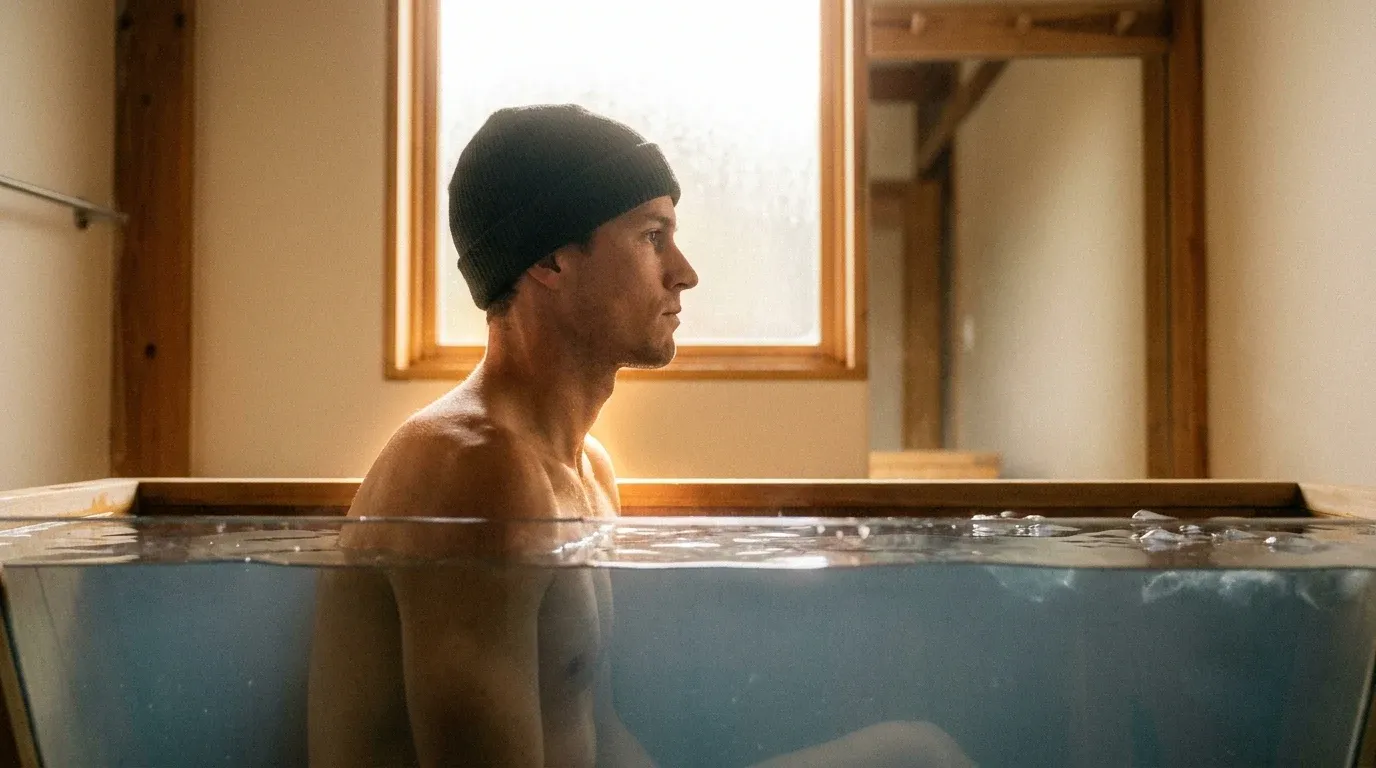
Cold-water immersion has moved from elite sports facilities to backyard tubs and gym recovery suites across the US, UK, and Australia. Athletes swear by it. Coaches debate it. And the science, for once, actually gives you something useful to work with rather than a flat "it depends."
The honest answer is that cold plunging does two things simultaneously. It genuinely reduces soreness and speeds up how quickly you feel ready to train again. It also suppresses the exact biological signals your muscles need to grow. Both of these things are true at the same time, and understanding that tension is what allows you to use cold immersion intelligently.
Why Cold Water Makes You Feel Better
When you lower your body into cold water, typically between 50°F and 59°F (10°C to 15°C), your blood vessels constrict rapidly. This vasoconstriction reduces blood flow to the muscles, which limits the inflammatory response that follows intense training. Less localized swelling means less pressure on surrounding tissues and nerve endings.
Cold also slows nerve conduction velocity. Your pain signals travel more slowly, which is why the soreness that would normally peak at 24 to 48 hours after training feels more manageable. This isn't a placebo effect. Multiple controlled trials have confirmed that cold-water immersion reduces delayed onset muscle soreness (DOMS) scores compared to passive recovery.
Sessions typically run between 10 and 20 minutes to produce meaningful effects. Shorter exposures tend to reduce core temperature without achieving the deeper tissue cooling that drives recovery benefits. Longer than 20 minutes offers diminishing returns and increases cold stress on the cardiovascular system.
The Mechanism That Complicates Everything
Here's where it gets uncomfortable for cold plunge enthusiasts. The same vasoconstriction that reduces soreness also reduces the blood flow carrying anabolic hormones and nutrients into the muscle tissue during the post-exercise window. That window matters more than most people realize.
Resistance training triggers a cascade of molecular signals, most critically through a pathway called mTOR (mechanistic target of rapamycin). mTOR activation is the primary driver of muscle protein synthesis. It responds to mechanical stress, leucine from protein intake, and the inflammatory environment that follows hard training.
When you introduce cold water immediately after a strength session, you're suppressing that inflammatory environment before it can do its job. Research published in the Journal of Physiology found that men who completed cold-water immersion after resistance training showed significantly lower rates of muscle protein synthesis over the following days compared to men who recovered passively. Satellite cell activity, which is essential for muscle fiber repair and growth, was also reduced.
A longer-term trial tracking participants over twelve weeks found that those using cold immersion regularly after strength training gained less muscle mass and less strength than the passive recovery group, despite identical training programs. The cold was blunting their adaptation.
Who Actually Benefits From Cold Plunging
The picture shifts considerably when you look at athletes whose primary goal isn't hypertrophy. Endurance athletes, team sport players, and anyone training twice a day have a different calculus. For them, reducing DOMS quickly so they can perform again at high intensity tomorrow matters more than maximizing every anabolic signal from today's session.
A rugby player who has a match on Saturday and a hard training block on Wednesday isn't trying to optimize muscle protein synthesis from Wednesday's session. They're trying to recover fast enough to compete well. Cold immersion serves that goal directly.
The same logic applies if you're managing a high training load and struggling with fatigue accumulation. Feeling less sore allows you to train with better technique and effort, which compounds over time. That's a legitimate performance benefit, even if it comes at some cost to the hypertrophy signal. Pairing smart recovery strategies with consistent training fundamentals, including avoiding the kind of 15 gym mistakes coaches say you're still making, tends to produce better outcomes than any single recovery modality alone.
Cold immersion also appears to be more useful in hot and humid climates where athletes are managing thermal load alongside mechanical fatigue. The cooling effect itself reduces cardiovascular strain and core temperature, which is a physiological benefit independent of the soreness question.
Timing Changes the Tradeoff
The most practical insight from recent research is that timing matters more than most people account for. The blunting effect on mTOR signaling is most pronounced when cold immersion follows training immediately. The anabolic signaling window is sharpest in the first two hours after a session. Disrupting it in that window appears to cause the most measurable interference with muscle adaptation.
Waiting 24 to 48 hours after a strength session before using cold immersion significantly reduces this tradeoff. By that point, the acute anabolic signaling has already done the majority of its work. What remains is primarily soreness and residual inflammation, exactly what cold water is good at addressing.
If you train strength on Monday, a cold plunge on Tuesday evening or Wednesday morning gives you the recovery benefit with a fraction of the adaptation cost. This timing approach lets you keep cold immersion in your routine without systematically undermining your strength progress.
It's also worth noting that sleep quality plays a central role in recovery that often gets overlooked when people are optimizing for modalities like cold plunging. Understanding what actually works for sleep debt recovery matters as much as any post-training protocol. The nervous system consolidates training adaptations during sleep, and no cold tub compensates for consistently poor rest.
Practical Guidelines by Goal
Here's how to apply the research based on what you're actually training for:
- If your primary goal is muscle hypertrophy: Avoid cold-water immersion in the 24 hours immediately following strength sessions. Use it on rest days or at least 24 to 48 hours post-training if you want the soreness benefits. Consider contrast therapy (alternating warm and cold) as a lower-interference alternative.
- If your primary goal is performance or sport: Cold immersion within two hours of training can be appropriate, particularly between competition days or during periods of high training density. Prioritize it after the sessions that matter least for hypertrophy and save passive recovery for sessions where adaptation is the goal.
- If you train for general fitness: The interference effect is real but relatively modest if you're not maximizing volume and progressive overload. Cold plunging is unlikely to significantly derail your progress if used a few times per week. Don't let perfect be the enemy of consistent recovery.
- If you're an endurance-focused athlete: Cold immersion fits well here. Aerobic adaptations appear to be less disrupted by cold than the mTOR-driven pathways of strength training. Research exploring what aerobic exercise does to the brain also suggests that protecting overall training continuity has cognitive benefits that compound over time.
Temperature and Duration: Getting the Protocol Right
If you've decided cold immersion is right for your goals, the protocol details matter. Water temperature between 50°F and 59°F (10°C to 15°C) hits the sweet spot for physiological effect without becoming a significant cold stress event in itself. Colder isn't necessarily better. Temperatures below 50°F increase cardiovascular demand and don't appear to meaningfully improve recovery outcomes.
Duration of 10 to 15 minutes is sufficient for most recovery purposes. Full-body immersion to at least shoulder level produces more consistent core temperature reduction than leg-only immersion, which matters for systemic fatigue but is less relevant if you're targeting localized lower-body soreness specifically.
Avoid warming up immediately with a hot shower or sauna directly after cold immersion. Rewarming too quickly reverses the vasoconstriction benefit before it can fully take effect. Allow your body to rewarm passively over 20 to 30 minutes where possible.
What Cold Immersion Won't Fix
Cold plunging has picked up a reputation as a general wellness intervention that extends far beyond recovery. Some of that reputation is warranted. Regular cold exposure does appear to support mood regulation, increase norepinephrine levels, and improve perceived energy. These are real effects worth considering.
But cold immersion doesn't replace the fundamentals. It won't fix a caloric deficit that's too aggressive for your training load. It won't substitute for the foundational movement quality that beginners often skip in their rush to add load. And it won't compensate for the kind of chronic sleep disruption that quietly undermines adaptation regardless of what recovery tools you stack on top.
Recovery is multifactorial. Cold water is one tool with a specific and relatively narrow use case. It works well within those constraints. Used outside them, it either offers modest benefit or actively works against what you're trying to build.
The Decision Framework
Ask yourself two questions before committing to cold immersion as a regular post-training practice. First: what is my primary training goal right now? If muscle growth is the answer, delay cold exposure or use it strategically on rest days. If performance and recovery speed are the answer, immediate post-training use is defensible.
Second: what does my recovery actually need? If your limiting factor is sleep quality, stress load, or inadequate nutrition, cold plunging is addressing a secondary variable while the primary ones remain unmanaged. Fix the foundation before layering in the protocol.
Cold-water immersion is neither the recovery revolution its advocates claim nor the muscle-killing mistake its critics warn against. It's a tool with real effects in both directions. Know which direction you need it to work, and use it accordingly.