
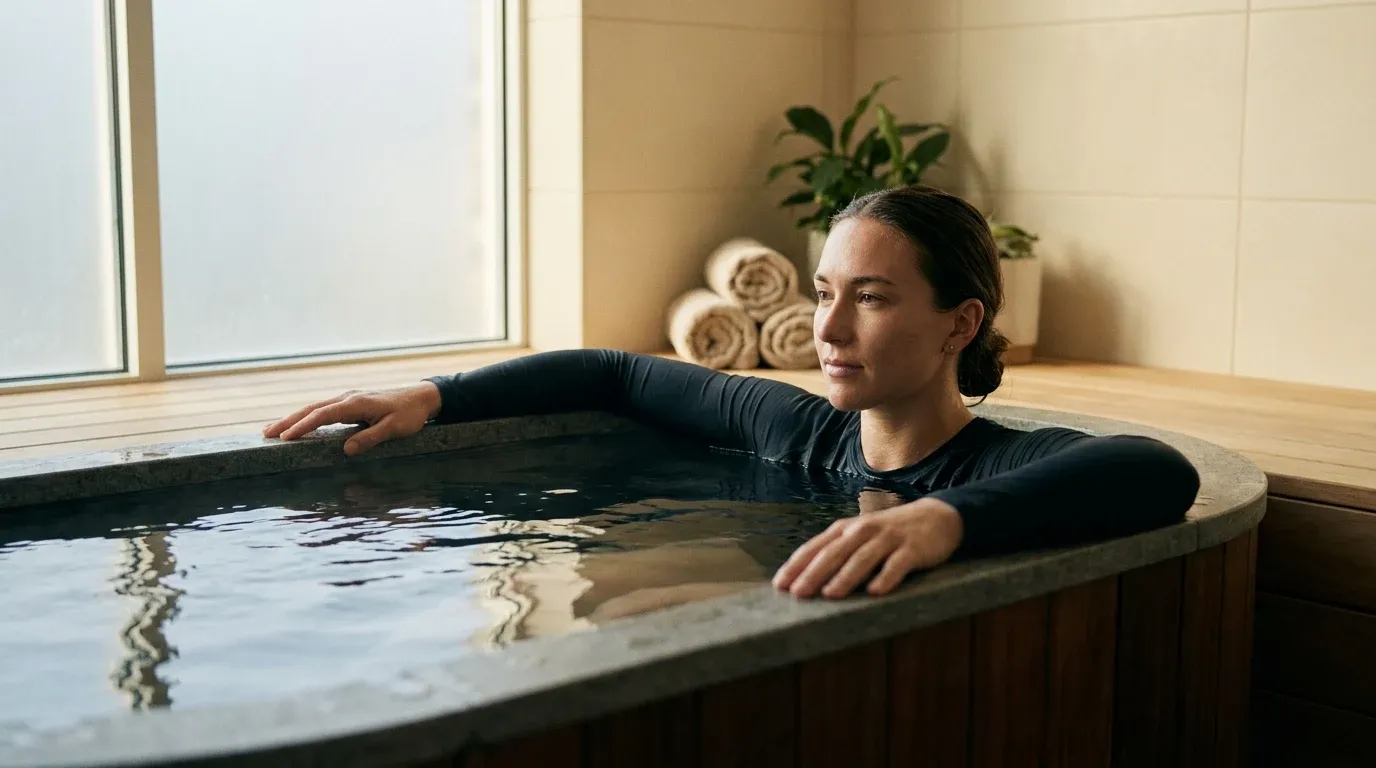
Cold plunges are everywhere right now. Influencers swear by them, gyms are installing tubs, and the wellness industry is selling the idea that submerging yourself in near-freezing water after every workout is the secret to faster recovery. Some of that enthusiasm is justified. A lot of it isn't.
September 2026 research has sharpened what we actually know about cold water immersion (CWI), and the picture is more nuanced than either the hype or the backlash suggests. Here's what the evidence says about when it works, when it gets in your way, and what it can never replace.
What Cold Water Immersion Actually Does
When you submerge in cold water, typically between 10°C and 15°C (50°F to 59°F), your body responds with vasoconstriction, a reduction in nerve conduction velocity, and a temporary blunting of the inflammatory cascade that follows intense exercise. The result: less perceived soreness, reduced swelling, and a faster subjective sense of feeling ready to go again.
The key word there is perceived. CWI reliably reduces how sore you feel. Whether it accelerates actual tissue repair at the cellular level is a separate, more complicated question. Most recent meta-analyses suggest it does modestly reduce markers of muscle damage in blood, but the effect size depends heavily on the type of training, the temperature, the duration of immersion, and how quickly you get in after exercise.
For a deeper look at how cold compression compares, Cold Compression Therapy: When It Actually Helps breaks down the differences between modalities and where each one fits.
The Best-Case Scenario: Back-to-Back Competition
Cold water immersion earns its strongest endorsement in one specific context: when you need to perform again within 24 to 48 hours and full physiological recovery isn't possible anyway.
Think of a tournament weekend, a multi-stage race, or a doubles session followed by a singles final the next morning. In those situations, the goal isn't optimal long-term adaptation. The goal is managing fatigue and soreness well enough to perform at a high level again very soon. CWI fits that job description well.
A 2026 systematic review covering endurance and team sport athletes confirmed that post-exercise cold immersion (10 to 15 minutes at 11°C to 14°C) meaningfully reduced perceived soreness and ratings of perceived exertion during subsequent sessions within 48 hours. The effect was most pronounced after high-volume, eccentric-heavy sessions like downhill running, heavy leg days, or repeated sprint protocols.
If you're a recreational athlete training four times a week with full rest days between sessions, the math changes. You probably don't need to intervene that aggressively, and doing so routinely may work against you.
When Cold Immersion Works Against You
This is where the conversation gets uncomfortable for cold-plunge enthusiasts. Muscle adaptation, specifically hypertrophy and strength gains, depends on the inflammatory signaling that happens in the hours after training. That soreness and inflammation you're trying to suppress? It's part of the process.
Satellite cell activation, protein synthesis upregulation, and the anabolic hormonal response to resistance training are all downstream of that initial inflammatory signal. Blunting it consistently with cold water may reduce the training adaptation you're working hard to earn.
A well-controlled 2025 trial, confirmed in follow-up analyses published in early 2026, found that athletes who used cold immersion after every strength session over a 12-week block gained significantly less lean mass and showed smaller increases in maximal strength compared to a control group that used active recovery. The immersion group didn't lose fitness. They just got less out of the same training volume.
If you're currently in a strength-focused block and tracking whether your volume is calibrated correctly, The Ideal Weekly Lifting Dose: 140,000-Person Study gives you a grounded benchmark for how much is enough without overdoing it.
The practical takeaway: save cold immersion for competition phases and high-volume endurance work. During dedicated strength-building cycles, consider skipping it post-lift, or at least delaying it by several hours to let the acute signaling window close.
Timing and Temperature: Getting the Details Right
If you're going to use CWI, the protocol matters. Vague advice like "take a cold shower" isn't the same thing. Here's what the current evidence supports:
- Temperature: 10°C to 15°C (50°F to 59°F). Colder isn't better. Below 10°C, you get diminishing returns and greater risk of cold shock response.
- Duration: 10 to 15 minutes. Sessions shorter than 5 minutes show minimal benefit. Sessions longer than 20 minutes increase discomfort without added recovery gains.
- Timing: Within 30 minutes post-exercise for maximum effect on soreness. If you're trying to preserve adaptation from strength work, waiting 4 to 6 hours substantially reduces the interference effect.
- Frequency: Not after every session. Reserve it for your hardest days or competition periods.
Whole-body immersion outperforms partial immersion (legs only) for full-body fatigue, but lower-body-only tubs still show meaningful effects for leg-dominant sports. If you're managing a training block that's pushing your limits, also check in with whether a structured reduction in load is due. Deload Week: When You Need One and How to Do It Right walks through the signals that tell you it's time to pull back.
What Cold Water Can't Do
Here's the part that doesn't get enough attention: no recovery modality, cold water or otherwise, compensates for missing the fundamentals. And the two fundamentals that matter most are sleep and hydration.
Sleep is where growth hormone peaks, muscle protein synthesis continues, and the nervous system consolidates the motor patterns you trained that day. No amount of cold immersion replicates that. Skipping sleep to make time for an elaborate post-workout recovery ritual is a poor trade by any measure.
Hydration is equally non-negotiable. Exercise-induced dehydration of even 2% of body weight impairs both physical performance and cognitive function. Rehydrating post-exercise isn't optional. And what you rehydrate with matters.
Chocolate milk remains one of the most rigorously studied post-exercise recovery drinks, offering a carbohydrate-to-protein ratio that supports glycogen resynthesis and muscle repair. For endurance athletes or anyone doing multiple sessions per day, sports drinks with a 3 to 8 percent carbohydrate concentration have a strong evidence base for restoring glycogen, maintaining plasma volume, and supporting electrolyte balance.
Plain water handles rehydration for short, low-to-moderate intensity sessions. But after anything lasting more than 60 to 75 minutes, or in hot conditions, a carbohydrate-electrolyte solution is the smarter choice. If you're making mistakes in this area without realizing it, Fall Hydration: The Mistake Almost Every Athlete Makes covers the most common errors athletes make as the season shifts.
Athletes who are underfueling, particularly those in endurance sports or those managing body composition, often have their recovery compromised long before cold immersion enters the picture. Getting your calorie and carbohydrate intake right is foundational. Recovery tools built on top of a fueling deficit don't work as intended.
The Right Mental Model for Cold Immersion
Think of cold water immersion the way you'd think of a tactical tool in a toolkit. It has a specific job, it does that job reasonably well under the right conditions, and it's not a substitute for the fundamentals.
It's most valuable when you're managing performance in a compressed timeline. It's potentially counterproductive when you're prioritizing strength adaptation. And it's never a replacement for the sleep and nutrition that actually rebuild your tissues.
Recovery fatigue is also real. Overtraining Without Rest Is Quietly Wrecking Your Progress addresses what happens when athletes add recovery tools on top of a training load that was already too high, and why more intervention doesn't always mean better outcomes.
The athletes who use cold immersion most effectively tend to be strategic about it. They know which training phases call for it, which don't, and they don't rely on it to paper over larger problems with their recovery stack.
A Practical Decision Framework
Before you fill the tub or book time at a cold plunge facility, run through this checklist:
- Do you need to perform again within 48 hours? If yes, CWI is a reasonable tool. If no, evaluate whether it's necessary at all.
- Was today's session primarily strength-focused? If yes, consider skipping or delaying CWI to protect adaptation signals.
- Have you eaten a recovery meal or drink within 30 to 45 minutes post-exercise? If not, do that first. It's a higher priority.
- Are you getting 7 to 9 hours of sleep? If not, no cold plunge compensates for that deficit.
- Are you properly hydrated? If you're still thirsty or your urine is dark, hydration comes before any other recovery intervention.
Cold water immersion is a legitimate tool with a legitimate evidence base. But it works best when you know exactly what problem you're solving with it, and when you've already handled everything that matters more.