
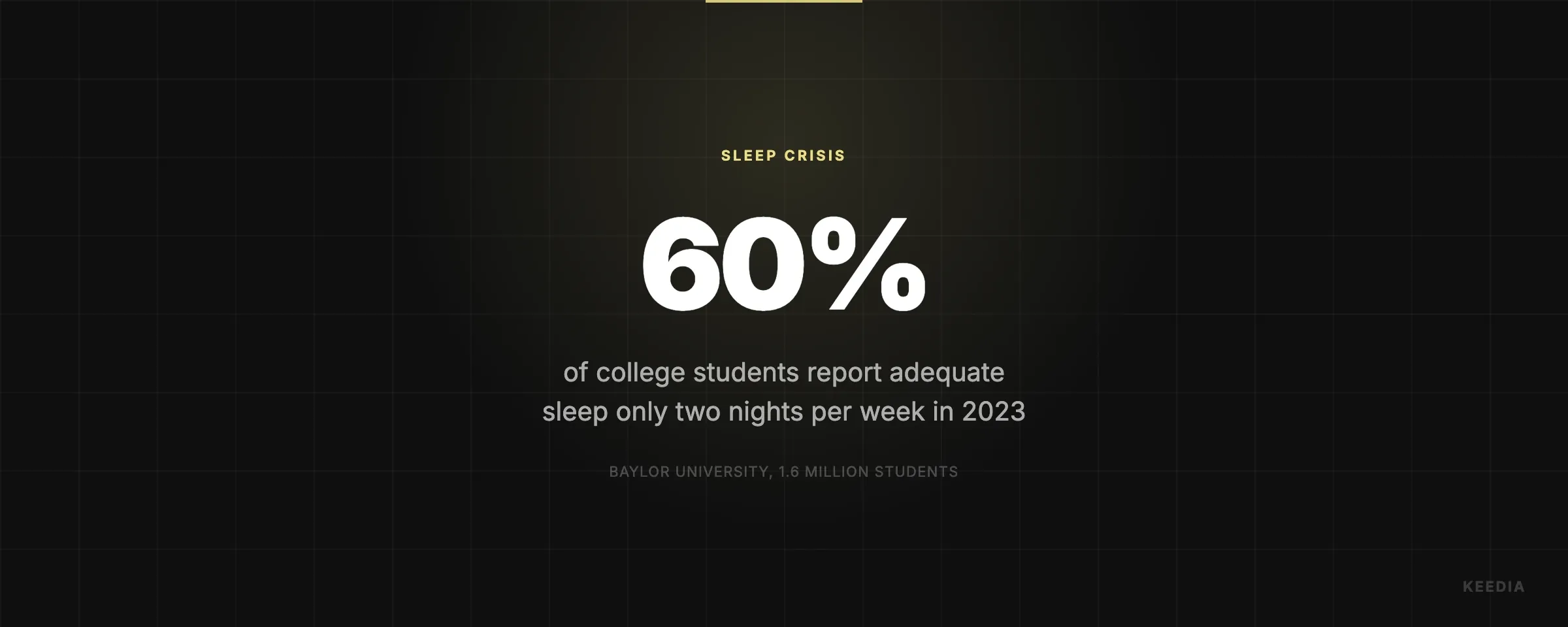
If you went to college and survived on five hours a night, you probably chalked it up to a rite of passage. New research suggests it's actually a public health crisis. A large-scale study from Baylor University analyzed sleep data from nearly 1.6 million US college students collected over two decades, and the numbers are stark.
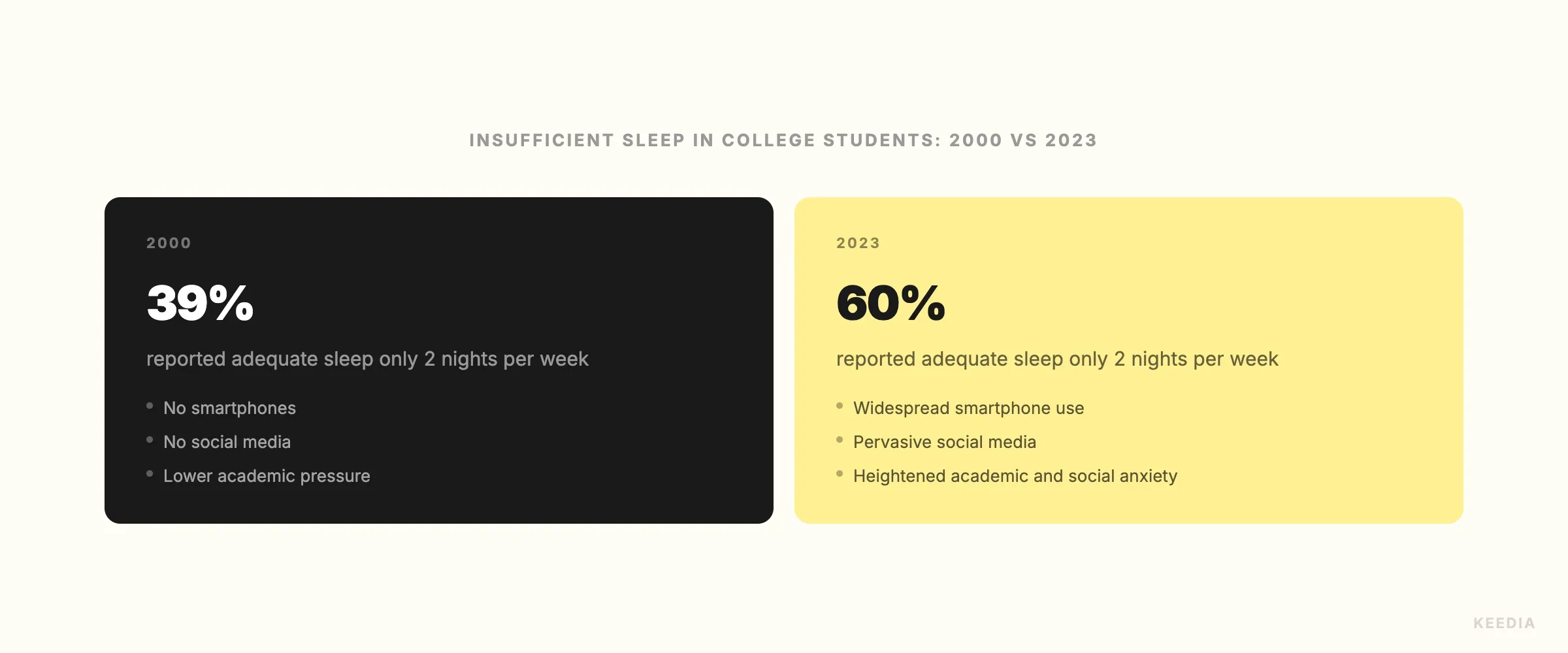
The proportion of students reporting adequate sleep on only two days per week jumped from 39% in 2000 to 60% in 2023. That's not a gradual drift. That's a structural collapse in how an entire generation is resting. And the consequences don't stay on campus.
What the Data Actually Shows
The Baylor study is one of the largest longitudinal analyses of college sleep behavior ever conducted. Researchers tracked self-reported sleep sufficiency across multiple US institutions, and the trend line moves consistently in the wrong direction regardless of the year, institution type, or demographic group examined.
By 2023, three in five college students were only sleeping enough on two nights out of seven. The other five nights, they were operating on insufficient rest. Over a semester, that compounds into a level of chronic sleep debt that doesn't resolve with a Saturday lie-in.
It's worth understanding what "adequate sleep" means here. The American Academy of Sleep Medicine defines sufficient sleep for adults aged 18 to 25 as seven to nine hours per night. Students weren't being held to an unrealistic standard. They were simply failing to meet a basic biological threshold on most nights of the week.
What's Driving the Decline
Researchers point to several converging factors. Smartphone use and social media are the most frequently cited culprits, and not just because students are scrolling at midnight. The blue light emitted by screens suppresses melatonin production, delaying the body's natural sleep onset. Combine that with the psychological stimulation of notifications, social comparison, and always-on communication, and you've built an environment that's physiologically hostile to sleep.
Academic pressure has also intensified. The post-2008 financial crisis raised the stakes of educational achievement, pushing students toward heavier course loads, more extracurricular commitments, and side employment. Many campuses responded to enrollment pressures by scheduling more classes in the late evening, further pushing bedtimes later without adjusting wake times.
There's also a social dimension. Later class schedules normalized a nocturnal rhythm that conflict with the body's circadian biology. Students shifted their sleep windows later and later until their weekday schedule simply didn't allow for recovery. The result is what sleep researchers call social jetlag, a chronic misalignment between biological sleep timing and social obligations.
The Mental Health Connection
Sleep deprivation doesn't just make you tired. It rewires how the brain processes stress, regulates emotion, and consolidates memory. The same period that saw college sleep collapse also saw a dramatic rise in campus mental health diagnoses. That's not coincidental.
Research consistently shows that sleeping fewer than seven hours per night is associated with significantly higher rates of anxiety, depression, and emotional dysregulation. For college-aged adults, whose prefrontal cortex is still completing its development into the mid-twenties, chronic sleep loss during this window may carry outsized long-term consequences.
The relationship runs in both directions. Poor sleep worsens anxiety, and anxiety disrupts sleep. Once that cycle starts, it's difficult to interrupt without deliberate intervention. That's partly why sleep debt recovery requires more than just sleeping in on weekends. The structural habits driving the deficit need to change first.
Academic performance follows a similar pattern. Sleep is when the brain consolidates learning, transfers information from short-term to long-term memory, and clears metabolic waste products. Students studying for exams while chronically under-slept are essentially pouring water into a leaking bucket. The input increases, but the retention doesn't follow.
Why This Matters Beyond Campus
Here's what makes this study more than a college-specific concern. The habits formed between ages 18 and 24 tend to calcify into adult defaults. A student who spends four years training their nervous system to function on poor sleep doesn't graduate into healthy rest. They carry those patterns into their first job, their relationships, and their long-term health trajectory.
Chronic sleep deprivation in early adulthood is associated with elevated cortisol, increased inflammatory markers, impaired glucose metabolism, and higher lifetime risk of cardiovascular disease. These aren't abstract long-term risks. They're biological processes that begin accumulating during the sleep-deprived years themselves.
The data on cardiovascular risk is particularly worth noting. While some research has suggested that weekend catch-up sleep may offer modest heart health benefits, that effect doesn't undo the damage of sustained weekday deprivation. Partial recovery is not the same as consistent sleep.
If you're in your twenties and reading this, you're in the window where your habits still have the most leverage. That's not meant to alarm you. It's meant to clarify the stakes.
The Smartphone Question
It's tempting to frame the smartphone as the villain and leave it there. But the research is more nuanced. Devices accelerated a trend that was already emerging from structural academic and economic pressures. Removing your phone from the bedroom at night is a good idea, and it genuinely helps, but it doesn't address the underlying scheduling and stress architecture that's keeping students awake.
That said, the behavioral case against late-night screen use is solid. Even low-intensity screen exposure within 90 minutes of your target bedtime delays sleep onset, reduces slow-wave sleep (the most physically restorative phase), and shortens overall sleep duration. The effect is dose-dependent. More exposure means more disruption.
There are also compounding wellness habits worth examining. Some students rely on stimulants to offset fatigue, which further disrupts sleep architecture, creating a self-reinforcing deficit cycle. Others use alcohol as a sleep aid, which reduces REM sleep and increases nighttime wakefulness. Neither strategy actually addresses the problem. Both make it worse over time.
If you're exploring other recovery tools, the evidence on passive heat exposure is worth reviewing. Research covered in our look at gym sauna protocols and the science behind heat recovery suggests that post-exercise sauna use can lower resting heart rate and support parasympathetic nervous system recovery, which is the state your body needs to enter before quality sleep becomes possible.
Practical Steps for Early-Career Adults
The Baylor findings aren't just a diagnosis. They're a prompt to audit your own habits before chronic underperformance becomes your baseline. Here's where to start:
- Anchor your wake time first. Most people try to fix sleep by adjusting when they go to bed. A fixed wake time, even on weekends, is more effective at stabilizing your circadian rhythm. Consistency trains your body's internal clock far more reliably than chasing a bedtime.
- Create a 60-minute wind-down window. This doesn't require a 10-step routine. It means reducing cognitive and visual stimulation in the hour before bed. Lower the lights, avoid news and social media, and let your nervous system begin its downshift naturally.
- Audit your caffeine cutoff. Caffeine has a half-life of roughly five to six hours in most adults. A 3 PM coffee still has half its caffeine load circulating at 8 PM. Most people who report trouble falling asleep are underestimating how long stimulants stay active in their system.
- Track sleep quality, not just duration. Seven hours of fragmented sleep is not equivalent to seven hours of consolidated sleep. If you're waking frequently, feeling unrefreshed, or snoring heavily, it may be worth exploring whether a sleep disorder is involved. Advances in treatment options are expanding. A condition like sleep apnea, for example, now has emerging pharmaceutical options that reduce breathing events by up to 44%, which is a meaningful development for people who can't tolerate CPAP therapy.
- Consider non-pharmacological support for anxiety. If racing thoughts are what's keeping you awake, addressing the anxiety directly pays dividends. Research suggests that even structured listening sessions can help. Studies have found that approximately 24 minutes of music can measurably reduce anxiety levels, which may be enough to lower arousal before bed without medication.
The Bigger Picture
One study doesn't capture the full picture of why sleep is deteriorating across an entire generation. But 1.6 million data points across two decades is hard to dismiss. The pattern is consistent, the direction is clear, and the downstream consequences are well-documented.
The most useful takeaway isn't to panic about a generation of exhausted students. It's to recognize that sleep is not a passive outcome of how busy your life is. It's an active system that responds to habits, schedules, light exposure, stress loads, and choices you make every day before you even get into bed.
You don't have to be in college to be running a sleep debt. You just have to be living in a world that rewards productivity over recovery and treats exhaustion as a badge of effort. The research suggests that trade-off costs far more than most people realize.
The good news is that the habits driving the crisis are mostly behavioral. And behavior, unlike genetics, is something you can actually change.