
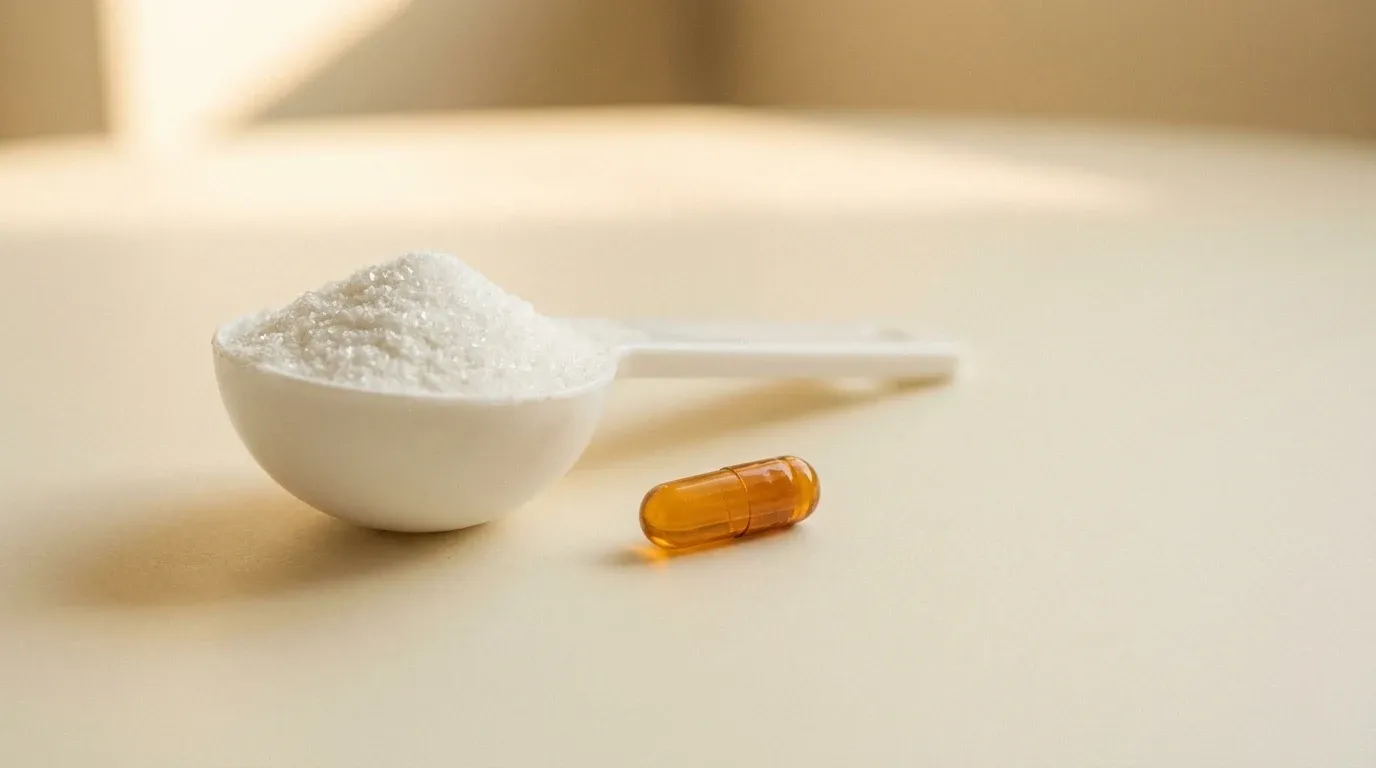
You probably know creatine as the white powder in your gym bag that helps you push out a few extra reps. But a growing body of research is asking a different question: could that same supplement also support your mental health? A recent review of five randomized clinical trials suggests the answer might be more nuanced than anyone expected.
The findings don't position creatine as a replacement for antidepressants or therapy. What they do suggest is that creatine may play a meaningful supporting role in depression treatment, particularly through its effects on how the brain produces and uses energy. For active adults already familiar with the supplement, that's a significant shift in perspective.
What the Research Actually Found
The review analyzed five randomized clinical trials that examined creatine supplementation in people diagnosed with depression. Across these trials, researchers found consistent signals that creatine, when used alongside standard treatments, was associated with improvements in depressive symptoms compared to placebo groups.
The effect sizes varied across studies, and the trials differed in population, dosage, and duration. But the directional consistency was notable. This wasn't a single outlier study. It was a pattern across multiple independent trials, which gives the findings more weight than any single piece of research could on its own.
Importantly, the review focused on creatine as an adjunct therapy, meaning participants were not replacing their existing medications or therapeutic interventions. They were adding creatine on top of them. That framing matters a lot for how you interpret the results.
The Brain Energy Connection
To understand why creatine might affect mood, you need to understand what it does in the body. Creatine plays a central role in the phosphocreatine system, which rapidly regenerates adenosine triphosphate (ATP), the primary energy currency your cells use to function. In muscle tissue, this is why creatine improves high-intensity performance. In the brain, the same mechanism has different but equally significant implications.
Research into the neuroscience of depression has increasingly pointed toward impaired energy metabolism in the brain as a potential contributor to the condition. Certain brain regions involved in mood regulation, including the prefrontal cortex, appear to show reduced metabolic activity in people with depression. The theory is that creatine supplementation may help restore some of that depleted energy capacity, giving neurons the fuel they need to function more effectively.
This isn't a speculative leap. Neuroimaging studies have documented measurable changes in brain creatine levels, and some of the clinical trials in the review used magnetic resonance spectroscopy to track these shifts alongside symptom scores. The biological mechanism is plausible, observable, and consistent with what we know about how creatine works elsewhere in the body.
Why Creatine Is Already a Strong Candidate for Further Study
Most supplements being explored for mental health applications come with significant unknowns around safety, dosing, and long-term effects. Creatine is different. It's one of the most extensively researched supplements in existence, with decades of safety data from athletic and clinical populations.
Standard doses of 3 to 5 grams per day have been shown repeatedly to be safe for healthy adults. Creatine monohydrate, the most common and well-studied form, is also relatively affordable and widely accessible, typically costing between $20 and $40 for a one-month supply at standard dosing. That lowers the barrier considerably for researchers and, eventually, clinicians who might want to recommend it as a complementary tool.
The safety profile also means that exploring creatine's mental health applications doesn't require the same caution as testing an entirely novel compound. You're working with a substance that has been studied in thousands of participants over decades. That's a significant head start.
If you're already navigating the supplement space, you know that not all products deliver what they promise. Can You Actually Trust What's on Your Supplement Label? is worth reading before you purchase anything, including creatine. Third-party testing and transparent labeling still matter.
What This Means for Active Adults
There's a particular relevance here for people who are already training regularly and using creatine for performance. Depression and high training loads often intersect in ways that aren't discussed enough. Overtraining, chronic stress, poor sleep, and the psychological demands of competitive or intense recreational sport can all contribute to low mood, burnout, and in some cases, clinical depression.
If you're someone who already takes creatine for strength or endurance, the emerging research adds another dimension to a supplement you're probably already comfortable with. You're not being asked to try something new and unknown. You're being given a reason to think differently about something already in your routine.
Mental load and physical recovery are also more connected than most training plans acknowledge. 5 Simple Recovery Habits That Actually Work covers the basics of physical recovery, but the relationship between stress, mood, and how well your body bounces back from training is real and bidirectional. Supporting brain energy metabolism may not just affect how you feel. It may affect how well you recover, too.
Sleep is another piece of this puzzle. Disrupted sleep both worsens depression and undermines physical performance, and the two create a feedback loop that's hard to break. Endless Scrolling Hurts Your Memory. Exercise Fights Back. addresses how lifestyle factors compound cognitive and emotional strain, which connects directly to why researchers are looking at systemic interventions like creatine supplementation.
What the Researchers Are Not Saying
This is worth being direct about. The researchers reviewing these trials are not suggesting that creatine cures depression, treats depression independently, or should replace any existing treatment. That's a critical distinction.
Depression is a complex, heterogeneous condition with biological, psychological, and social dimensions. No single supplement addresses all of those dimensions. What creatine may do, based on current evidence, is support one specific aspect of the condition, specifically the energy metabolism component, in a way that complements what standard treatments are already doing.
The clinical trials in the review also had limitations worth acknowledging. Sample sizes were generally small. Trial durations varied. Some studies focused on specific populations, such as women with major depressive disorder or adolescents, which limits how broadly the findings can be generalized right now. Larger, more diverse trials are needed before any clinical guidelines shift.
That's not a reason to dismiss the research. It's a reason to take it seriously and fund more of it. The signal is there. What science needs now is scale and replication.
How to Think About Creatine If You're Navigating Mental Health
If you're currently managing depression, the most important thing you can do is work with a qualified healthcare provider. Creatine is not a self-treatment strategy, and it shouldn't be used as a reason to delay or deprioritize professional care.
What the research does suggest is that if you're already in treatment and your provider is open to it, discussing creatine as an adjunct supplement is a reasonable conversation to have. The safety data supports that conversation. The emerging efficacy data gives it clinical relevance.
For anyone working with a coach or trainer who is supporting clients through stress, mood challenges, or burnout alongside training, this research adds useful context. Understanding the relationship between nutrition, supplementation, and mental health is increasingly part of what good coaching looks like. Personalized Nutrition: How to Actually Use Your Blood Work offers a practical framework for connecting biological markers to real lifestyle decisions, which is the direction this field is heading.
The Bigger Picture
What makes this research compelling isn't just the creatine finding itself. It's what it represents. The line between sports nutrition and mental wellness is blurring, and it's doing so for good scientific reasons. Supplements that were designed to support physical performance are being examined through the lens of brain health, and the mechanisms often overlap more than we once assumed.
Energy metabolism, inflammation, oxidative stress, sleep quality. these are areas where physical training and mental health intersect, and where nutritional interventions may have effects that cross both domains. Creatine may be one of the first well-studied examples of a performance supplement with credible mental health applications. It's unlikely to be the last.
For now, the takeaway is measured but meaningful. If you use creatine for training, you may already be giving your brain a subtle metabolic edge. If you're exploring ways to support mental wellness alongside physical performance, creatine is worth a conversation with your doctor. And if you're a researcher or clinician, the five trials reviewed here represent a foundation that deserves to be built on.
The science isn't finished. But it's pointing somewhere worth following.