

How Exercise Controls Cortisol — and Which Intensity Actually Works
Here's the contradiction that confuses most people who exercise for stress management: high-intensity interval training spikes cortisol acutely, yet studies consistently show it reduces psychological distress over time. Meanwhile, moderate-intensity exercise is often dismissed as "too easy" to drive real adaptation — yet the research positions it as the most effective tool for cortisol reduction in chronically stressed individuals.
Both statements are true. The key is understanding which cortisol response you're dealing with, and matching your training intensity to your current stress load — not just your fitness goals.
Cortisol Is Not the Enemy
Cortisol gets framed as a purely negative hormone, but that's incomplete. It's a stress-response molecule that helps mobilize energy, regulate inflammation, and sharpen focus in high-demand situations. The problem isn't cortisol itself. It's chronic elevation — the kind that emerges when your nervous system never fully recovers between stressors.
Chronically elevated cortisol suppresses immune function, disrupts sleep architecture, degrades lean muscle mass, and is strongly associated with anxiety and depression. The goal of exercise-based cortisol management isn't elimination. It's regulation: lower baseline levels, faster recovery to baseline after stressors, and reduced reactivity when stress hits.
What the Research Actually Shows About Moderate Intensity
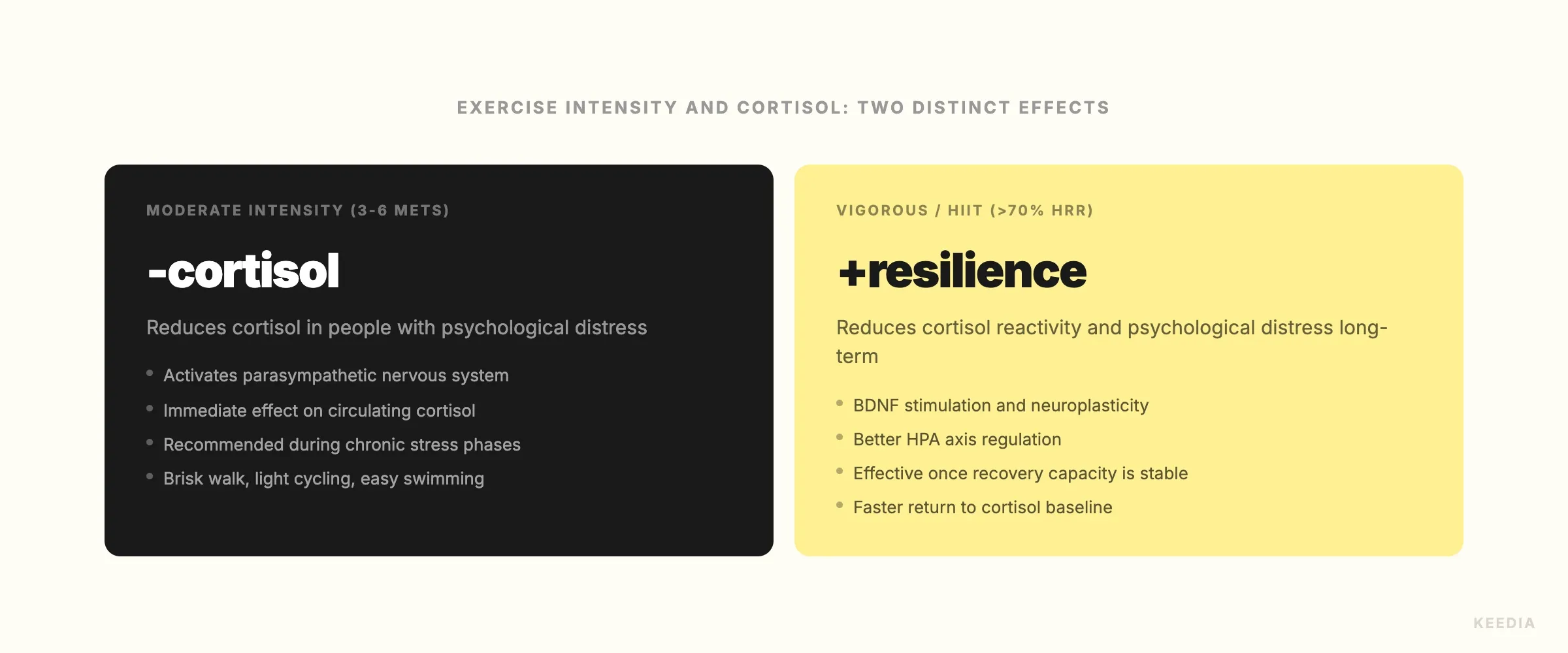
A systematic review published in MDPI Sports Medicine examined the relationship between exercise intensity and cortisol in populations with psychological distress. The finding was clear: moderate-intensity exercise, defined as 3 to 6 METs (metabolic equivalents), produced the most consistent and significant reductions in cortisol among stressed individuals.
This range maps roughly to brisk walking, light cycling, swimming at a comfortable pace, or low-to-moderate resistance training. You're working, but you can still hold a conversation. If you're trying to identify this zone more precisely, Zone 2 Without a Lab: Find Your Zone Accurately walks through practical field methods that don't require lab equipment.
Why does this intensity work so well for stressed populations? At moderate intensities, the sympathetic nervous system is engaged enough to produce beneficial hormonal shifts, but not so aggressively that it compounds an already elevated cortisol burden. The hypothalamic-pituitary-adrenal (HPA) axis gets a controlled stimulus — enough to trigger adaptation, not enough to overwhelm recovery.
Vigorous Exercise: Dampening Reactivity, Not Just Acute Output
At higher intensities — roughly 70% of heart rate reserve and above — a different cortisol-related adaptation emerges. Research shows that individuals who exercise regularly at vigorous intensity don't just have lower resting cortisol. They show dampened cortisol reactivity to psychological stressors. When exposed to a standardized stress task (the Trier Social Stress Test is commonly used in research), trained individuals produce less total cortisol and return to baseline faster than untrained controls.
This is meaningful. It means vigorous training doesn't just help you recover from a hard workout. It fundamentally changes how your neuroendocrine system responds to non-exercise stressors — the work deadline, the difficult conversation, the chronic background noise of modern life.
This adaptation is likely linked to improvements in cardiovascular efficiency, including higher VO2max. Protocols designed to push VO2max upward through structured high-intensity work have a documented relationship with improved autonomic regulation. How to Improve Your VO2max: The Research-Backed Protocols covers the specific training structures that drive these gains.
The HIIT Paradox: Acute Cortisol Spike, Long-Term Stress Reduction
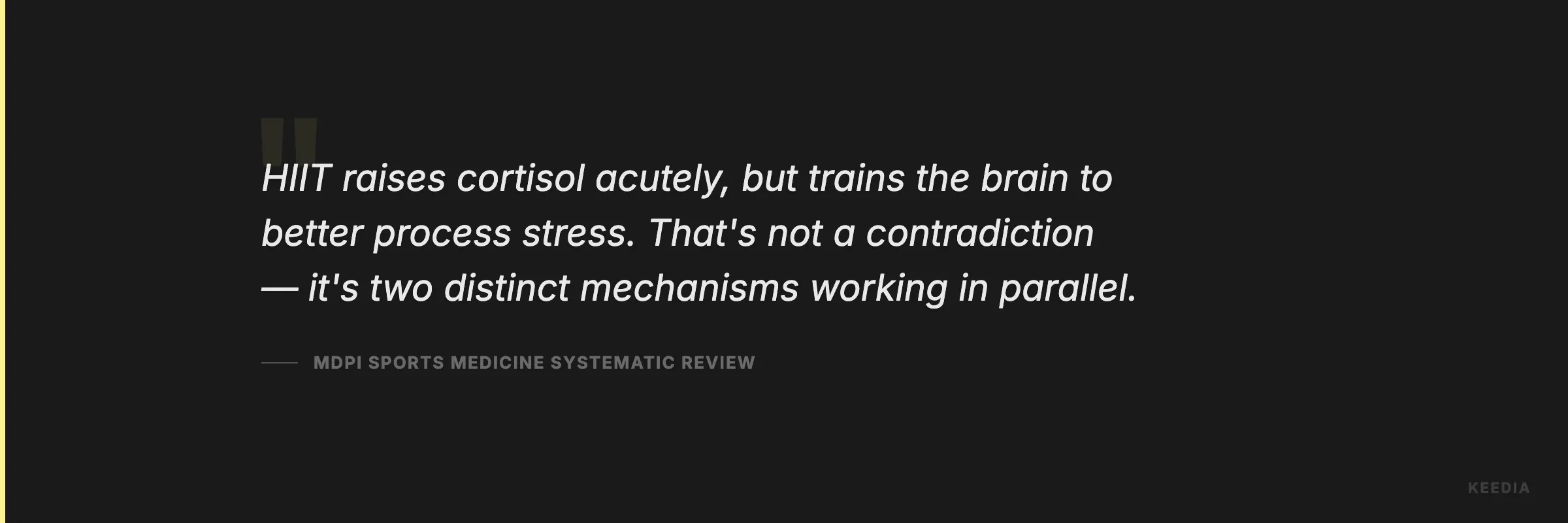
HIIT is where the apparent contradiction lives. A single HIIT session raises cortisol significantly — sometimes by 50 to 80% above resting levels, depending on the protocol. If chronically elevated cortisol is the problem, why would you deliberately spike it?
The answer lies in what HIIT triggers downstream. High-intensity exercise is one of the most potent known stimuli for brain-derived neurotrophic factor (BDNF), a protein that drives neuroplasticity, supports hippocampal volume, and is directly implicated in resilience to psychological stress. Studies show that BDNF expression increases significantly after HIIT sessions, and regular HIIT training is associated with measurable reductions in anxiety, depression scores, and perceived psychological distress — even while acute cortisol output remains high.
So HIIT doesn't reduce cortisol acutely. It reduces the psychological context that makes cortisol chronically problematic. It builds a more resilient nervous system that handles cortisol spikes better, recovers faster, and is less reactive to everyday stressors over time.
The critical caveat: this adaptation requires adequate recovery capacity to materialize. If you're already running on a cortisol surplus from chronic work stress, poor sleep, or under-eating, adding HIIT to that load doesn't trigger neuroplastic adaptation. It compounds systemic stress. The cortisol spike stays elevated longer, recovery is blunted, and the benefits don't land.
Practical Framework: Match Intensity to Your Stress State
Here's how to think about this in practice:
- Chronically stressed, poor sleep, low energy: Prioritize moderate-intensity training, 3 to 5 sessions per week. Think brisk walking, Zone 2 cardio, and low-to-moderate resistance work. This is not a concession. It's the most evidence-aligned choice for your current physiological state. Your HPA axis needs a manageable stimulus, not another demand.
- Recovering, sleep improving, energy stabilizing: Begin introducing one session of vigorous-intensity work per week. Not HIIT yet. Sustained effort at 70 to 75% heart rate reserve for 20 to 30 minutes. Monitor recovery quality before progressing.
- Recovery capacity stable, stress load manageable: Add one HIIT session per week — structured intervals, not random intensity spikes. Track sleep, resting heart rate, and subjective energy. If any of these deteriorate, pull back before adding more volume.
- Well-recovered, high fitness baseline: Two HIIT sessions per week with adequate deload structure built in. Deload Protocols: What the Research Actually Says covers the evidence on when and how to program recovery weeks without losing adaptation.
The progression logic here is simple: you can only extract the long-term cortisol-regulating benefits of vigorous and high-intensity exercise if your body has the recovery capacity to adapt. Without that, the acute cortisol spike is cost without return.
Sleep, Nutrition, and the Recovery Floor
No training framework for cortisol management works in isolation. Sleep is the primary cortisol regulator. Cortisol follows a diurnal rhythm — it should be highest in the early morning and lowest at night. Chronic sleep disruption inverts or flattens this rhythm, leaving you cortisol-elevated at night and blunted in the morning.
Magnesium plays a documented role in both sleep quality and HPA axis regulation. Research on athletes shows that adequate magnesium intake is associated with improved sleep architecture and lower nighttime cortisol. Magnesium and Sleep for Athletes: Which Form, What Dose, What Results breaks down the specific forms and dosing that the evidence supports.
Nutrition timing and protein adequacy also matter. Cortisol is catabolic. Chronically elevated cortisol combined with low protein intake accelerates muscle loss — a dynamic that's increasingly relevant for individuals on GLP-1 medications. GLP-1 and Muscle Loss: What Training Can — and Can't — Fix addresses how to structure resistance training and protein to protect lean mass in high-cortisol, caloric-deficit contexts.
Where Mind-Body Practices Fit
Yoga, meditation, and breathwork are not alternatives to exercise for cortisol management. They're complements — and they work through different mechanisms.
Long-term practitioners of meditation show measurable differences in stress-gene expression, specifically in pathways related to NF-kB signaling and inflammatory cytokine production. These are not psychological effects. They're molecular changes that reflect a genuinely recalibrated stress response system. Studies on yoga show similar patterns, with consistent reductions in salivary cortisol after sustained practice.
The practical implication: if you're working through a high-stress period and using moderate-intensity exercise as your primary tool, adding a 15 to 20 minute daily breathwork or meditation practice meaningfully accelerates the cortisol recalibration. These practices downregulate the sympathetic nervous system directly, reducing the baseline activation level that your training is trying to offset.
Sauna use shows a related pattern, with regular heat exposure associated with improved autonomic recovery and reduced cardiovascular stress markers. Sauna and Cardiovascular Health: What the Research Says in 2025 covers the current evidence on mechanisms and protocols.
The Takeaway
The cortisol-exercise relationship isn't a paradox once you understand that acute and chronic responses operate differently. Moderate intensity reduces cortisol burden in the short and medium term, making it the right starting point for chronically stressed individuals. Vigorous intensity and HIIT build long-term resilience, blunt reactivity to psychological stressors, and drive neuroplastic changes that shift how your entire stress system functions.
The mistake is treating intensity as a pure fitness variable. It's also a stress-load variable. Match it accordingly, build recovery capacity first, and the research falls into a clear, actionable sequence rather than a contradiction.