
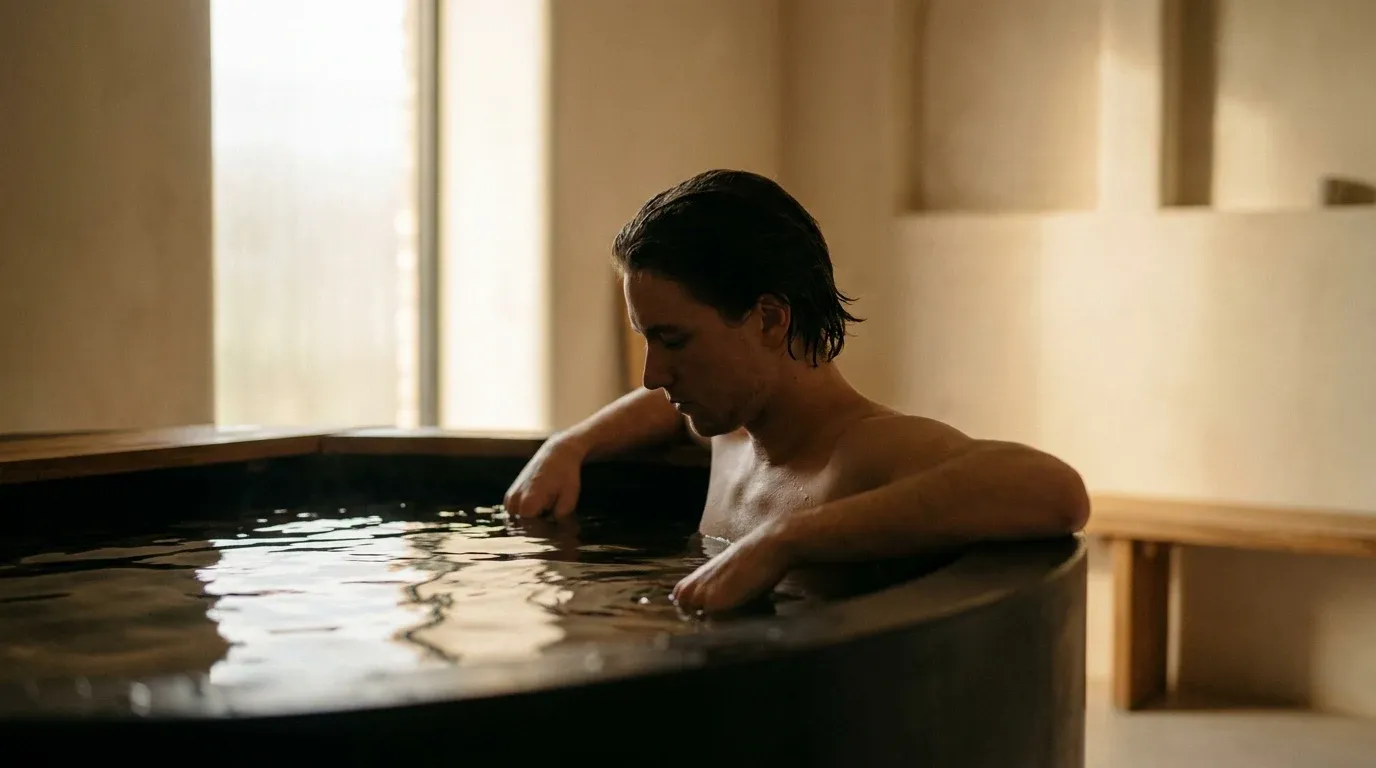
There's something deeply satisfying about sliding into a tub of ice water after a hard training session. The ache fades, the inflammation quiets, and you feel like you've done something serious for your recovery. But if building muscle is your goal, that feeling of relief may be coming at a real cost.
Research published over the past several years has built a consistent case: frequent cold water immersion after resistance training can blunt the very adaptations you're working toward. The soreness goes down. So does the signal for muscle growth.
What Ice Baths Actually Do to Your Muscles
Cold water immersion reduces soreness primarily by constricting blood vessels, slowing nerve conduction velocity, and decreasing metabolic activity in the muscle tissue. That's exactly why it feels effective. The problem is that some of that metabolic activity you're suppressing is what drives muscle repair and growth.
When you lift weights, you create small amounts of mechanical damage in muscle fibers. That damage triggers an inflammatory cascade. Satellite cells migrate to the site, protein synthesis ramps up, and over time the muscle rebuilds slightly larger and stronger than before. This process, hypertrophy, depends on that inflammatory signal being allowed to run its course.
Cold water immersion interferes with that signaling. Studies have found that post-exercise ice baths reduce the activation of mTOR, the primary molecular pathway responsible for muscle protein synthesis. They also suppress satellite cell activity, which is critical for muscle fiber repair and growth. One widely cited trial found that subjects who used cold water immersion consistently after resistance sessions gained significantly less muscle mass and strength over 12 weeks compared to those who used active recovery instead.
The effect isn't subtle. It's measurable, and it accumulates over months of training.
The Soreness Problem Is Real, but It's Being Misread
Delayed onset muscle soreness (DOMS) is uncomfortable, and it makes sense that people want to reduce it. But soreness is not a reliable marker of training quality, and reducing it doesn't necessarily mean you're recovering better. It may just mean you've quieted the signal.
Many athletes and gym-goers equate less soreness with more readiness, and from there conclude that ice baths are helping their progress. The logic is understandable. It's also backwards. The research suggests that in the context of resistance training, the acute soreness is partly a byproduct of the process that builds muscle. Suppressing it frequently doesn't accelerate that process. It slows it.
This doesn't mean ice baths are useless. It means they're being used by the wrong people, for the wrong goal, too often.
Who Should Actually Be Using Cold Water Immersion
Cold water immersion has a legitimate place in performance recovery. That place just isn't in the post-squat routine of someone trying to add lean mass.
Endurance athletes benefit more clearly. When the primary goal is reducing systemic fatigue and allowing someone to train again the next day, not maximizing hypertrophy signals, cold water immersion can support performance continuity. Cyclists, runners, and swimmers operating on high-frequency competition schedules have different physiological priorities than someone training three to five days per week for muscle growth.
Cold immersion also has a reasonable case in contact sports or combat sports, where soft tissue inflammation from impacts needs managing, and where the muscle-building tradeoff is a secondary concern compared to injury management and event readiness.
If you're training for general strength, body composition, or muscle hypertrophy, and you're not competing in back-to-back events, cold water immersion is probably not your best recovery tool. It may be working against you.
What the Evidence Says Works Better
The two most consistently supported recovery strategies in the research are also the least exciting to talk about. Sleep and nutrition. They outperform cold water immersion, compression garments, massage guns, and infrared saunas in terms of measurable impact on muscle adaptation.
Sleep: Seven to nine hours of quality sleep per night is where the majority of muscle protein synthesis occurs. Growth hormone secretion peaks during slow-wave sleep, and that's when the repair process is most active. Cutting sleep to five or six hours doesn't just leave you tired. It measurably reduces the anabolic response to training. No ice bath compensates for that. Sleep and Food Still Beat Every Recovery Gadget breaks down the full comparison if you want the broader picture.
Post-exercise protein: Consuming 20 to 40 grams of high-quality protein in the hours after resistance training provides the amino acid substrate that muscle protein synthesis requires. Leucine content matters significantly here. Animal proteins and well-formulated plant proteins with adequate leucine trigger the mTOR pathway more effectively than lower-quality sources. Not All Protein Sources Are Equal: Here's Why It Matters covers how to evaluate what you're actually getting.
Carbohydrates: Protein doesn't work in isolation. Pairing it with sufficient carbohydrates supports insulin release, which assists amino acid uptake into muscle tissue and replenishes glycogen stores. This matters especially if your next training session is within 24 hours.
These aren't optional extras. They're the core of the recovery process, and for most people, they're where the biggest untapped gains are sitting.
If You Still Want to Use Cold Water Immersion
There's a practical middle ground here. If you genuinely find ice baths help you manage soreness and stay consistent with training, you don't have to eliminate them entirely. The research points more clearly to frequent, habitual use as the problem rather than occasional use.
Using cold water immersion on rest days rather than immediately post-workout reduces the direct interference with the acute inflammatory signaling window. Waiting at least six hours after a resistance session before any cold exposure may also limit the suppressive effect on mTOR activation, though the evidence on exact timing thresholds is still developing.
Where the risk is highest is the pattern many people fall into: lifting, then immediately submerging for 10 to 15 minutes, multiple times per week, year-round. That's the protocol most associated with blunted hypertrophy in the available research.
A Note for People Focused on Long-Term Muscle Growth
If you're training specifically to build muscle, whether you're newer to lifting or working on a structured hypertrophy program, the details of your recovery approach matter more than most people realize. The ice bath question is one piece of that. Program design is another.
Understanding how to organize your sessions around compound and accessory work, progressive overload, and appropriate training volume can dramatically affect how much of your recovery investment actually pays off. Compound vs. Isolation: How to Actually Structure Your Program is a useful starting point for making sure your training is set up to take advantage of good recovery in the first place.
If you're over 40, the stakes around recovery are even higher. Muscle protein synthesis rates naturally decline with age, which makes every post-workout decision, what you eat, how long you sleep, what you do or don't do in the cold tub, more consequential. How to Choose a Trainer for Building Muscle After 40 addresses how to get the right guidance if you're navigating that stage of training.
The Bottom Line
Ice baths aren't bad. They're misapplied. For most people training for muscle growth, habitual cold water immersion after resistance sessions suppresses the inflammatory processes that drive hypertrophy, and the research is clear enough on this that it warrants changing behavior.
The recovery strategies that actually support long-term muscle adaptation are consistent sleep in the seven-to-nine-hour range and a post-workout meal built around 20 to 40 grams of quality protein with carbohydrates. These aren't glamorous answers. They're just the ones that work.
If you want to use cold water immersion, use it strategically. Keep it for rest days, for endurance blocks, or for competition seasons when training-to-training recovery is the priority over maximizing muscle growth signals. Don't let the feeling of relief convince you that it's helping you build. Relief and adaptation are not the same thing.