
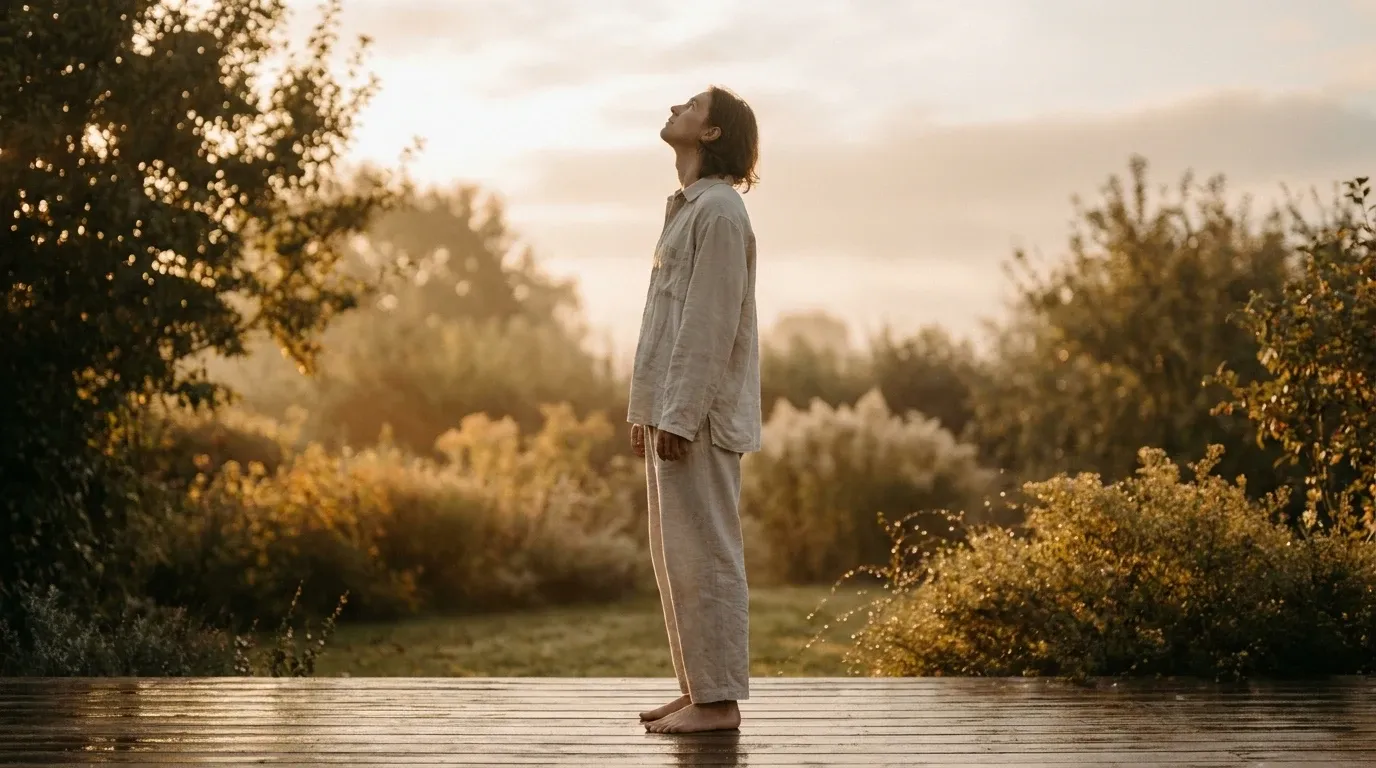
Most people trying to manage stress focus on what they do at night. Magnesium before bed, blue-light glasses, wind-down routines. All of that has merit. But the research is clear: the single most powerful lever for your cortisol rhythm isn't pulled at 10 p.m. It's pulled within the first 30 minutes of waking up.
That lever is morning light. Specifically, natural outdoor light hitting your retina shortly after you open your eyes. Ten minutes is enough to shift your entire hormonal day.
Why Cortisol Needs an Anchor
Cortisol isn't your enemy. It's a signaling molecule, and your body is designed to produce a sharp, clean surge of it right after waking. This is called the cortisol awakening response (CAR), and it typically peaks 30 to 45 minutes after you get out of bed. The CAR primes your immune system, sharpens mental focus, and mobilizes energy for the day ahead.
The problem isn't having this morning spike. The problem is when the spike is weak, poorly timed, or followed by cortisol that stays elevated throughout the afternoon and evening. That's the pattern associated with poor sleep, fatigue, anxiety, and impaired recovery.
Your cortisol rhythm is directly tied to your circadian clock, which runs primarily on light signals. Without a strong morning light cue, that clock drifts. The CAR becomes blunted or mistimed, and your evening cortisol fails to drop as it should, pushing melatonin onset later and fragmenting your sleep. It's a slow feedback loop that quietly undermines everything else you're trying to do with your health.
What Happens in Your Brain During Morning Light Exposure
When photons from natural light hit specialized cells in your retina called intrinsically photosensitive retinal ganglion cells (ipRGCs), they send a signal directly to the suprachiasmatic nucleus (SCN) in the hypothalamus. The SCN is your body's master clock. It coordinates virtually every hormonal rhythm in your body, including cortisol production from the adrenal glands.
A robust morning light signal tells the SCN exactly what time it is. This anchors the clock, producing a stronger and more precisely timed CAR. Research shows that people who get outdoor light exposure within 30 minutes of waking have measurably higher morning cortisol peaks and, critically, measurably lower cortisol levels in the evening compared to those who spend their mornings in indoor light.
That evening drop is where the real recovery benefit lives. Lower cortisol in the hours before bed allows melatonin to rise earlier and reach higher concentrations, producing deeper sleep with more slow-wave and REM stages. Better sleep improves the CAR the next morning. The cycle compounds in the right direction instead of the wrong one.
Indoor Light Doesn't Cut It
Your office or kitchen ceiling light produces roughly 100 to 500 lux. A bright, sunny outdoor environment delivers 10,000 lux or more. Even an overcast winter morning outside sits around 1,000 to 5,000 lux. That's still 10 times brighter than indoor lighting, which means the "it's cloudy where I live" excuse doesn't hold up for most people in most climates.
The ipRGCs that drive this system are particularly sensitive to short-wavelength blue light in the 480-nanometer range, which natural daylight is rich in. Indoor artificial lighting, even when bright, lacks the full spectral composition of outdoor light and doesn't produce the same downstream hormonal effect. You can't replicate this with a SAD lamp on your desk while you scroll through email, though a high-quality light therapy lamp can help in very low-light winter conditions.
The bottom line: if you're spending your first hour indoors after waking, your circadian system is effectively flying without instruments.
The 10-Minute Protocol
This doesn't need to be complicated. The goal is simply to get outdoor light into your retinas, without filtering, as early after waking as you can manage. Here's the protocol:
- Timing: Get outside within 30 minutes of waking. Earlier is better, but the window extends to about 60 minutes before the benefit begins to drop off meaningfully.
- Duration: Ten minutes on a clear day is sufficient. On overcast days, extend to 15 to 20 minutes to compensate for reduced lux.
- Eyes: No sunglasses. The light needs to reach your retina unfiltered. You're not looking at the sun. You're looking at the open sky, allowing ambient light to enter your eyes naturally.
- Direction: Face toward the bright part of the sky. You don't need to look directly at any light source. Simply being outside and oriented toward open sky is enough.
- Movement: Combine your light exposure with a slow walk. Even gentle walking reduces cortisol independently through movement-related reductions in sympathetic nervous system tone. The combination produces an additive effect that a static outdoor stand doesn't.
- Phone: Leave it in your pocket or inside. Scrolling during your light walk undermines the mental stillness that amplifies its stress-reduction benefit.
That's it. Ten minutes, no sunglasses, slow walk, face toward the sky. You're not asked to restructure your morning. You're being asked to step outside before you make coffee.
Stacking the Protocol with Movement
The slow walk recommendation isn't arbitrary. Low-intensity movement in the morning has its own cortisol-modulating effect, independent of light. When you combine both stimuli, you create a stronger anchor for the circadian system while simultaneously activating parasympathetic tone, the physiological state associated with calm, digestion, and recovery.
If your mornings already include some form of physical activity, the light walk works as a warm-up or cool-down rather than an addition to your schedule. Research on brief daily activity shows that even short movement sessions meaningfully shift cardiovascular and metabolic markers. As covered in Rest Days: Why Not Training Makes You Stronger, recovery physiology operates on cues, and morning light paired with movement is one of the clearest cues you can give your body to regulate itself properly.
You don't need to sprint. You don't need a structured workout. A slow, deliberate 10-minute walk in outdoor light achieves more for your cortisol rhythm than an hour of intense exercise done entirely indoors. It's about signal quality, not intensity.
The Sleep Connection You're Probably Missing
Most people treat sleep problems as a nighttime problem. They optimize their bedroom, take melatonin supplements, and cut caffeine after noon. These interventions help at the margins. But they address symptoms rather than causes.
The root issue for most poor sleepers is a disanchored circadian clock that produces a flat or mistimed cortisol curve. When cortisol doesn't drop clearly in the evening, melatonin can't rise cleanly. The result is lying in bed wired but tired, or waking at 3 a.m. with your mind already running.
A well-anchored cortisol curve, built through consistent morning light exposure over one to two weeks, produces measurable improvements in sleep onset time and sleep depth. Studies tracking objective sleep measures consistently show that participants who add morning outdoor light shift their melatonin onset earlier by 30 to 60 minutes on average. That's the difference between lying awake frustrated and falling asleep before you've finished the first chapter of whatever you're reading.
This connects directly to diet and mood as well. Poor sleep drives appetite dysregulation, impairs insulin sensitivity, and raises baseline inflammation. If you're working on your nutrition or training and hitting a plateau you can't explain, your cortisol rhythm deserves a serious look. As explored in Your Partner's Bad Sleep Is Wrecking Your Diet, sleep disruption has downstream consequences that extend well beyond tiredness.
Who Benefits Most
Morning light exposure is relevant for everyone, but the benefit is most dramatic for specific groups:
- Night owls and late chronotypes: People naturally wired to sleep and wake late see the strongest circadian anchoring effects from morning light, which can shift their clock earlier without drugs or supplements.
- Remote workers: If you work from home and your mornings involve moving from the bedroom to the desk, you may not see natural daylight for hours. This population is particularly at risk of circadian drift.
- People using stimulants to function: If you need significant caffeine to feel alert in the morning, your CAR is likely blunted. Morning light helps restore it.
- Athletes in hard training blocks: Elevated training stress raises baseline cortisol. A well-anchored cortisol curve improves the body's ability to return to baseline between sessions, directly supporting adaptation and recovery.
For athletes specifically, the interaction between cortisol rhythm and training adaptation is meaningful. Proper hormonal recovery between sessions affects muscle protein synthesis and readiness. For context on how small, consistent habits interact with physical performance, 3 Minutes of Daily Activity Cuts Heart Risk in Half illustrates how brief, consistent physiological inputs outperform sporadic large ones. The same logic applies here.
Making It a Habit
The circadian system responds to consistency above all else. One morning of outdoor light does measurably shift your cortisol curve that day. But the cumulative effect after seven to fourteen days of consistent morning light exposure is substantially larger, representing a genuine recalibration of the SCN's daily rhythm.
The simplest way to build this habit is to attach it to something you already do. If you make coffee every morning, put your shoes on before you start the machine and take your walk while it brews. If you have a dog, the walk is already happening. If you commute, leave five minutes early and walk the first part of your route without sunglasses.
You don't need a perfect sunrise view. You don't need to live somewhere warm. You need to be outside, eyes open, moving gently, for ten minutes. The biology doesn't ask for more than that.
If you're also working on the nutritional side of recovery and stress resilience, it's worth understanding how your body's overall recovery systems connect. Real Food vs. Supplements for Recovery: Who Actually Wins? covers how diet interacts with the same physiological systems that morning light supports.
Your cortisol rhythm isn't broken. It's just waiting for the right signal. Step outside and give it one.