
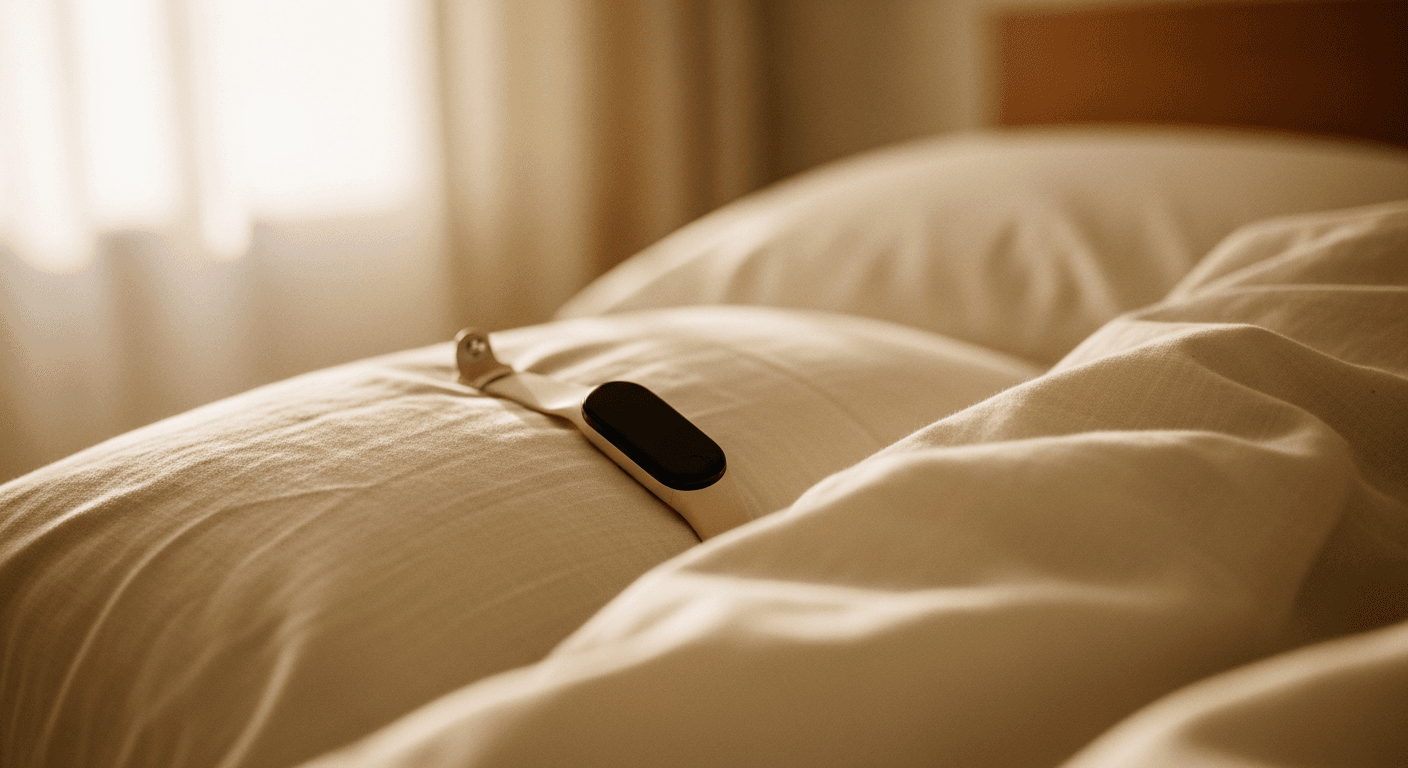
You wake up, grab your phone, open the Oura or WHOOP app. Recovery score: 47 out of 100. Deep sleep: too short. HRV: dropping. And before you've even moved out of bed, your day already feels off. You assume you'll be tired, your workout will suck, you should probably wind down early.
Five minutes before checking your tracker, you actually felt rested.
This loop has a clinical name now: orthosomnia. It was first described in a 2017 case series of patients in a sleep clinic, and it became a serious topic in 2025-2026 as wearable adoption hit critical mass. Today, clinicians identify orthosomnia as one of the leading reasons some patients show up to sleep clinics asking about insomnia.
What Wearables Actually Measure (and What They Don't)
Oura, WHOOP, Fitbit, Apple Watch, Garmin. All these devices estimate several metrics during your sleep: heart rate, heart rate variability (HRV), oxygen saturation, body temperature, and they attempt to break the night into sleep stages (light, deep, REM).
What's important to understand: these are statistical estimates, not direct measurements. The gold standard for measuring sleep is still in-lab polysomnography with scalp electrodes. Wearables approximate that, but with meaningful error margins, especially in distinguishing deep sleep from REM. Several comparative studies published between 2022 and 2025 placed sleep stage classification accuracy between 60 and 80 percent depending on the device. Useful for trends, unreliable for any single night.
The problem is that users read the output like a scientific verdict. And when the verdict reads 47 out of 100, the brain interprets it as a health alert, even when the underlying physiology is likely much less dramatic.
Recent Research: Daytime Function Beats Nighttime Scores
A 2026 study from the University of Maryland clarified what we should really be measuring to evaluate sleep quality. The researchers compared two approaches for assessing the effect of insomnia treatments: traditional recall questionnaires, and smartphone-based daytime function assessments (energy, focus, mood, physical performance).
The daytime assessments detected treatment effects far more powerfully than recall-based questionnaires. In other words, how you feel during the day is a better indicator of sleep quality than what you remember about your night, or what your wearable says about it.
This finding has a direct implication. If you feel rested, alert, and capable of effort, your sleep probably did its job, regardless of what score the tracker shows. Conversely, if you feel drained all day while your score reads 90, something else is going on — chronic stress raising your cortisol can quietly undermine recovery in ways no wearable will explain.
How Orthosomnia Develops
The standard pattern unfolds in three stages. First, the user starts wearing a tracker and finds the data interesting. They adjust a few behaviors (earlier bedtime, no caffeine after 2 pm) and see scores improve. The tracker becomes a useful tool.
Second, dependency builds. The user checks scores routinely after waking and starts associating their morning emotional state with the displayed number. A subjectively good night confirmed by a bad score creates dissonance that resolves in favor of the number. A subjectively bad night confirmed by a good score gets rationalized as an exception.
Third, performance anxiety sets in. The user starts trying to sleep well the way you'd try to pass an exam. They check the score multiple times per night. They modify sleep behaviors to optimize the tracker rather than optimize how they actually feel. Paradoxically, their sleep deteriorates. Performance anxiety is a known trigger for insomnia's most disruptive effects.
The Behaviors That Actually Drive Better Sleep
Before you check your tracker, look at your routines. The factors that reliably and measurably influence sleep are well established:
- Consistent bedtime within roughly 30 minutes, including weekends.
- No caffeine within 8 hours of bedtime for most adults.
- Limited or no alcohol, especially in the 3 hours before bed. Alcohol directly disrupts REM sleep.
- Daylight exposure in the first hour after waking.
- Regular physical activity, ideally more than 6 hours before bedtime.
- Cool bedroom, between 60 and 67 degrees Fahrenheit, dark and quiet.
None of these levers requires a wearable to identify or adjust. The objectivity of a tracker can be useful for confirming behavioral changes, but it's not the source of sleep quality. Your routines are.
How to Use Your Data Without Falling Into the Trap
If you already own a wearable and don't want to ditch it, here's an approach that limits orthosomnia risk:
First, look at your data in weekly averages, never in individual nights. One bad night means nothing. A 14-day trend is informative.
Second, don't check your score in the morning before consciously assessing how you feel. Note your subjective state first, then look at the tracker. If the two diverge often, trust your subjective state.
Third, use the tracker to identify causal relationships (alcohol effects, late caffeine, stress, jet lag), not to produce a verdict on your night. Effective recovery isn't measured in numbers. It's felt in performance and mood.
Fourth, accept that some variability is normal and physiological. Nobody sleeps perfectly seven nights a week. Chasing perfect sleep is exactly what creates orthosomnia.
When to Unplug Entirely
If you recognize yourself in the pattern (anxious morning checking, day shaped by the score, obsessive sleep adjustments for the tracker), the best intervention is probably a complete pause. Put the wearable away for two to four weeks. Observe your sleep and energy without quantified data. Resume later with more emotional distance.
The point of sleep isn't to produce good data. It's to function well the next day. Any metric that doesn't serve that final goal is, at best, noise. At worst, it's the trigger of the exact problem it claimed to solve.