
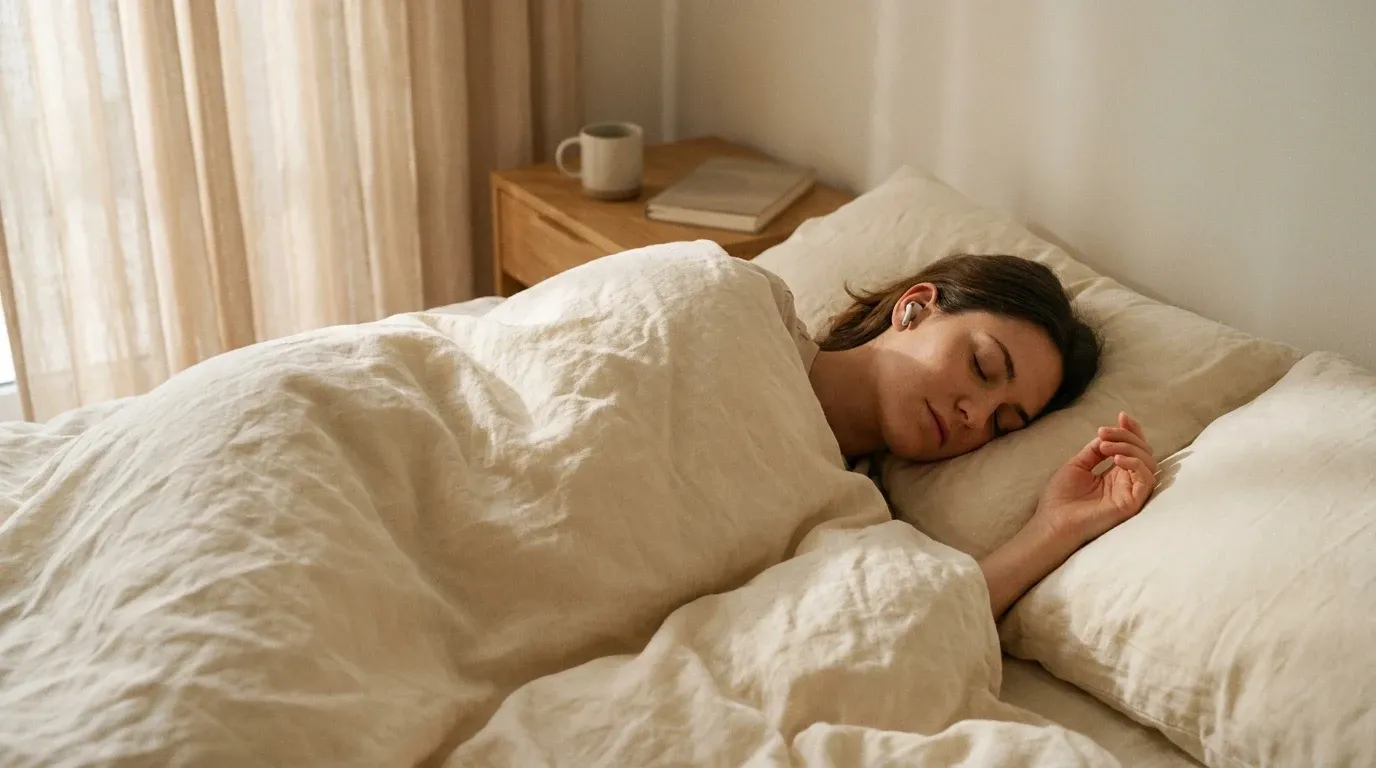
You're probably sleeping the right number of hours and still waking up exhausted. The problem isn't duration. It's depth. A growing body of research points to slow-wave sleep, the deepest stage of non-REM rest, as the real driver of recovery, memory consolidation, and hormonal repair. And a finding from MIT researchers suggests a surprisingly low-tech tool can push you further into that restorative stage: pink noise, delivered in precise bursts timed to your sleep cycles.
This isn't ambient noise as background filler. The nuance is everything, and most people using sleep playlists are currently missing it.
What the Research Actually Found
MIT researchers studying auditory stimulation during sleep found that short bursts of pink noise, synchronized to the slow oscillations of slow-wave sleep (SWS), measurably increased slow-wave activity in the brain. Crucially, this enhancement happened without fragmenting sleep architecture. Participants moved more deeply into SWS without being jolted into lighter stages or full waking.
The mechanism works because slow-wave sleep has a rhythm. The brain oscillates between "up" states (brief cortical activation) and "down" states (near-silence). Delivering a short burst of pink noise during the up state amplifies the wave, making it larger and more restorative. Continuous sound, by contrast, doesn't synchronize with anything. It just runs underneath your sleep and can actually suppress the natural oscillation pattern you're trying to enhance.
Pink noise itself sits between white noise (which hits all frequencies equally, producing a harsh hiss) and brown noise (which skews toward lower, rumbling frequencies). Pink noise rolls off at higher frequencies, producing a balanced, natural sound that researchers and listeners both describe as easier to tolerate across longer exposures. Think steady rainfall or a wind through trees.
Why Continuous Playback Doesn't Work the Same Way
This is where most sleep playlists and ambient noise apps fall short. Eight hours of unbroken pink noise has a masking effect. It can reduce environmental disruptions, which is useful, but it doesn't meaningfully amplify slow-wave activity because it isn't timed to anything. The brain has no synchronized signal to respond to.
The MIT protocol used closed-loop stimulation, meaning sensors detected each slow oscillation in real time and triggered a sound burst precisely at the peak. Consumer-grade sleep trackers can't replicate this perfectly, but the research also showed benefit from fixed-interval burst patterns that approximate the natural rhythm of slow oscillations, which occur roughly every 0.5 to 1 second during SWS.
Short bursts at that interval, even without live brainwave feedback, appear to produce measurable increases in slow-wave amplitude compared to silence or continuous noise. Several app developers have built this pattern into dedicated sleep sound tools, and it's worth knowing exactly what to look for before you download anything.
Practical Setup: Apps, Devices, and Positioning
You don't need expensive hardware to run a useful pink noise protocol. Here's what actually matters.
Choosing the right app
- Pzizz (iOS and Android, free tier available): Uses a proprietary audio engine that includes pulsed sound sequences timed to sleep stage estimates. It's not a perfect closed-loop system, but the pulsed delivery is closer to the research protocol than flat ambient audio.
- Sleep as Android (Android, free with premium option): Offers pink noise with a sonar-based sleep tracking function and can automate sound delivery based on detected sleep stages. One of the few consumer apps that attempts real timing integration.
- Endel (iOS and Android, subscription around $7/month): Generates adaptive soundscapes that shift in real time based on heart rate and movement data from connected wearables. The pink noise mode adjusts dynamically rather than looping a static file.
- Free option: YouTube and Spotify both carry pink noise tracks, but these are continuous files with no burst timing. If you use them, set a sleep timer so the audio cuts off after 30 to 45 minutes rather than running all night.
Speaker placement and volume
- Position a small Bluetooth speaker (a $30 to $60 portable unit works fine) on a nightstand at roughly arm's length from your head. You don't want the source directly at ear level.
- Target a volume between 40 and 50 decibels. That's roughly the sound level of a quiet conversation in another room. A free decibel meter app on your phone lets you calibrate before you fall asleep.
- Do not exceed 50 dB. Above that threshold, you risk masking environmental alarms, including smoke detectors and phone alerts you've designated as important. Sleep studies consistently flag this as the practical upper limit for safe overnight audio exposure.
- If you share a bed, a single compact speaker between both pillows at low volume is preferable to earbuds, which create pressure discomfort during sleep and carry long-term hearing risk at close range.
Timing the protocol
- Slow-wave sleep is front-loaded. Your deepest SWS stages occur in the first two to three sleep cycles, meaning the first three to four hours after you fall asleep carry the most restorative weight.
- If you're using a fixed-schedule approach without real-time tracking, set your app or speaker to run for the first 60 to 90 minutes after you expect to be asleep, then pause, then optionally run again 90 minutes later to catch a second SWS window.
- Many apps with timer functions let you set this interval automatically. "Sleep timer" and "schedule" features in apps like Sleep as Android make this straightforward to configure without manual interruption.
Who Benefits Most from This Protocol
Pink noise stimulation isn't a universal upgrade. It's most useful for specific profiles where slow-wave sleep is already being compromised.
Light sleepers are the clearest beneficiaries. If minor sounds, your partner shifting, street noise, or your own internal restlessness pull you out of deeper stages repeatedly, the masking effect of even non-timed pink noise reduces those disruptions. Combined with timed burst delivery, you get both a quieter environment and enhanced SWS depth when you do reach it.
High-stress individuals often show disrupted slow-wave architecture even when they log seven to eight hours. Elevated cortisol in the evening compresses the depth and duration of SWS. Pairing a pink noise protocol with intentional cortisol management before bed compounds the benefit. The evening routine that helps lower cortisol before bed is worth reading alongside this guide if stress is the underlying factor keeping your sleep shallow.
People over 40 experience a natural decline in slow-wave sleep amplitude that accelerates with age. Research consistently shows that SWS decreases measurably decade by decade, which partly explains why older adults feel less rested despite similar time in bed. Auditory stimulation appears to partially compensate for this decline by amplifying the slow oscillations that still occur.
People dealing with high training loads also have particular reason to prioritize SWS. Slow-wave sleep is the primary window for growth hormone release and muscle tissue repair. If you're following a consistent strength or conditioning program, the quality of your slow-wave sleep directly affects recovery speed. The same logic applies to anyone managing physical stress alongside mental stress, and it connects to why sleep-first strategies keep appearing in athletic performance research. For context on how recovery integrates with training, sleep and stress strategies busy professionals actually use covers the overlap between workload and sleep quality in useful detail.
Combining Pink Noise with a Broader Sleep Protocol
Pink noise works best as one layer of a sleep environment, not a standalone fix. The research gains are real, but they're modest if your pre-sleep routine is actively working against you.
Room temperature between 65 and 68 degrees Fahrenheit (18 to 20 Celsius) supports the core body temperature drop that triggers SWS onset. Total darkness, or a sleep mask, prevents light-based suppression of melatonin. Consistent sleep and wake times stabilize circadian rhythm so your slow-wave windows become predictable and deeper over time.
On the supplementation side, there's ongoing interest in compounds that support SWS specifically, including magnesium glycinate and certain adaptogenic herbs. The evidence varies considerably by substance. What science actually says about supplements most adults take gives a grounded breakdown of what holds up and what doesn't, which is useful before adding anything to your nighttime stack.
Stress load during waking hours also shapes what happens during sleep. Combining mindfulness with exercise for stress reduction has shown measurable downstream effects on sleep quality in recent meta-analyses, particularly for people carrying chronic mental load.
A Simple First-Night Setup
If you want to try this tonight without overthinking the configuration, here's a stripped-down starting point.
- Download Pzizz or Sleep as Android. Use the pink noise or pulsed sleep sound setting.
- Set the audio to run for 90 minutes starting from when you plan to be asleep (not when you get into bed).
- Place your phone or a small Bluetooth speaker on your nightstand. Use a free decibel meter app to confirm the volume lands under 50 dB.
- Keep the room cool, dark, and phone-screen-free for at least 20 minutes before you intend to sleep.
- Run the protocol for five consecutive nights before evaluating results. Single-night impressions are unreliable. The benefit accumulates as your brain learns to respond to the auditory cue.
Sleep research rarely produces tools this accessible. Most interventions require clinical settings, prescriptions, or significant behavioral overhaul. A well-configured pink noise protocol costs nothing beyond a speaker you probably already own and five minutes of app setup. The limiting factor isn't access. It's whether you apply the timing correctly, which is the one detail that separates the research protocol from a playlist you'd otherwise ignore by morning.