
Most people treat recovery as an afterthought. You finish a hard session, feel wrecked, sleep on it, and then maybe book a massage two days later or finally drag yourself to the pool for a slow swim on day three. It feels responsible. It feels like you're doing something. But according to a growing body of research, that timing is costing you real physiological benefit.
Cold-water immersion, massage, and active recovery are not tools you can deploy whenever it's convenient. They have a window. And that window closes faster than most athletes and gym-goers realize.
The 24-Hour Window: What the Research Shows
Multiple peer-reviewed studies now point to the same pattern: the three most widely used recovery modalities, cold-water immersion, soft-tissue massage, and low-intensity active recovery, all deliver their greatest physiological return when applied within the first 24 hours after intense exercise. After 48 to 72 hours, the measurable benefits drop sharply. In some cases, the intervention makes no statistically significant difference at all compared to passive rest.
The reason comes down to biology. In the hours immediately following hard exercise, your body is managing an acute inflammatory response, clearing metabolic byproducts like lactate and hydrogen ions, and beginning the process of muscle repair. These processes are time-sensitive. The tools that support them work best when they're introduced during, not after, this acute phase.
Once the acute phase resolves, typically somewhere between 36 and 60 hours post-exercise, your body has already handled most of the immediate chemical disruption on its own. Applying recovery tools at that point is a bit like mopping the floor after the water has already dried. You're not wrong to do it. You're just not doing much.
Cold-Water Immersion: Front-Load It or Lose the Benefit
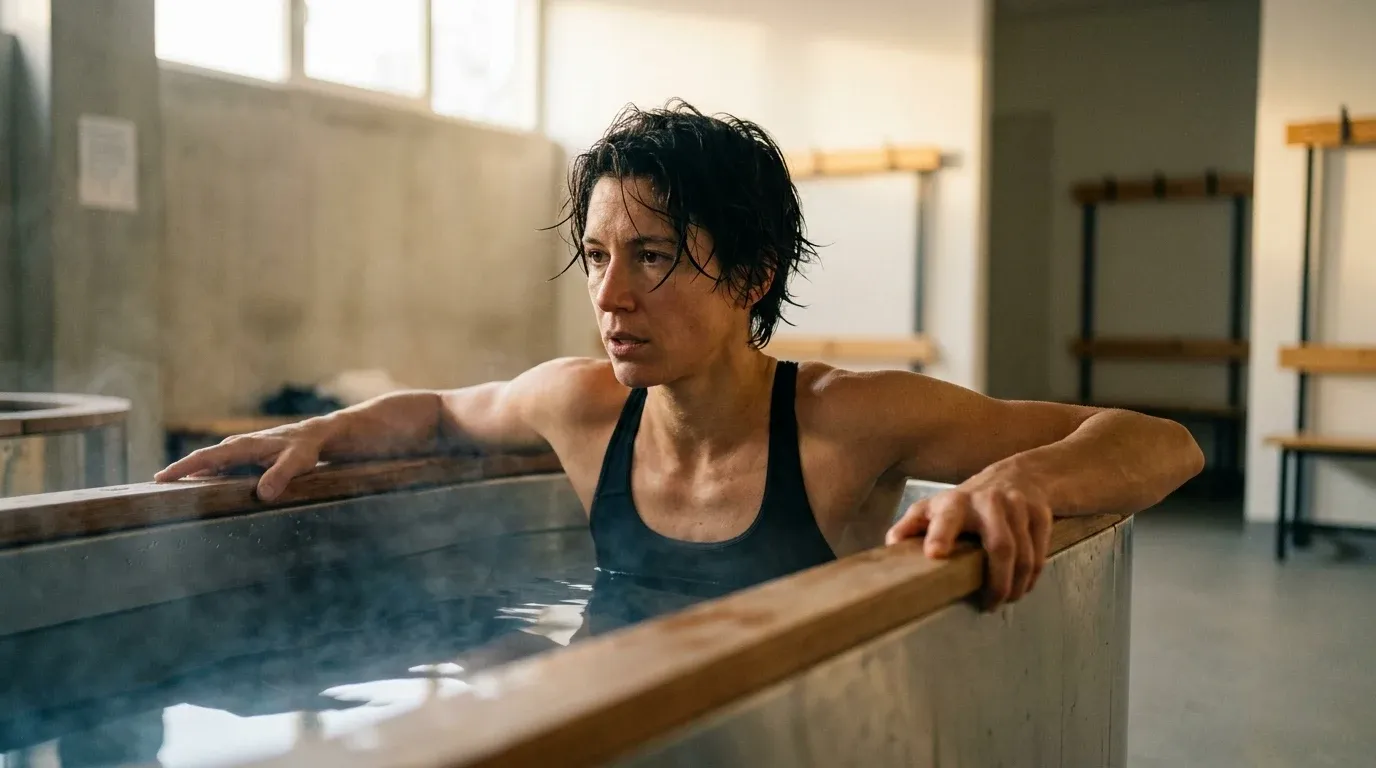
Cold-water immersion (CWI) is one of the most studied recovery tools in sports science, and the data on timing is consistent. Studies show that immersion in water between 10 and 15 degrees Celsius for 10 to 15 minutes, applied within the first few hours after exercise, significantly reduces muscle soreness and helps restore explosive performance capacity faster than passive rest alone.
Critically, CWI appears most effective for athletes whose primary goal is to perform again soon. If you've just done a hard lower-body strength session or a high-intensity interval workout and you need to compete or train again within 24 to 48 hours, cold water is your best option. It blunts the acute inflammatory response, reduces tissue swelling, and helps maintain neuromuscular function.
But that same anti-inflammatory effect becomes a liability if you delay it. Apply CWI at 72 hours, and you're dampening an inflammatory process that your body has largely already resolved. You're getting almost none of the performance-restoration benefit and potentially interfering with the later-stage muscle adaptation signals you actually want to keep.
There's also an important nuance for anyone focused on long-term muscle building. Research suggests that frequent use of cold-water immersion after resistance training may blunt hypertrophic adaptations over time by interfering with the anabolic signaling that follows inflammation. Timing and goal matter here more than most people appreciate. For a broader look at how training stimuli and recovery interact across a progressive plan, Progressive Overload: How to Explain It So Clients Get It lays out the physiology clearly.
Massage: Best for Perceived Soreness, Not Performance Restoration
Massage is the most popular recovery tool in professional sport, and for good reason. It works. But it works for a specific goal, and it works best within a specific timeframe.
The evidence supports massage most strongly as a tool for reducing delayed onset muscle soreness (DOMS) and improving perceived recovery, meaning how recovered you feel, rather than how recovered you are in measurable performance terms. Studies consistently show that massage applied within 24 hours post-exercise reduces soreness scores significantly more than massage applied at 48 or 72 hours.
The mechanism is partly mechanical, partly neurological. Soft-tissue work supports lymphatic drainage, reduces localized swelling, and may downregulate the nervous system's pain sensitization response. All of these effects are more pronounced during the acute post-exercise window when the tissue is still in an active inflammatory state.
If you're booking a sports massage for Thursday when you trained hard on Monday, you'll likely feel good on the table. But the data suggests you're getting a fraction of the physiological benefit you would have received on Monday evening or Tuesday morning.
Active Recovery: The Tool With the Shortest Window
Of the three main modalities, active recovery has the tightest effective window. Light movement, walking, cycling at low resistance, gentle swimming, or yoga-style mobility work supports circulation and accelerates the clearance of metabolic waste products. But this effect is most pronounced in the first 12 hours after a hard effort.
The physiology is straightforward. During intense exercise, your body accumulates metabolic byproducts and experiences localized blood flow disruption in fatigued muscle groups. Low-intensity movement increases cardiac output just enough to improve circulation without creating additional stress. It acts as a gentle pump, moving blood through tissues and supporting the delivery of oxygen and nutrients to damaged muscle fibers.
After 12 to 24 hours, the body's own resting circulation has largely caught up. A 20-minute walk at hour 36 post-training isn't harmful. It's just not doing the circulatory heavy lifting that the same walk would have done at hour four or six. For a complete breakdown of what to prioritize across the full first day after a hard session, What to Do in the First 24 Hours After a Hard Workout is worth reading alongside this piece.
The Mistake Most People Are Making
Here's the pattern that this research directly challenges. You train hard on a Monday. You feel sore on Tuesday, so you rest completely. By Wednesday you're stiff and uncomfortable, so you finally book a massage for Thursday or do a light jog on Friday. You feel a bit better and assume the recovery tools worked.
What actually happened is that your body recovered on its own timeline, and the tools you applied were too late to meaningfully accelerate that process. The soreness you're feeling by Wednesday is a later-stage symptom of tissue remodeling, not the acute inflammatory peak that recovery tools are designed to address.
This is not about dismissing rest. Passive rest is an essential part of recovery, particularly for sleep quality and hormonal restoration. The point is that rest and recovery tools are not interchangeable. Doing nothing for 24 hours and then reaching for cold water or massage is a sequencing error, not a strategy.
This timing problem becomes even more consequential for older athletes, where the recovery curve already moves more slowly. Why Your Muscles Lose Strength as You Age explains why the neuromuscular system becomes less efficient at bouncing back and why front-loading recovery is not optional for athletes over 40.
Matching Method to Goal: A Practical Framework
Rather than picking one recovery tool and applying it whenever it's convenient, the smarter approach is to match the method to your specific goal within the relevant timeframe.
- Goal: Restore explosive performance quickly. Use cold-water immersion within two to six hours post-exercise. Prioritize this if you need to compete or train at high intensity again within 24 to 48 hours.
- Goal: Reduce perceived soreness and feel better faster. Use massage within 12 to 24 hours post-exercise. This is the window where soft-tissue work has the strongest effect on DOMS and subjective wellbeing.
- Goal: Support circulation and speed metabolic clearance. Do light active recovery within the first four to 12 hours. A 20 to 30 minute walk, easy bike ride, or gentle mobility session is enough. Don't overthink the modality.
- Goal: Long-term muscle adaptation (hypertrophy focus). Use cold-water immersion selectively, not habitually after every strength session. Preserve the inflammatory signal that drives muscle growth.
These goals can overlap. If you've just finished a hard competition day, you might do a 15-minute walk within the first hour, followed by cold-water immersion in the evening, and schedule a massage for the following morning. That sequencing makes sense. What doesn't make sense is waiting 48 hours and then trying to accomplish all three at once.
What This Means for Your Weekly Training Structure
If you're training multiple times per week, recovery timing stops being optional. It becomes part of programming. A well-structured training week includes not just the sessions but also the recovery windows, planned and protected, in the hours immediately following high-intensity work.
This is especially relevant for athletes managing a strength and cardiovascular split. The recovery demands and the most useful modalities differ depending on what kind of stress you've imposed. Strength vs. Cardio After 40: What a Coach Should Prescribe addresses exactly this kind of programming challenge for athletes who need to balance both modalities without compromising recovery between sessions.
The broader takeaway is simple. Recovery tools are not passive add-ons you deploy when you get around to it. They're time-sensitive interventions with a biological window. Use them early, match them to your goal, and don't let the best 24 hours pass before you act.