
Recovery supplements are now one of the fastest-growing segments in sports nutrition, with the global market projected to exceed $8 billion by 2027. Walk into any supplement store or scroll through a fitness feed and you'll find products promising faster muscle repair, deeper sleep, and reduced soreness. Most of those promises rest on shaky ground.
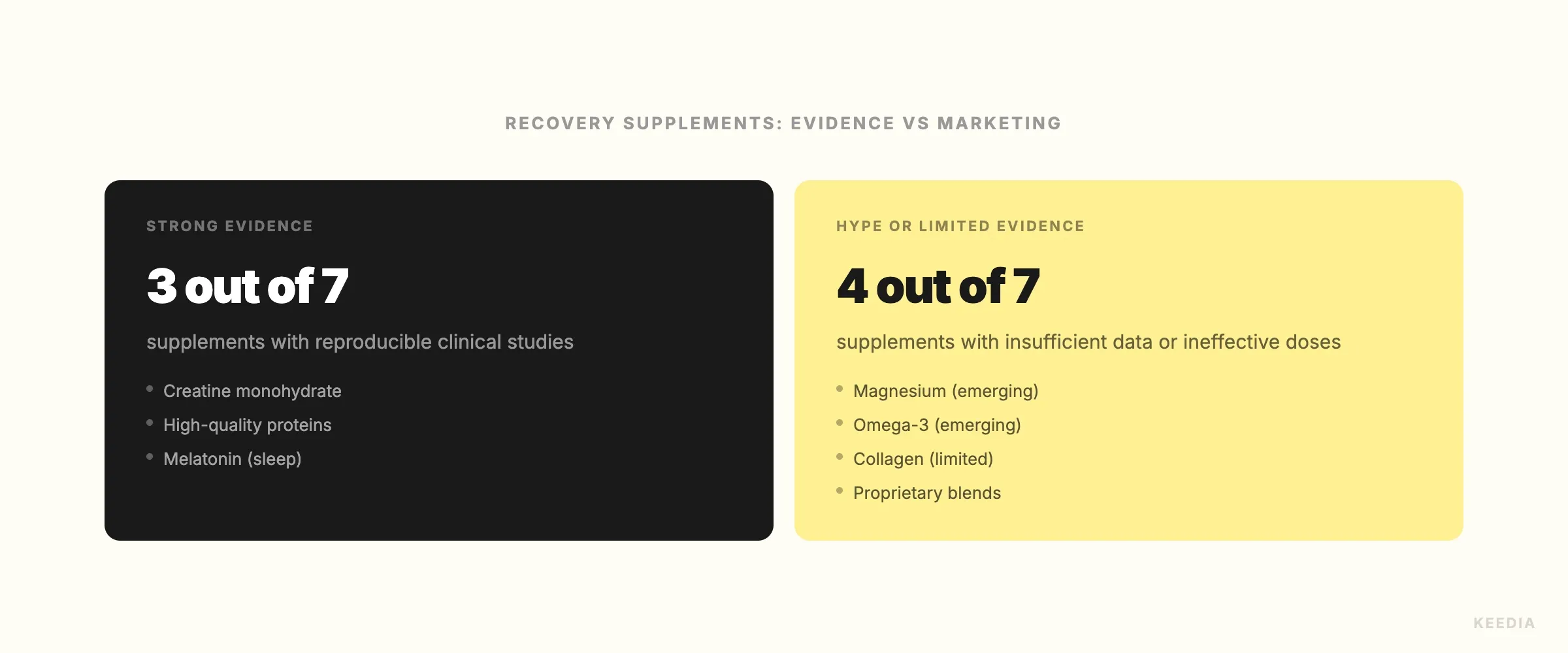
That doesn't mean every supplement is worthless. A handful have genuine, multi-study support. Others show early promise but need more research. And some are largely marketing with a scientific-sounding label slapped on. Here's how seven of the most talked-about recovery supplements actually stack up.
Before the Supplements: What Research Rates Highest
Before spending a dollar on capsules or powders, it's worth being clear on one thing: no supplement outperforms the basics. Sleep quality, protein intake, hydration, and stress management consistently rank as the highest-leverage recovery tools in the clinical literature. As covered in Recovery Done Right: Basics Beat Gadgets Every Time, the fundamentals deliver results that even the best-evidenced supplements can only modestly build on.
Supplements work at the margin. That margin matters more when you're already doing the foundational work. With that framing in place, here's the breakdown.
1. Creatine Monohydrate: Strong Evidence
Creatine is the most researched supplement in sports science, full stop. Dozens of randomized controlled trials confirm it supports muscle recovery, reduces exercise-induced muscle damage, and helps maintain performance across repeated bouts of effort. It works by replenishing phosphocreatine stores in muscle tissue, accelerating recovery between high-intensity sessions.
Dosing is well established: 3 to 5 grams daily, taken consistently. Timing matters less than consistency. It's safe for most healthy adults, and the monohydrate form is equally effective as any premium branded version sold at three times the price. If you train regularly, creatine is the one supplement with the evidence to justify routine use.
2. Protein Supplementation: Strong Evidence
Protein isn't a "supplement" in the traditional sense, but protein powders and shakes are widely marketed as recovery aids. The evidence here is robust: adequate protein intake is essential for muscle protein synthesis, and post-exercise protein consumption accelerates repair of damaged muscle fibers.
The critical variable is total daily intake, not just the post-workout window. Research suggests active adults need between 1.4 and 2.0 grams of protein per kilogram of body weight per day to support recovery and adaptation. How Much Protein Do You Actually Need Based on Your Activity Level? breaks that math down clearly by training volume. Whey protein has the strongest evidence among protein sources due to its leucine content and absorption speed, but high-quality plant blends work well when consumed in sufficient quantities.

3. Magnesium: Emerging Evidence
Magnesium plays a role in over 300 enzymatic processes, including muscle contraction, nerve function, and protein synthesis. Many active adults are deficient, partly because sweat increases loss. Some research links magnesium supplementation to improved sleep quality and reduced muscle cramps, both relevant to recovery.
The evidence is promising but not as consistent as creatine or protein. Studies on magnesium and sleep show meaningful improvements in sleep onset and duration, particularly in people who start out deficient. AI Is Finding Sleep Insights Doctors Routinely Miss highlights how sleep quality gaps often go undetected until measured carefully. Forms matter here: magnesium glycinate and magnesium threonate show better absorption and tolerability than magnesium oxide. A dose of 200 to 400 mg before bed is the range most studies have used.
4. Omega-3 Fatty Acids: Emerging Evidence
Omega-3s, primarily EPA and DHA from fish oil, have well-documented anti-inflammatory effects. Several studies show reduced delayed onset muscle soreness (DOMS) and lower markers of exercise-induced inflammation with consistent omega-3 supplementation. Two to three grams of combined EPA and DHA daily appears to be the effective range.
The catch is that most studies are short-term and involve relatively small sample sizes. Omega-3s aren't a fast-acting recovery tool. They work over weeks and months of consistent use by modulating the inflammatory response at a cellular level. If your diet already includes fatty fish two or three times per week, your baseline intake may already be adequate. If it doesn't, supplementation is a reasonable option, and food-first approaches using sources like healthy fats from whole foods complement supplementation well.
5. Tart Cherry Extract: Emerging Evidence
Tart cherry juice and concentrated extracts have attracted genuine scientific attention over the past decade. Studies in endurance athletes and resistance trainers show reductions in DOMS, lower inflammation markers, and improved sleep quality. The active compounds are anthocyanins, which have antioxidant and anti-inflammatory properties.
The evidence base is growing but still moderate. Most trials are small, and the research is weighted toward endurance sport contexts. That said, the safety profile is excellent and the mechanisms are plausible. For athletes in hard training blocks or around competitions, tart cherry extract is one of the more credible emerging options. Around 480 mg of montmorency tart cherry extract twice daily has been the common study dose.
6. Branched-Chain Amino Acids (BCAAs): Mostly Hype
BCAAs were once considered essential for recovery, but the research picture has shifted significantly. Studies now consistently show that BCAAs offer no meaningful recovery advantage when total protein intake is already adequate. The leucine, isoleucine, and valine in BCAA supplements are present in far greater quantities in a standard serving of whey protein or whole food protein sources.
You're paying a premium for an isolated fraction of what's already in your food. If your daily protein intake meets the thresholds outlined in point two above, BCAA supplementation adds little. It's not harmful, but it's an unnecessary expense for most active adults. Redirect that budget toward creatine or a quality omega-3 product.
7. Glutamine: Mostly Hype
Glutamine is the most abundant amino acid in muscle tissue, and that fact has been used to market it aggressively as a recovery aid. The theory sounds compelling. The evidence doesn't support it for most people. Multiple reviews of the literature find no significant benefit from glutamine supplementation on muscle recovery or soreness in athletes who already consume adequate dietary protein.
There is a narrow context where glutamine may have clinical relevance: extreme endurance events or illness-related gut permeability. But for recreational to moderately competitive athletes doing strength or interval training, the evidence simply isn't there. This is one of the clearest cases where marketing has run well ahead of the science.
How to Use This Information Practically
The picture that emerges from the evidence is actually quite simple. Two supplements. creatine and sufficient protein. have strong enough support to recommend routinely for active adults. Two others. magnesium and omega-3s. are worth considering, particularly if dietary intake is low or training load is high. Tart cherry extract is a reasonable short-term tool for competitive periods. BCAAs and glutamine are largely redundant if your diet is in order.
Timing matters less than consistency for most of these. Creatine works the same taken morning or evening. Protein synthesis is supported throughout the day, not only in a 30-minute post-workout window. Magnesium is best taken before bed. Omega-3s simply need to be taken daily.
One practical point worth stating directly: supplements interact with training load. What helps a person running 50 miles a week may be irrelevant to someone doing three gym sessions. As you build a structured training plan, working with a qualified coach helps you calibrate both training and recovery appropriately. How to Find a Personal Trainer in 5 Steps is a useful starting point if you're building out that support structure.
The Hierarchy That Actually Matters
Even with all the evidence sorted, supplements occupy the smallest tier of the recovery hierarchy. Sleep quantity and quality sit at the top. Protein and caloric adequacy come next. Stress management, hydration, and training periodization round out the foundation. Research on recovery as a longevity strategy makes clear that consistent, foundational habits compound over years in ways that no capsule can replicate.
Supplements are a finishing layer, not a foundation. Treat them that way, prioritize the options with actual evidence, and you'll spend less money while recovering better than most people in your gym.