
Most people think of a sleep study as something you do when your partner complains about your snoring. In reality, a polysomnography is one of the most information-dense tests available in modern medicine. It reads your brain, your heart, your lungs, and your muscles all at once, while you're doing the one thing you can't fake: sleeping.
If you're an active adult or athlete who takes recovery seriously, understanding what this test actually measures could change how you think about your training, your rest, and your long-term health.
What a Sleep Study Actually Records
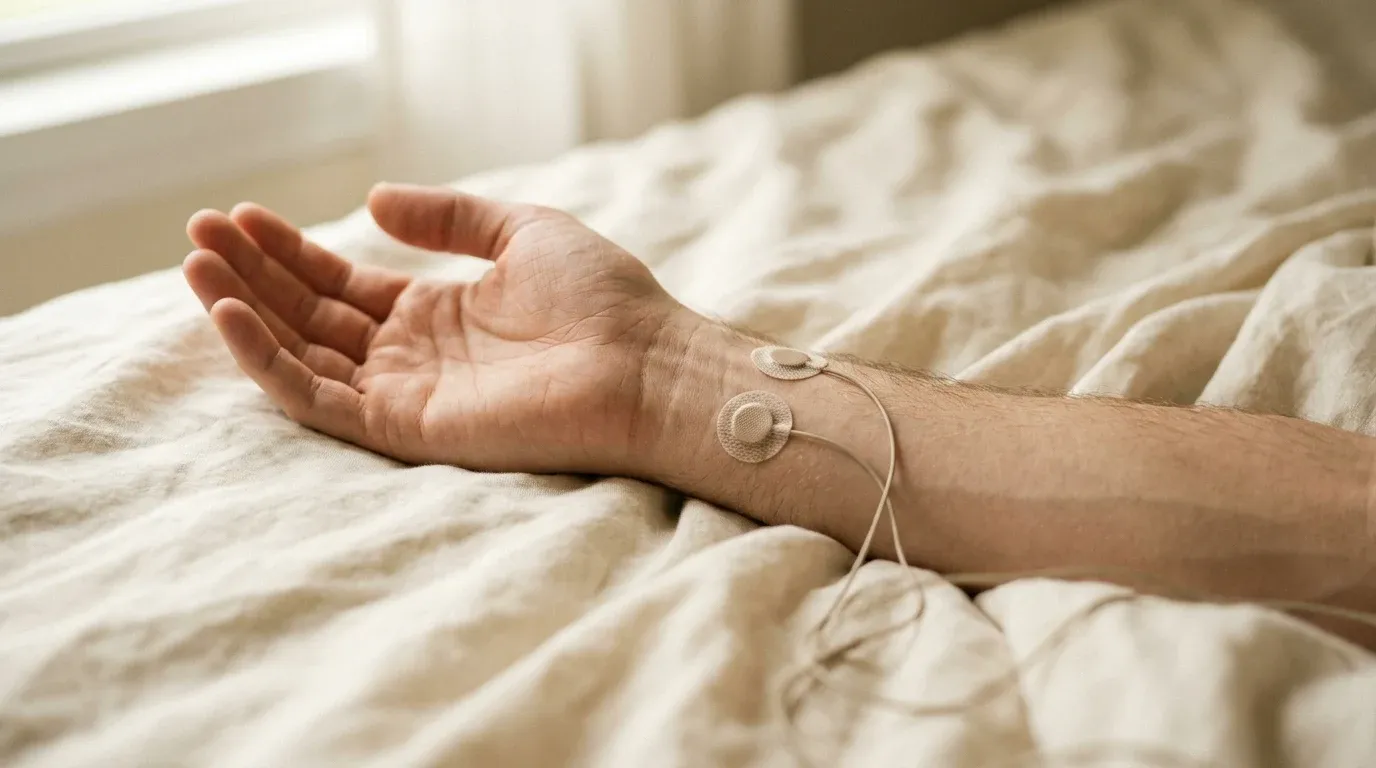
During a standard polysomnography, technicians attach sensors across your body before you fall asleep. Each sensor is watching something different, and together they build a picture that no single specialist could construct alone.
Here's what's being recorded simultaneously:
- Electroencephalogram (EEG): Measures brain wave activity to track sleep stages, including light sleep, deep slow-wave sleep, and REM.
- Electrocardiogram (ECG): Monitors heart rate and rhythm, flagging irregularities like arrhythmias that only appear during specific sleep stages.
- Pulse oximetry: Tracks blood oxygen saturation continuously, revealing drops that signal breathing disruptions.
- Respiratory effort belts: Placed around the chest and abdomen to measure how hard you're working to breathe.
- Airflow sensors: Detect actual air movement at the nose and mouth, independent of effort.
- Electromyogram (EMG): Records muscle activity in the legs and chin, catching restless leg movements and sleep paralysis abnormalities.
- Electrooculogram (EOG): Tracks eye movements to confirm REM sleep entry and duration.
The result is a multi-channel data stream that runs for six to eight hours. Sleep medicine specialists describe it as a masterclass in physiology precisely because no other routine clinical test captures so many organ systems interacting in real time.
What Your Heart Does While You Sleep
Your cardiovascular system doesn't clock out at night. During healthy sleep, heart rate drops and blood pressure follows what researchers call a "dipping" pattern. This overnight dip is genuinely protective. Studies have consistently linked non-dipping patterns to higher risk of cardiovascular events, independent of daytime blood pressure readings.
A sleep study catches this. The ECG data can reveal nocturnal arrhythmias, bradycardia episodes, or sustained elevated heart rate that would never show up during a standard clinical visit. For athletes, a chronically elevated resting heart rate during sleep is often one of the earliest measurable signals of overtraining or accumulated fatigue.
Obstructive sleep apnea (OSA) is where the cardiology signal becomes urgent. Each apnea event forces the heart to work harder against a closed airway, triggering surges in blood pressure and stress hormones. Over time, untreated OSA is associated with hypertension, atrial fibrillation, and left ventricular dysfunction. The sleep study catches these events with precision that wearables simply cannot match.
What Your Lungs Are Telling the Study
The pulmonology layer of a sleep study is where breathing patterns get dissected in detail. Technicians distinguish between obstructive apneas (airway physically blocked), central apneas (the brain fails to send the breathing signal), and hypopneas (partial reductions in airflow). Each has different causes and different treatment paths.
Oxygen saturation data tells the second half of the story. A healthy sleeper maintains SpO2 above 95 percent throughout the night. When oxygen dips repeatedly below 90 percent, it's called nocturnal hypoxemia. For endurance athletes, this matters because repeated hypoxemic episodes impair the body's ability to manage oxidative stress, blunt erythropoietin signaling, and disrupt the hormonal repair processes that make training adaptations stick.
Respiratory effort data adds context that airflow sensors alone can't provide. Upper airway resistance syndrome, for example, produces arousals and fragmented sleep without full apneas, making it invisible to simpler home testing but visible in full polysomnography.
Why Sleep Architecture Matters for Athletes
Your body doesn't recover evenly across all sleep stages. Deep slow-wave sleep, technically called N3, is when growth hormone secretion peaks. This is the stage most directly linked to tissue repair, glycogen replenishment, and immune function. REM sleep handles memory consolidation, motor learning, and emotional regulation, all of which affect how well you absorb coaching feedback and manage competitive stress.
A sleep study maps exactly how much time you spend in each stage and how often you're yanked out of them. Fragmented sleep architecture, even without a diagnosable disorder, measurably harms performance. Research consistently shows that insufficient slow-wave sleep correlates with higher perceived exertion on subsequent training days, reduced reaction time, and impaired protein synthesis.
As detailed in Why Recovery Takes Longer After 40 (And What to Do), sleep architecture shifts with age in ways that compound training stress. N3 sleep declines naturally, making the preservation of whatever deep sleep you do get even more critical after your late thirties.
This is also why nutrition timing and composition are not trivial. Sleep and Food Still Beat Every Recovery Gadget outlines the evidence clearly: no device substitutes for sleep quality, and dietary patterns directly influence how long you spend in restorative stages.
Wearables vs. Clinical Testing: Where the Line Is
Consumer wearables have improved substantially. Devices from major brands now estimate sleep stages using heart rate variability, accelerometry, and peripheral temperature. Some have received regulatory clearance to flag potential atrial fibrillation or low oxygen saturation. These are genuinely useful screening tools.
But they're screening tools, not diagnostic instruments. A wearable estimates sleep stages using algorithms trained on population-level data. A polysomnography measures your actual brain waves. That distinction matters when the question shifts from "how did I sleep generally?" to "do I have a condition that requires treatment?"
OSA diagnosis still requires either a full in-lab polysomnography or, for straightforward cases, a validated home sleep apnea test interpreted by a sleep physician. Conditions like central sleep apnea, periodic limb movement disorder, and REM sleep behavior disorder cannot be reliably detected by wearables at all.
If your wearable is consistently flagging poor sleep, elevated resting heart rate, or low overnight SpO2, treat that as a prompt to seek clinical evaluation rather than a diagnosis in itself.
How to Advocate for Yourself
Many athletes and active adults who would benefit from a sleep study never get referred for one. Primary care providers often don't ask about sleep quality in the context of athletic performance, and patients often don't raise it. Knowing what to ask changes that dynamic.
If you're experiencing any of the following, a referral to a sleep specialist is worth pursuing directly:
- Persistent fatigue despite adequate training load and recovery time
- Morning heart rate that's elevated or erratic compared to baseline
- Waking with headaches, dry mouth, or a sense of unrefreshed sleep
- Wearable data showing repeated overnight oxygen dips
- A bed partner reporting witnessed apneas, gasping, or restless movement
- Plateaued performance without an obvious training explanation
When you see your doctor, frame it around measurable signals rather than vague tiredness. Mention specific data points from your wearable. Ask explicitly whether a home sleep test or full polysomnography is appropriate. Sleep medicine is a specialty with real diagnostic tools, and you're entitled to use them.
The same principle applies to strength and conditioning. What Hiring a Trainer Teaches You About Your Body makes the case that working with experts who read data about your specific physiology produces better outcomes than generic advice. Sleep medicine works the same way.
The Bigger Picture for Long-Term Health
A sleep study is not just a diagnostic tool for sick people. It's a window into how your cardiovascular system, respiratory system, and nervous system cooperate under the conditions that govern a third of your life. For anyone serious about longevity and sustained athletic performance, that information is genuinely valuable.
Conditions identified and treated early through sleep studies, particularly OSA, have shown significant downstream benefits for blood pressure control, metabolic health, and cognitive function. These aren't marginal gains. They're the kind of compounding health improvements that support decades of active living.
If you're building a structured training program, The Weekly Lifting Sweet Spot Coaches Should Know covers how to structure resistance work for long-term health. But even the most carefully designed program underperforms when the sleep driving adaptation is compromised.
Your training is only as good as the recovery it's built on. A sleep study tells you, in detail, what's actually happening during those hours. That's not a niche medical test. For an athlete or active adult who takes their health seriously, it's one of the most practical assessments available.