
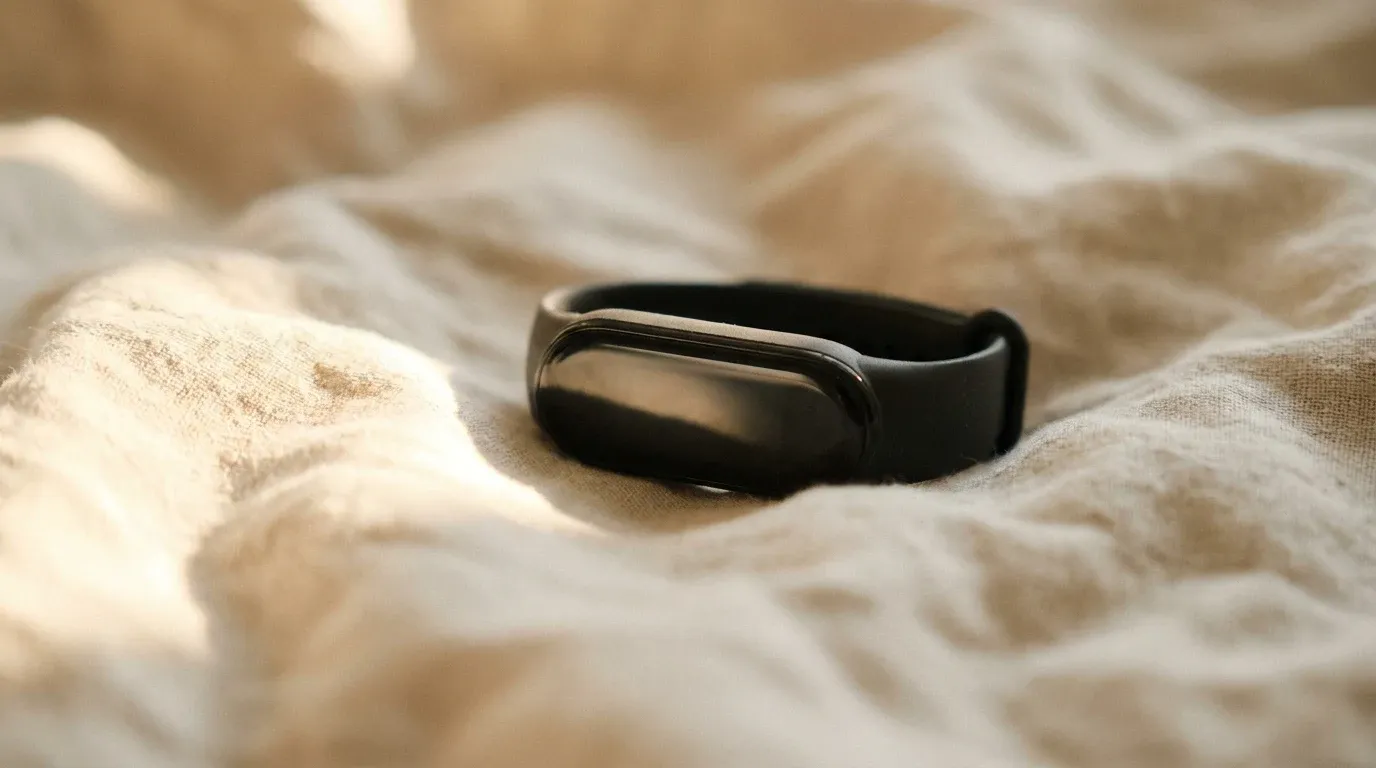
You wake up groggy, take three cups of coffee to feel human, and spend the afternoon fighting your eyelids. Then you check your tracker. Eight hours logged. Score: 87. Green across the board.
Something doesn't add up. And according to research out of Penn State, your instinct is right. The score isn't lying exactly. It's just measuring the wrong thing.
What the Penn State Research Actually Found
A study from Penn State researchers examined how bedroom environmental factors affect sleep quality independent of total sleep duration. The findings were pointed: conditions like elevated noise, light exposure, and temperature disrupted sleep architecture measurably, increasing awakenings and suppressing slow-wave and REM sleep, without significantly reducing the total hours logged by participants.
That distinction matters more than it might sound. Most consumer wearables and sleep trackers treat duration as the headline metric. It's the number on your morning dashboard. It's what gets color-coded green or red. But duration is a blunt instrument. You can spend eight hours in bed cycling through fragmented, shallow sleep and still hit your "goal."
The Penn State findings confirm what sleep researchers have known clinically for years: it's entirely possible for your environment to steadily erode sleep quality while every metric your tracker reports looks perfectly fine.
What Your Tracker Is Actually Measuring
To understand the gap, you need to understand what wearables can and can't detect. Most devices on the market use a combination of accelerometry (movement detection) and photoplethysmography (optical heart rate sensing). Some premium models add skin temperature and blood oxygen sensors.
From this data, trackers infer sleep stages using proprietary algorithms. The key word is infer. They're not reading your brain waves. Polysomnography, the clinical gold standard, places electrodes directly on your scalp to measure electrical brain activity. That's what produces a reliable picture of how much time you spent in deep sleep versus light sleep versus REM.
Your wristband is estimating. And it tends to estimate reasonably well for total sleep time. It's far less accurate when it comes to staging, particularly distinguishing light sleep from wakefulness, which is precisely the kind of fragmentation that a noisy or bright environment causes.
Studies comparing consumer wearables to polysomnography have found that most devices overestimate sleep efficiency and struggle to accurately detect brief awakenings. In other words, when your environment is waking you up for 90 seconds at a time, your tracker likely isn't counting those as wake periods. It's logging sleep. The score stays green.
The Specific Environmental Factors That Damage Sleep Architecture
The Penn State research focused on the bedroom environment as a system. Several factors emerged as consistently problematic.
- Noise: Even sounds that don't fully wake you can trigger cortical arousals, brief shifts in brain activity that fragment sleep without producing conscious waking. Traffic, a partner's snoring, or an HVAC system cycling on and off can all do this throughout the night.
- Light: Your circadian system is sensitive to light even through closed eyelids. Streetlights through thin curtains, standby LEDs, or early morning sunrise can suppress melatonin production and pull you toward lighter sleep stages prematurely.
- Temperature: Core body temperature needs to drop to initiate and maintain quality sleep. A bedroom that's too warm, typically above 67 to 68 degrees Fahrenheit, has been associated with reduced slow-wave sleep and more frequent awakenings.
- Air quality: Elevated CO2 levels in poorly ventilated rooms have been linked to more frequent arousals and subjective reports of worse sleep quality, even at concentrations that don't produce any noticeable symptoms while awake.
None of these factors necessarily shorten the time you spend in bed. All of them can degrade the biological value of the sleep you're getting.
How to Audit Your Sleep Beyond the Score
The tracker isn't useless. It's giving you part of the picture. Your job is to fill in the rest. Here's a practical framework for doing that.
Start with subjective data, and take it seriously. How you feel in the morning is a legitimate data point. Researchers use validated tools like the Pittsburgh Sleep Quality Index and the Epworth Sleepiness Scale for exactly this reason. You don't need the formal version, but ask yourself honestly: Do you feel rested within 20 minutes of waking? Do you need caffeine to function before 10 a.m.? Do you feel a significant energy dip between 2 and 4 p.m.? Consistent "yes" answers alongside a green tracker score is a signal worth investigating.
Track your sleep onset and your wake episodes separately. Many trackers log this if you dig into the data. A healthy sleeper typically falls asleep within 10 to 20 minutes. If you're lying awake for 45 minutes each night but eventually clocking eight hours, your total duration looks fine but your sleep onset latency is flagging a problem. Same principle applies to mid-night wakings you do remember.
Do a physical audit of your bedroom environment. You don't need expensive equipment to start. Close your bedroom door at midnight and stand still for two minutes. What do you hear? A white noise test like this reveals ambient noise you've habituated to. Then check light: put your hand in front of your face in complete darkness. If you can see it, the room isn't dark enough. Check your thermostat. Most people keep bedrooms several degrees warmer than the recommended 65 to 68 Fahrenheit range.
If you want objective environmental data, basic CO2 monitors and noise-level apps cost between $30 and $80 and can log overnight readings. A consistent CO2 reading above 1,000 ppm in your bedroom is worth addressing with better ventilation.
Look at tracker trends, not single nights. One night of poor subjective sleep proves nothing. But if your tracker shows consistent sleep efficiency below 85% over two weeks, or HRV values that are trending downward without a corresponding increase in training load, that pattern is meaningful. Pair that with your environmental audit data and you're building a real picture.
Where Exercise Fits Into This
Environmental changes aren't the only lever available. The relationship between daily physical activity and sleep quality is well-established and worth considering alongside any environmental intervention. Research has consistently shown that even modest daily movement improves sleep architecture, particularly deep slow-wave sleep, which is the stage most easily disrupted by environmental factors.
If you're looking at ways to improve your sleep quality beyond adjusting your thermostat, 10 Minutes of Daily Exercise Unlocks Deeper Sleep covers the specific mechanisms and what the evidence actually supports for sleep depth improvement.
For those in their 60s or older, the stakes are higher. Sleep architecture changes naturally with age, with less time spent in deep sleep and more frequent awakenings. Environmental disruptions compound those changes. How a Trainer Would Coach You in Your 60s addresses the broader physical context that intersects with sleep quality as the body changes.
When the Problem Might Be Bigger Than Your Bedroom
It's worth naming one scenario where the tracker-versus-reality gap signals something more significant. If you've cleaned up your sleep environment, your bedroom is dark, cool, and quiet, and you're still waking exhausted with a green score, consider whether fragmented sleep is being caused by something your tracker definitely can't detect: a breathing disorder.
Sleep apnea, in particular, is dramatically underdiagnosed. It causes repeated micro-arousals throughout the night that most consumer trackers classify as continued sleep. The result is the same pattern: hours logged, low felt restoration. Sleep Apnea Treatment Is Getting Personal in 2026 outlines how diagnostic and treatment options have evolved if you think this might apply to you.
The broader point is that a number on a screen, however sophisticated the algorithm behind it, is not the same as restful sleep. Your tracker is a useful tool for trend monitoring and habit reinforcement. It's not a clinical assessment.
Building a Smarter Picture
The Penn State findings do something useful: they put a research frame around something many people have sensed but struggled to articulate. You can sleep eight hours in the wrong conditions and still be running a sleep debt. Duration is not quality. And quality is not something most trackers are actually equipped to measure well.
The practical response isn't to throw out the tracker. It's to treat the score as one input among several. Add your subjective morning assessment. Log your sleep onset time. Audit the physical conditions of your bedroom with the same seriousness you'd give to your nutrition or training. And look at trends over weeks, not the green badge on Tuesday morning.
If you're also thinking about how lifestyle factors accumulate over time and what they mean for your long-term health, Living Longer Disease-Free: What Your Diet Actually Does covers the intersection of daily habits and healthspan in a way that connects directly to sleep's role in recovery and longevity.
The tracker is a starting point. You're the one who has to interpret what it's telling you and, more importantly, what it isn't.