
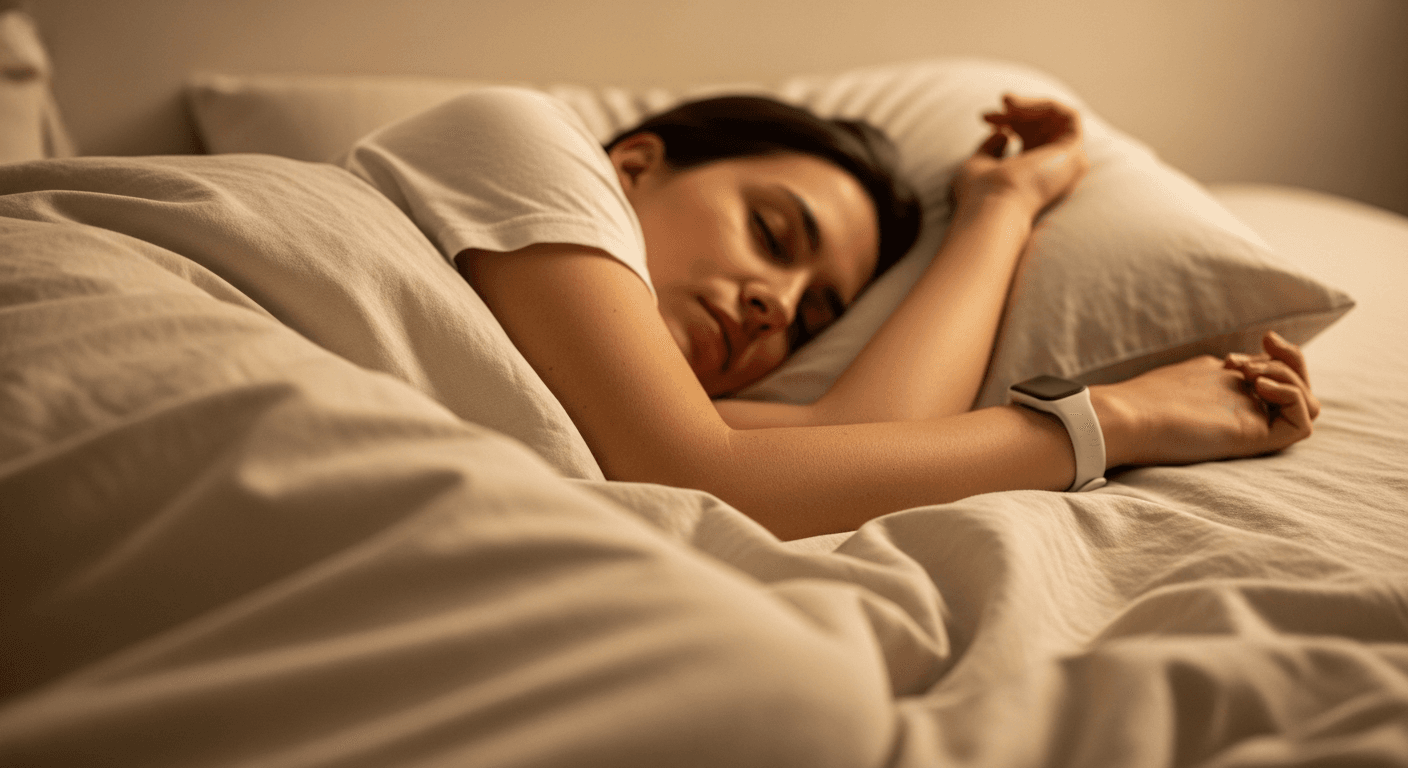
In 2026, a Stanford research team published work that's about to change how preventive medicine uses sleep data. By training AI models on standard polysomnography recordings, the researchers showed they could flag elevated risk for cardiovascular disease, neurological disorders, and metabolic dysfunction years before any clinical symptoms appeared.
Sleep carries diagnostic information that physicians alone weren't extracting. AI sees it.
What the Machine Sees in Your Nights
A standard sleep study captures multiple physiological signals in parallel. Heart rate, heart rate variability, oxygen saturation, sleep stages, breathing patterns, micro-arousals, involuntary muscle activity, and many more.
Taken individually, each of these signals is used to diagnose a specific sleep disorder. Sleep apnea, narcolepsy, insomnia. Taken together and analyzed across tens of thousands of nights by AI models, they tell a much broader story.
The Stanford researchers showed that models trained on this data identified signatures associated with diseases that had no visible clinical manifestation yet. A slightly reduced heart rate variability combined with subtle fragmentation of REM cycles. That's a pattern humans don't pick up. For AI, it's a signal.
Why This Research Matters Beyond the Lab
The critical detail is that the signals captured in the lab are largely similar to what consumer wearables already measure across millions of people. Oura, WHOOP, Fitbit, Apple Watch, Garmin. All of these platforms capture heart rate, heart rate variability, oxygen saturation, and sleep stage estimates.
The gap between medical-grade data and wearable data has narrowed considerably in the past three years. Wearable algorithms don't yet match clinical polysomnography for diagnosing something like sleep apnea. But for longitudinal trend analysis across hundreds of nights, they capture enough information that a properly trained AI model can extract meaningful signal.
The practical implication is massive. If an Apple Watch or an Oura ring can eventually feed a model that detects elevated cardiovascular risk two or three years before symptoms, that transforms preventive medicine into a mass-scale tool. Not an annual cardiologist visit, but passive continuous surveillance that triggers a consultation at the right moment.
The Trap of Optimizing Sleep Alone
Parallel research published by the University of Maryland in 2026 adds an important nuance. Improving sleep duration and quality alone isn't enough to properly evaluate insomnia or sleep disorder treatments.
The markers that actually matter to the patient are daytime functions. Perceived fatigue, cognitive performance, mood, and concentration. These daytime functioning metrics are often neglected in clinical protocols in favor of nighttime indicators that are easier to measure.
The UMD study also showed that smartphone-based assessments, where patients answer short questionnaires multiple times a day, captured treatment-related changes that traditional weekly questionnaires missed entirely. Temporal granularity changes the quality of the diagnosis.
So the winning combination isn't a single source. It's a wearable that captures physiological sleep quality at night, plus a quick and frequent assessment of daytime functioning during the day. One without the other gives you a partial picture.
What This Changes for Your Own Tracking
If you already wear a sleep tracker, several practical adjustments come out of this research.
First, don't read your data night by night. AI models detect patterns across long durations, weeks or even months. One bad night in isolation has no diagnostic value. A drift across 30 or 60 days does.
Second, watch your heart rate variability and resting heart rate metrics more than your composite sleep scores. These two indicators are far more stable and more loaded with physiological information than sleep stage estimates, which remain imprecise on consumer wearables.
Third, add a daytime dimension to your tracking. For two weeks, log your energy, focus, and mood on a simple scale. You'll start to see correlations between those daytime metrics and your nighttime data that neither alone reveals.
The Limits to Keep in Mind
The enthusiasm around AI and personal health data has created a category of problems that research is starting to document. Orthosomnia, or sleep anxiety induced by tracking, is now recognized as a side effect of wearables in sensitive users.
To benefit from these tools without paying the downside, balance shows up in how often you check your data. Reviewing sleep numbers every morning can generate more anxiety than useful information. A weekly or biweekly trend review is enough to catch drifts without turning tracking into a source of stress.
The other limit is the variable quality of consumer-grade models. Not all wearables are equal in algorithm precision. Clinical comparisons published in 2025 and 2026 place Oura, WHOOP, and Apple Watch at the top for heart rate and HRV accuracy, with sleep stage estimates being less reliable across the broader market.
The Near-Term Future of Sleep as a Biomarker
The Stanford research won't have immediate clinical application in your doctor's office. The path from lab to standard practice typically takes years, sometimes a decade.
But the trajectory is clear. Sleep is becoming a composite biomarker that informs general health far beyond perceived fatigue. Wearables are becoming precise enough data collectors to feed this new kind of preventive medicine.
For anyone trying to anticipate rather than react, investing in sleep quality and consistent tracking of nighttime data is no longer eccentric. It's a rational choice in light of what the research is now revealing.