
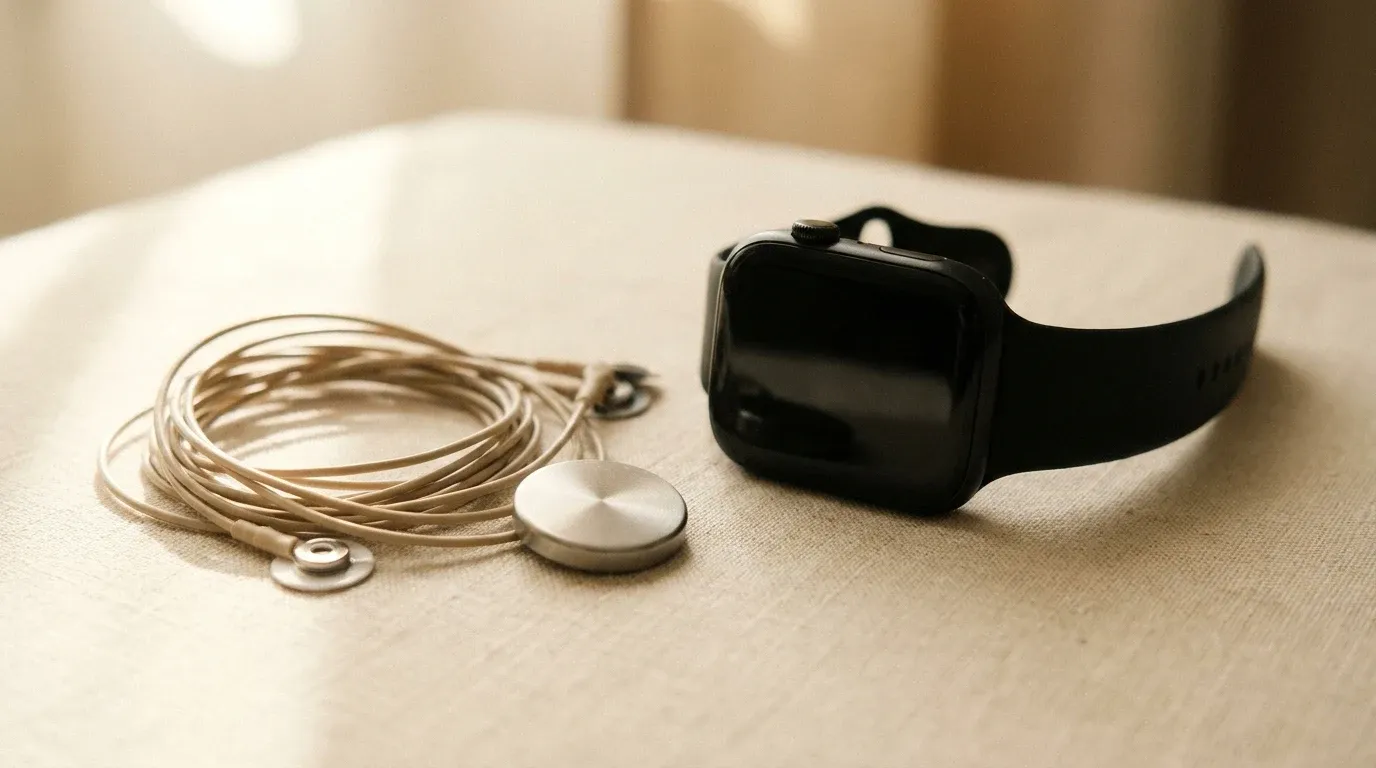
Your smartwatch flashes a stress score after a tough meeting, and for a moment you believe it. It feels authoritative. It has a number. But a comprehensive integrative narrative review published in November 2026 raises a pointed question: does that score actually measure stress, or is it measuring something else entirely and calling it stress?
The answer, according to the researchers behind the review, is uncomfortable for anyone who relies on wearable data to understand their mental and physical state. Most consumer devices are conflating three distinct phenomena. And that conflation has real consequences for how you interpret what your body is telling you.
Three Things Your Device Is Probably Mixing Up
The review draws a clear line between three separate constructs that wearable manufacturers routinely treat as interchangeable.
The first is physiological stress. This is the body's measurable biological response to a demand. Heart rate variability drops. Cortisol rises. Electrodermal activity shifts. These are objective signals, but they're also non-specific. The same physiological pattern that appears during a stressful work call can appear during a cold shower, a hard sprint, or intense excitement.
The second is subjective distress. This is what you actually feel. It's your internal experience of being overwhelmed, anxious, or under pressure. It doesn't map neatly onto physiology. Two people can have identical HRV readings and report completely different emotional states.
The third is psychiatric symptoms. Anxiety disorders, burnout, depression. These are clinical conditions with their own diagnostic criteria, their own thresholds, and their own validated measurement tools developed over decades of clinical research.
The November 2026 review argues that validating a wearable for one of these three constructs tells you almost nothing about whether it's valid for the other two. Yet most devices on the market are built, marketed, and used as though all three are essentially the same thing.
What HRV and Skin Conductance Actually Tell You
The two most common physiological proxies used in consumer stress tracking are heart rate variability (HRV) and electrodermal activity, also called skin conductance or galvanic skin response.
HRV measures the variation in time between consecutive heartbeats. A higher HRV is generally associated with parasympathetic nervous system dominance, recovery, and lower perceived stress. A lower HRV is associated with sympathetic activation. Wearable devices use this as a proxy for stress load, often presented as a daily readiness or stress score.
Skin conductance measures changes in the electrical properties of your skin driven by sweat gland activity. It responds to arousal of any kind. Fear, excitement, cognitive effort, physical exertion. It's a signal of activation, not specifically of psychological distress.
The review highlights a core problem. These signals are loosely correlated with stress in controlled laboratory settings, but correlation weakens substantially in real-world conditions. Motion artifacts, temperature, hydration, sleep quality, caffeine, and even the time of day all influence readings. The devices rarely account for all of these variables, and the algorithms that convert raw signals into a "stress score" are largely proprietary, meaning independent researchers can't fully audit them.
The Validation Problem Nobody Is Talking About
When a pharmaceutical company develops a drug, it must demonstrate efficacy against a specific, well-defined outcome. The same logic, the review argues, should apply to wearable stress measurement. But it largely doesn't.
Many devices have been validated against other physiological measures, confirming that their sensor readings correlate with what other sensors pick up. That's technical validity. It's not the same as demonstrating that the device accurately reflects what you experience, or that it has any predictive value for clinical outcomes like anxiety or burnout.
The researchers found that studies used to support wearable stress features frequently relied on small, homogeneous samples, often university students in lab settings subjected to artificial stressors like mental arithmetic tasks or public speaking. That's a poor proxy for the complex, sustained, real-world stress most people are actually trying to monitor.
The review also notes that validation standards for subjective distress require comparison against established self-report instruments, like the Perceived Stress Scale or similar tools. For psychiatric symptom detection, the bar is even higher: clinical diagnostic interviews, longitudinal outcome data, sensitivity and specificity thresholds. Almost no consumer wearable has cleared those bars for any of these categories with robust, independent evidence.
What Your Stress Score Can and Cannot Tell You
None of this means your wearable is useless. It means you need to be precise about what you're using it for.
Here's where the data tends to be more reliable:
- Trend tracking over time. If your HRV has been consistently lower than your personal baseline for two weeks, that's a signal worth paying attention to, even if the absolute number is imprecise. Your own longitudinal data is more meaningful than a comparison to population averages.
- Recovery from physical load. HRV-based recovery scores perform reasonably well in athletic contexts, particularly for tracking how well your body has recovered from training. If you're using structured training, pairing HRV data with subjective feel is a legitimate strategy. Articles on how short training sessions can still support long-term health are relevant here. Managing recovery load matters, and wearable data is one reasonable input.
- Acute autonomic shifts. A spike in skin conductance during a specific moment can flag something worth reflecting on, even if the device can't tell you whether that something is excitement, fear, or just a strong coffee.
Here's where the data is unreliable or actively misleading:
- Diagnosing anxiety or burnout. Your wearable cannot do this. A stress score of 78 out of 100 is not a clinical finding. It's a composite of loosely correlated physiological signals run through an opaque algorithm. Using it as evidence of a mental health condition is not supported by current evidence.
- Validating or dismissing how you feel. If your stress score is low but you feel terrible, believe how you feel. The inverse is also true. The device doesn't know your subjective experience.
- Comparing yourself to others. Stress scores are not standardized across devices, algorithms, or individuals. Comparing your score to a friend's on a different platform is meaningless.
The Broader Risk: When a Proxy Becomes the Point
There's a subtler issue the review raises that deserves attention. When you spend enough time monitoring a physiological proxy, you can start optimizing for the proxy rather than for the underlying thing it's meant to represent.
Someone who becomes anxious about their HRV score may actually be generating the kind of psychological arousal that depresses HRV, creating a feedback loop the device can't see or account for. Stress about stress tracking is real, and poorly validated stress scores can contribute to it.
This matters especially for people who are already navigating mental health challenges. If a wearable signals high stress during a period of clinical anxiety, it may feel validating. But the device isn't measuring anxiety. It's measuring a physiological correlate that overlaps imperfectly with the clinical construct. Acting on that signal as though it's clinical data, without speaking to a professional, is a risk the evidence doesn't support.
If you're managing genuine stress or anxiety, evidence-based strategies remain the most reliable starting point. Certain breathing techniques have demonstrated stress-reduction effects that hold up under controlled conditions far more robustly than most wearable algorithms. Sleep quality and consistency also play a substantial role. Research on the relationship between irregular sleep patterns and mental health points to circadian consistency as a key lever most people underestimate.
What Should Change, and What You Can Do Now
The November 2026 review stops short of recommending consumers abandon wearable stress features altogether. Instead, it calls for the field to develop and adopt distinct validation frameworks for each of the three constructs: physiological stress, subjective distress, and psychiatric symptom detection. Devices claiming to do any of these things should be required to demonstrate validity against appropriate reference standards, not just other hardware.
Until that happens, here's the practical position worth taking.
Use your wearable as one data point, not a verdict. Treat persistent low HRV or elevated stress scores as a reason to check in with yourself, adjust your load, prioritize recovery, and assess your sleep and nutrition. Research on sleep duration versus sleep consistency suggests that irregular patterns may matter as much as total hours, and that's something you can act on without needing a perfect algorithm.
Don't let a good stress score talk you out of how you actually feel. And don't let a bad one convince you that something is clinically wrong when it may just be a noisy signal from a device that hasn't earned that level of trust yet.
The technology is getting better. The science of validating it is not keeping pace. Knowing that gap exists is the most useful thing your wearable can't tell you.