
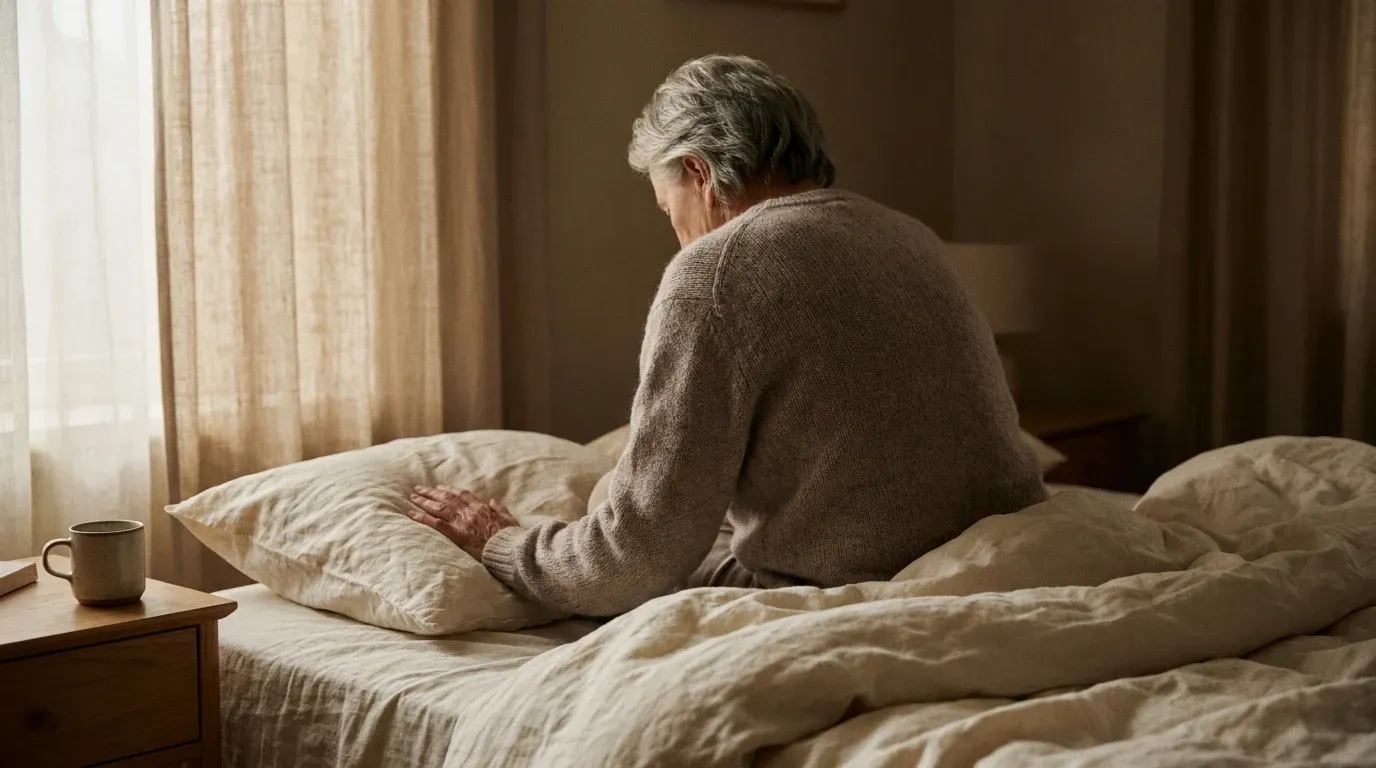
If you're over 50 and waking up at 3 a.m. for no clear reason, lying there until your alarm goes off, or dragging through afternoons despite eight hours in bed, you're not imagining it. Sleep quality genuinely deteriorates with age, and new data suggests the decline is sharper and faster than most people expect, especially for those still in the workforce.
A growing body of research points to adults over 50 as a particularly high-risk group. It's not just that they sleep fewer hours. It's that the architecture of their sleep is changing in ways that standard advice, counting sheep, dimming screens, cutting caffeine, largely fails to fix.
Why Sleep Gets Harder After 50
The disruption doesn't come from one source. It's a convergence of several biological and behavioral shifts happening at roughly the same time, which is what makes it so difficult to address.
Hormonal changes are the most significant driver. In women, the menopausal transition brings falling estrogen and progesterone levels, both of which play a direct role in regulating body temperature and sleep continuity. Hot flashes alone account for sleep fragmentation in roughly 40% of perimenopausal and postmenopausal women, according to data from the National Sleep Foundation. In men, declining testosterone is linked to lighter sleep stages and more nighttime awakenings.
At the same time, the circadian rhythm shifts earlier with age. Your internal clock nudges you toward earlier bedtimes and earlier wake times. If your job demands a standard 9-to-5 schedule or later, that mismatch creates a form of chronic social jet lag, where your biology and your calendar are pulling in opposite directions.
Add chronic pain into the equation, which affects more than 70% of adults over 65 and a significant portion of those in their 50s, and the problem compounds further. Discomfort from arthritis, lower back issues, or neuropathy doesn't have to be severe to disrupt deep sleep. Even mild pain elevates cortisol at night, pushing the body out of restorative slow-wave sleep and into lighter, more fragmented stages.
Work stress completes the picture. Adults in their 50s are frequently at peak career responsibility: managing teams, navigating organizational pressure, handling finances ahead of retirement. That cognitive load keeps the nervous system activated well into the evening, making it harder to transition into sleep. Cortisol levels that should be dropping by 9 or 10 p.m. are staying elevated hours longer.
The Health Stakes Are Higher Than Most People Realize
Poor sleep isn't just an inconvenience at this age. It's a risk factor that accelerates two of the most serious threats facing adults over 50: cognitive decline and cardiovascular disease.
Research published over the past decade consistently links fragmented or insufficient sleep to a faster buildup of amyloid plaques, the protein clusters associated with Alzheimer's disease. During deep sleep, the brain's glymphatic system, essentially its waste-clearance network, flushes out metabolic byproducts including amyloid-beta. When that deep sleep is cut short, clearance is incomplete. Over years and decades, the accumulation accelerates.
The cardiovascular data is equally stark. Adults who consistently sleep fewer than six hours per night have a 20% higher risk of heart attack compared to those sleeping seven to eight hours, according to a large-scale analysis of European and US cohort data. High blood pressure, arterial stiffness, and elevated inflammatory markers are all downstream effects of chronic sleep restriction, and they compound the baseline cardiovascular risks that already rise after 50.
It's worth noting that the issue is rarely just duration. Two people can both report "seven hours of sleep" while one gets restorative, consolidated sleep and the other cycles through repeated micro-awakenings. That distinction matters enormously for health outcomes, and it's one reason sleep tracking devices, despite their limitations, have become genuinely useful for identifying patterns in this age group.
What the Evidence Actually Supports
Here's where most sleep advice falls short for this demographic. Generic sleep hygiene recommendations were developed primarily for younger adults with straightforward insomnia. Adults over 50 with hormonal disruption, chronic pain, and early-morning circadian shifts need a more targeted approach.
Sleep restriction therapy has the strongest evidence base for chronic insomnia in older adults. Despite the counterintuitive name, it doesn't mean sleeping less. It means temporarily compressing your time in bed to match your actual sleep capacity, then gradually extending it as sleep efficiency improves. Multiple randomized controlled trials have shown it outperforms sleep medication for long-term outcomes in this age group. It's also a core component of Cognitive Behavioral Therapy for Insomnia (CBT-I), which is now the first-line clinical recommendation from both the American Academy of Sleep Medicine and the UK's National Institute for Health and Care Excellence.
Consistent wake times are probably the single most powerful free intervention available. Anchoring your wake time. even on weekends. stabilizes your circadian rhythm and builds sleep pressure throughout the day. This is distinct from weekend catch-up sleep, which does appear to carry some cardiovascular benefit, but shouldn't come at the cost of a consistent wake anchor. The research supports flexibility in sleep timing while maintaining a fixed morning anchor as the most practical balance.
Magnesium glycinate has emerged as one of the few supplements with credible evidence for improving sleep quality in adults over 50. The glycinate form is better tolerated than magnesium oxide and crosses the blood-brain barrier more effectively, where it supports GABA activity and helps quiet an overactive nervous system. Doses in the 200-400mg range taken 30-60 minutes before bed show consistent effects in randomized trials. That said, the supplement industry is heavily influenced by funding bias, and it's worth understanding how to evaluate supplement research before committing to any product.
Sauna use is gaining attention as a recovery and sleep aid with legitimate mechanistic support. The drop in core body temperature following a sauna session mimics the natural thermal shift the body needs to initiate sleep. Evidence from both Finnish population studies and smaller controlled trials suggests regular sauna use improves sleep onset and reduces nighttime awakenings. The science behind sauna as a recovery protocol is more robust than most people expect, and the sleep benefits are a legitimate secondary effect.
Light exposure management is critical for adults experiencing early circadian shifts. Getting bright light exposure in the late morning rather than immediately at sunrise can push the circadian rhythm slightly later, reducing the tendency toward 9 p.m. fatigue and 4 a.m. wake-ups. Conversely, minimizing bright light after 8 p.m. supports melatonin onset, which is already delayed by screen use.
Addressing sleep apnea is non-negotiable for a portion of this group. Obstructive sleep apnea affects an estimated 20-30% of adults over 50, and many cases go undiagnosed because the primary symptom isn't always loud snoring. Fragmented sleep, morning headaches, and daytime fatigue can all indicate disordered breathing. CPAP remains the gold standard treatment, but emerging pharmacological options are showing promise. A new sleep apnea medication recently demonstrated a 44% reduction in breathing events in clinical trials, offering an alternative for those who can't tolerate CPAP.
Rebuilding Sleep as a Structured Practice
For adults over 50, sleep can't be treated as a passive afterthought. It needs to be managed with the same intentionality you'd apply to nutrition or physical training. That means tracking patterns, identifying specific disruptions (is it onset, maintenance, or early waking?), and applying targeted interventions rather than broad lifestyle tweaks.
If you're working with a coach or health professional, sleep quality should be a standard intake metric. Not everyone has access to a sleep specialist, but a well-qualified wellness or performance coach can help you structure behavioral interventions and monitor progress. Knowing how to choose the right type of coach for your specific goal matters here, particularly when the issue sits at the intersection of physical recovery, stress management, and behavioral change.
The workers facing the worst sleep disruption are often the ones least likely to prioritize fixing it. Productivity culture rewards pushing through fatigue, and the symptoms of poor sleep, irritability, slower thinking, emotional reactivity, tend to be attributed to aging or stress rather than a specific and fixable problem.
The data is clear: sleep quality in your 50s has direct consequences for your cognitive health, your heart, and your ability to perform at whatever you're working toward. Treating it seriously isn't a luxury. It's one of the highest-leverage health decisions available to you.