

Zone 2 Without a Lab: Find Your Zone Accurately
Most recreational athletes think they're training in Zone 2. Most of them are wrong. Research consistently shows that endurance athletes overestimate their aerobic base training by 20 to 30 beats per minute, which means what feels like a comfortable aerobic run is actually a sustained metabolic stress session. The result: slower progress, higher fatigue, and an aerobic engine that never fully develops.
The good news is you don't need a lactate analyzer or a treadmill in a sports science lab to find your true Zone 2. Three field methods give you reliable estimates, and understanding why Zone 2 matters in the first place makes it easier to commit to training at the right intensity.
What Zone 2 Actually Means
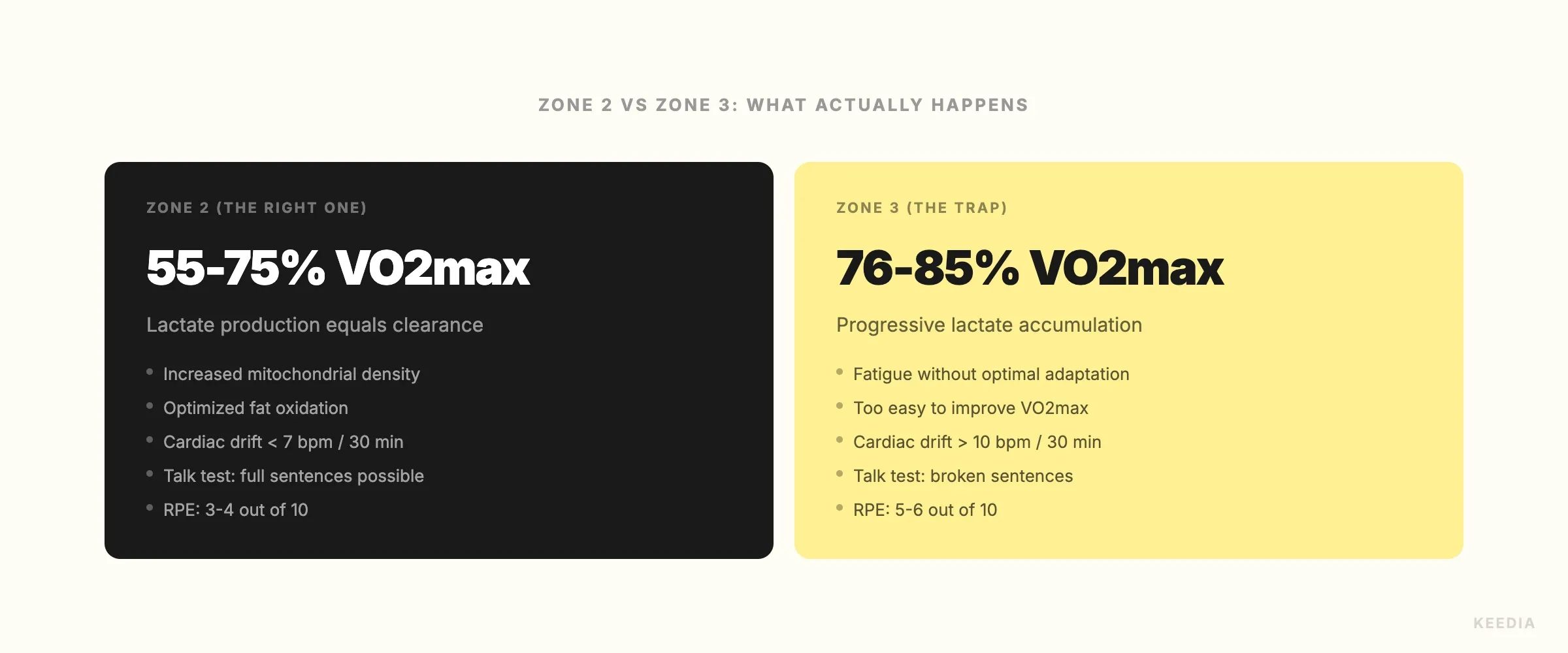
Zone 2 is defined physiologically as the exercise intensity at which lactate production and lactate clearance are in equilibrium. Below this threshold, your aerobic system handles the workload cleanly. Above it, lactate accumulates faster than it can be processed, and the metabolic environment shifts in ways that blunt long-term adaptations.
In practical terms, Zone 2 sits at roughly 55 to 75 percent of VO2max, though the exact range shifts depending on your training history. Well-trained endurance athletes tend to have higher lactate thresholds relative to their VO2max, while recreational athletes often hit their threshold earlier. This is partly why improving your VO2max through structured protocols can shift your zones upward over time.
The adaptations that come from consistent Zone 2 work are specific and significant. Mitochondrial density increases, fat oxidation improves, and your cardiovascular system becomes more efficient at delivering oxygen. These are the foundational adaptations that make higher-intensity training more productive. Without a solid aerobic base, hard sessions produce less and cost more.
Why Most Recreational Athletes Train Too Hard
The problem isn't effort. It's calibration. When you run or cycle at a pace that feels moderately hard, your perceived exertion maps poorly to your actual heart rate zone. Moderate effort often lands squarely in Zone 3, a metabolic no-man's-land that's too hard to allow full recovery and too easy to drive peak adaptations.
Studies tracking recreational runners with heart rate monitors have found that athletes frequently describe Zone 3 intensities as "easy" or "conversational." This perceptual drift is worse in athletes who train without data, but it also affects people using heart rate monitors if they haven't calibrated their zones correctly from the start.
Training quality also interacts with recovery in ways that compound the problem. When you're not sleeping well, perceived effort decreases at any given intensity, which means you're more likely to push past Zone 2 without realizing it. Research confirms that poor sleep measurably impairs physical performance, and the same mechanisms that reduce strength output can skew your sense of effort during aerobic training.

Method 1: The Talk Test
The talk test is the simplest and most accessible Zone 2 field method. The rule is straightforward: in Zone 2, you should be able to speak in complete, full sentences. You might need to pause briefly between sentences, but the words come out clearly and without gasping.
The diagnostic is what you can't do: sing. If you can sustain a phrase from a song at your current pace, you're likely below Zone 2. If you can speak in sentences but singing feels impossible, you're in the zone. If you're answering questions in clipped phrases or feel breathless mid-sentence, you've crossed into Zone 3.
The physiological basis for this test is solid. Ventilatory threshold, which closely tracks lactate threshold in most people, corresponds to the point at which breathing becomes controlled and rhythmic speaking becomes difficult. It's not a perfect proxy, but research comparing talk test results to lab-measured lactate threshold shows strong correlation in recreational populations.
Use it as a real-time check during your runs. If your training partner has to wait between sentences to understand you, slow down.
Method 2: The Maffetone 180 Formula
The Maffetone method offers a heart rate target rather than a subjective feel check. The base formula is simple: subtract your age from 180. Then apply adjustments based on your training history and health status.
- Subtract 10 if you've been injured, are recovering from illness, or have significant health issues
- Subtract 5 if you've been inconsistently training or are new to structured endurance work
- Keep the number as-is if you've been training consistently for two or more years without major setbacks
- Add 5 if you've been training for more than two years with consistent progress and no injury history
The resulting number is your maximum aerobic heart rate for Zone 2 work. Training at or below this number keeps you in the aerobic fat-burning zone and away from the lactate accumulation that undermines recovery.
For a 38-year-old recreational runner training consistently: 180 minus 38 equals 142. That's likely 10 to 15 beats lower than what they'd consider an "easy" run. That gap is exactly the problem. The formula has been validated against lactate threshold tests in recreational athletes and tends to produce accurate Zone 2 estimates across a wide range of fitness levels, though elite athletes may find the upper adjustments don't fully capture their physiology.
Method 3: The Borg RPE Scale
The Rate of Perceived Exertion scale, developed by exercise physiologist Gunnar Borg, gives you a structured way to quantify effort on a scale from 6 to 20. Zone 2 corresponds to an RPE of approximately 11 to 13, described as "light" to "somewhat hard."
At RPE 12, you feel like you're working but the effort is genuinely sustainable. You're aware of your breathing but not controlled by it. You could continue for a very long time. Most people who think they're training at RPE 12 are actually closer to 14 or 15, particularly earlier in a run before fatigue sets in and recalibrates their perception.
The Borg scale works best when you practice it honestly and consistently. Rate your effort without reference to pace or distance. Ask yourself how hard the effort feels, not how fast you think you should be going. Over time, your internal calibration improves.
Combining RPE with the talk test gives you a more reliable estimate than either alone. If your RPE reads 12 but you're answering in sentence fragments, trust the talk test and back off.
The Heart Rate Drift Test: A Confirmation Tool
Once you have a Zone 2 estimate from any of the above methods, the heart rate drift test helps you confirm it. The protocol is simple: run or cycle at a constant pace for 30 minutes while tracking your heart rate. If your heart rate rises more than 5 to 7 beats per minute over that period without any change in effort or terrain, you're working above Zone 2.
Cardiac drift at true Zone 2 intensity is minimal. At Zone 3 and above, the cardiovascular system has to work progressively harder to maintain output as temperature rises and fatigue accumulates, which pushes heart rate upward even at the same pace.
Run this test on flat terrain in temperate conditions for the clearest signal. High heat or humidity will increase drift independently of intensity, so account for environmental factors. If your heart rate climbs more than 7 beats in the 30-minute window, lower your pace by 30 to 45 seconds per mile and retest.
The Counterintuitive Part: Slower Is the Point
When athletes first apply these methods, the required slowdown can feel disorienting. Runners who pride themselves on sub-9-minute miles may find their Zone 2 pace is 11 minutes per mile or slower. Cyclists used to averaging 18 mph may need to drop to 14.
This is not regression. It's accurate training. The aerobic adaptations that come from true Zone 2 work, specifically increased mitochondrial density and improved fat oxidation, require sustained time below the lactate threshold. Training slightly above it produces fatigue without the same structural benefit.
Nutrition also plays a role in how effectively you can sustain Zone 2 training and recover from it. Structuring your protein intake to support muscle protein synthesis across the day, for example, becomes more relevant as your training volume increases. Research on how protein distribution across meals affects muscle protein synthesis is directly applicable to endurance athletes managing a higher weekly load.
Similarly, cardiovascular health extends beyond training intensity. Practices that support heart function and vascular recovery matter alongside your zone work. Research on sauna use and cardiovascular health suggests meaningful benefits for endurance athletes as a recovery modality, though it works best as a complement to, not a substitute for, consistent aerobic base training.
Building a Zone 2 Practice That Sticks
Start with three sessions per week at 45 to 60 minutes each. Use the talk test as your primary real-time guide and check your heart rate against the Maffetone formula at intervals. After four to six weeks, run the heart rate drift test to assess whether your aerobic base is developing.
You'll know the adaptation is working when your pace at the same heart rate improves. This is the aerobic efficiency signal. You're running faster at the same metabolic cost, which means your aerobic engine has grown stronger.
Track your heart rate data over time rather than relying on single sessions. Trends matter more than individual readings, and the clearest sign of Zone 2 progress is a sustained drift in your pace-to-heart-rate relationship over weeks and months.
The lab gives you precision. These field methods give you accuracy that's good enough to produce real results. The difference between training at your actual Zone 2 and training 25 beats above it, compounded across months, is the difference between building an aerobic base and spinning in metabolic neutral.