

4-Day Work Week and Physical Health: What Trials Show at 12 Months
Most coverage of the four-day work week focuses on productivity metrics and whether companies lose output. That framing misses what the data actually shows. At 12 months, the most comprehensive trial to date reveals something more consequential: sustained, measurable improvements in physical health across nearly 3,000 workers.
This isn't a survey of opinions or a short-term experiment that faded after the novelty wore off. It's longitudinal data published in Nature Human Behaviour in 2025, and the health outcomes hold up over time.
The Trial: Scale and Structure
The study tracked 141 organizations and 2,896 employees across multiple industries and countries. Participating companies shifted to a four-day week without reducing pay, following a 100-80-100 model: 100% of pay, 80% of hours, 100% of output expected.
The headline productivity numbers got attention early. But the researchers also tracked health outcomes, absenteeism, and employee behavior at baseline, at trial completion, and again at 12-month follow-up. That last data point is what separates this from earlier, shorter pilots.
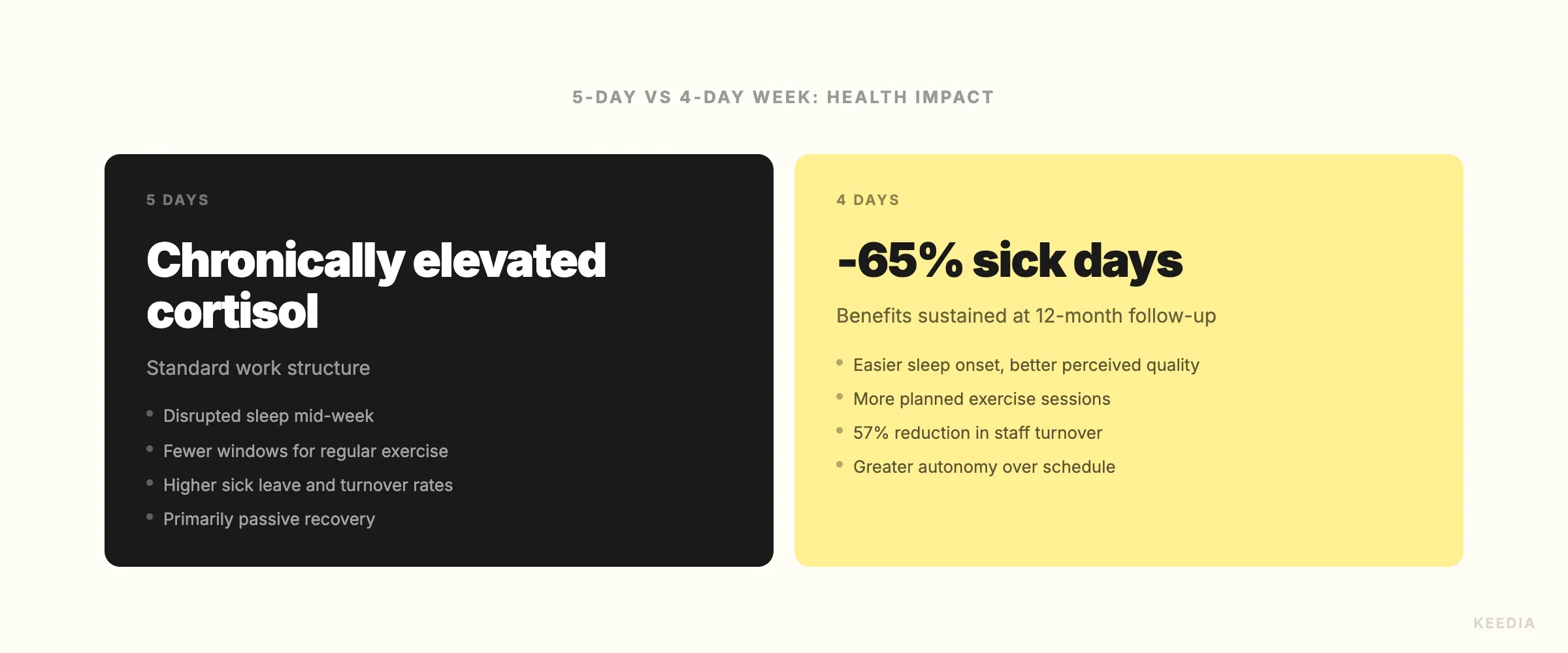
The result: a 65% reduction in sick days compared to the year prior, and a 57% fall in staff turnover. Both figures held at the 12-month mark, meaning the improvements weren't a temporary effect of novelty or initial enthusiasm.

What the 12-Month Follow-Up Actually Shows
Short-term workplace wellness interventions are notoriously poor at sustaining results. Employees feel better for a few weeks, habits don't stick, and absenteeism drifts back toward baseline. That pattern did not occur here.
According to the Nature Human Behaviour publication, health benefits were maintained at 12-month follow-up across multiple indicators. Workers reported lower levels of stress and burnout, better sleep quality, and more consistent physical activity compared to when they were working five days a week.
90% of the participating companies chose to make the four-day week permanent after the trial. That's a business decision, but it's also a signal: the organizations observed enough benefit, including reduced absenteeism and lower turnover costs, to absorb any operational adjustments required.
For context on why this matters to the broader workplace wellness conversation, the data from this trial aligns closely with findings in the Wellhub 2026 report on workplace wellness and performance, which similarly found that structural changes to work conditions produce more durable health outcomes than add-on wellness perks.
Exercise, Sleep, and Stress: The Specific Outcomes
Three physical health markers stand out from the trial data.
Exercise frequency increased. Workers reported fitting in more physical activity during the trial period and continued that pattern at 12 months. The mechanism here isn't complicated. An extra day off creates scheduling flexibility that a lunchtime yoga class or corporate step-count challenge simply can't replicate. When you have a full weekday available, barriers to training drop significantly.
Sleep improved. Participants reported falling asleep more easily and waking feeling more rested. This matters more than it might seem as a standalone data point. A 2025 meta-analysis found that poor sleep reduces strength output by approximately 12%, and the downstream effects on recovery, hormonal regulation, and motivation compound over weeks and months of disrupted rest.
Stress levels fell and stayed lower. This is arguably the most significant finding, because chronic stress sits upstream of most of the other outcomes. When stress comes down, sleep improves, exercise adherence improves, and immune function stabilizes. That's likely a major driver of the 65% reduction in sick days.
The Mechanism: It's Not Just About Having More Time
A common assumption is that the four-day week helps health simply because people have more hours available to look after themselves. The research suggests the mechanism is more specific than that.
Two factors appear to drive the sustained outcomes: reduced chronic stress and increased autonomy over schedule.
Chronic workplace stress is associated with persistently elevated cortisol. Over time, that elevation disrupts sleep architecture, suppresses immune response, increases inflammatory markers, and reduces the motivation to exercise. Cutting one day of work doesn't just give you more time. It reduces the total stress load your body is carrying, and it does so in a way that's structural rather than reliant on individual coping strategies.
Autonomy over schedule operates through a different but related pathway. Research on self-determination theory consistently shows that perceived control over your time is independently associated with lower cortisol levels, better sleep quality, and higher rates of voluntary physical activity. When you feel less scheduled and more in control, your nervous system responds differently. That physiological shift is measurable.
This distinction matters for anyone thinking about how to use an extra day effectively. The health gains aren't contingent on spending the fifth day at the gym. They emerge partly from the structural reduction in chronic stress that comes from working fewer days in total.
What This Means for Your Training and Recovery
If you're currently working a standard five-day week and managing your fitness around it, the trial data points to something worth taking seriously: your work schedule is a training variable, whether you're treating it as one or not.
Chronic stress and sleep disruption don't just make you feel worse. They materially affect your physical capacity. If you're finding that your training quality fluctuates week to week, or that recovery feels inconsistent despite solid nutrition and programming, the stress load from your work schedule may be contributing more than you realize.
This is particularly relevant for sleep. If you're consistently getting fewer than seven hours or waking unrefreshed, the downstream effects on strength, endurance, and body composition are real and documented. Addressing sleep quality often comes down to reducing the chronic stress load rather than adding another supplement or adjusting your bedtime by 20 minutes.
On the exercise side, the workers in this trial weren't suddenly following elite periodization programs. They were simply moving more consistently because they had more scheduling flexibility. If you're an active person who currently trains three or four times a week, an extra day of structural breathing room tends to translate into better session quality, not just more sessions. That's consistent with what we know about how strategic recovery periods improve training outcomes over a longer arc.
The Broader Implication for Workplace Wellness
The $8 billion corporate wellness industry is built largely on interventions layered on top of unchanged work structures. Meditation apps, step challenges, subsidized gym memberships, and mental health days are all offered within a system that still demands the same hours, the same cognitive load, and the same chronic stress exposure.
The four-day week trial data suggests a different hypothesis: structural change to how work is organized produces better health outcomes than wellness programs designed to offset the damage of the current structure.
That's not an argument against fitness benefits or coaching programs. It's an argument for looking upstream. The companies that showed the largest reductions in sick days weren't necessarily the ones with the best wellness perks. They were the ones that changed the fundamental time structure of work.
For fitness professionals and coaches, this framing is also relevant to client results. If a client is struggling with consistency, recovery, or stress-related plateaus, their work schedule is a legitimate variable to explore in intake conversations. Understanding how work structure affects training capacity is part of building effective programs around real lives, not idealized ones.
What the Data Does and Doesn't Prove
The trial is rigorous by workplace research standards, but it has limitations worth acknowledging. The participating companies were, by definition, willing to run the experiment. That self-selection means they may have been better managed or more employee-focused than average, which could inflate some of the reported outcomes.
The study also relied partly on self-reported health measures. Objective biomarkers like cortisol levels, sleep stage data, or VO2max weren't tracked across the full sample. The self-reported improvements in sleep, stress, and exercise frequency are credible, but they aren't the same as controlled clinical measurements.
What the data does show clearly is that a structural reduction in working hours, sustained over 12 months, correlates with meaningful reductions in absenteeism, sustained improvements in self-reported health, and a high rate of organizational adoption. Those outcomes aren't easy to dismiss, and they're consistent with the biological mechanisms connecting chronic stress, cortisol, sleep, and physical health.
If you want to understand the full picture of how recovery quality shapes physical performance, the research on VO2max improvement protocols offers a useful lens. Aerobic capacity is deeply sensitive to training load, stress, and sleep quality. All three of those variables shift under a four-day work week, and they shift in the right direction.
The trial doesn't prove that a four-day week is the right model for every organization or every role. It does prove that working one fewer day per week, at full pay, produces lasting and measurable health benefits that no wellness program layered on top of a standard schedule has reliably replicated.
That's worth taking seriously, whether you're an employer, an employee, or a fitness professional trying to understand why your clients' progress stalls every time work gets heavy.