
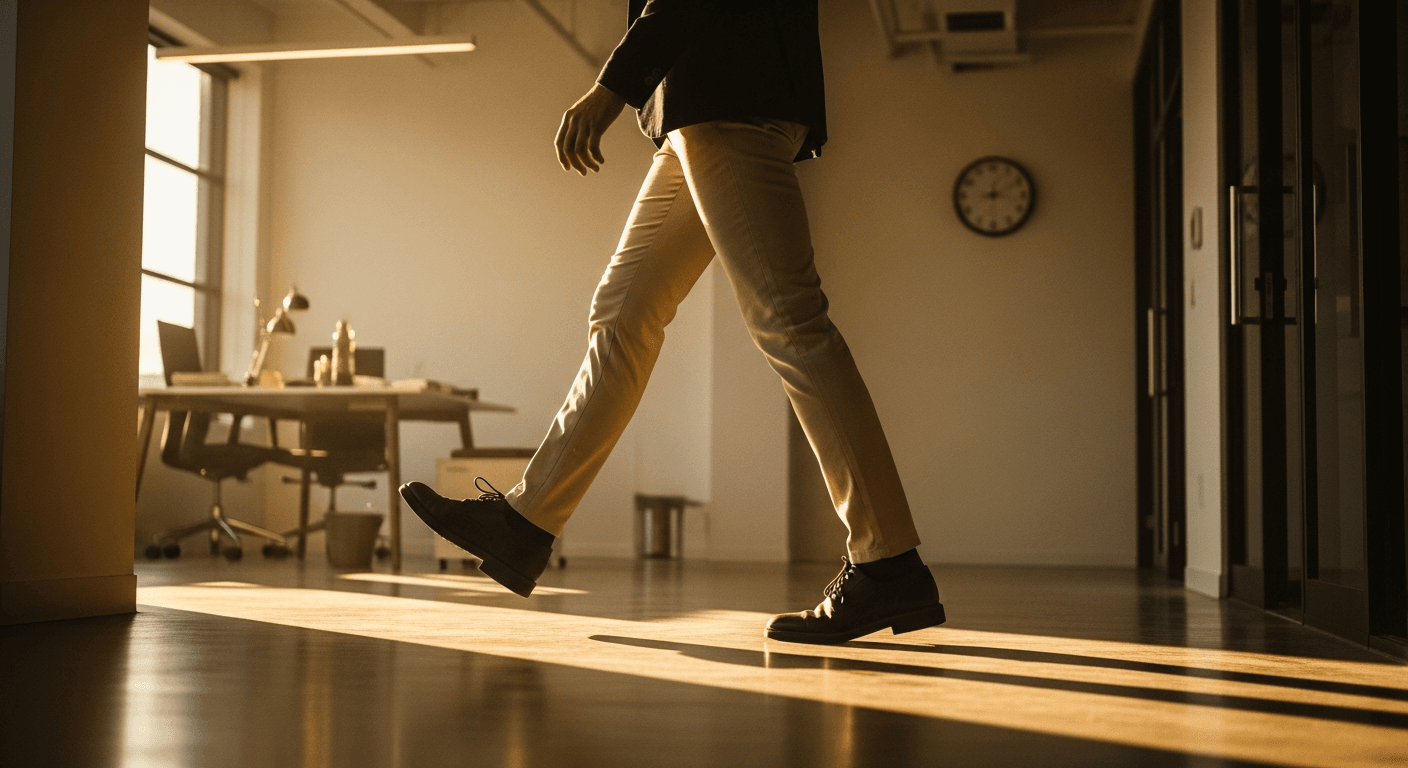
If you've been looking for a science-backed reason to step away from your desk, here it is. A large real-world study published in the British Journal of Sports Medicine on June 24, 2026 confirms that five-minute walking breaks taken every hour represent the most effective and practical intervention against the health risks of prolonged sitting. Not ten minutes. Not a lunchtime run. Five minutes, every hour, during the workday.
The finding matters because it's specific. Workplace wellness programs have long struggled with the "dose" question. How much movement is enough to make a measurable difference? This study answers it with precision, and the answer is more achievable than most people assumed.
What the Study Actually Found
Researchers tracked participants across real workplace conditions, not controlled lab environments. That distinction is significant. Most earlier studies on movement breaks were conducted in settings that don't reflect the interruptions, deadlines, and cognitive demands of actual office work. This one did.
The five-minute hourly walk outperformed longer, less frequent breaks on two key outcomes: mood and fatigue. Participants who took these short walks reported meaningfully better emotional states and lower energy depletion by the end of the workday compared to those who remained seated for longer stretches.
Critically, there was no measurable negative impact on work performance. That's the finding HR leaders have been waiting for. The most common objection to structured movement breaks is the assumption that pulling employees away from their screens costs the organization in output. This study removes that objection directly. You don't lose productivity. You gain wellbeing.
Why Sitting Is the Problem You Can't Ignore
Prolonged sitting has been linked to increased risk of cardiovascular disease, metabolic dysfunction, musculoskeletal problems, and declining cognitive performance. The issue isn't just that people aren't exercising enough outside of work. It's that the structure of the modern workday actively works against the body's need for intermittent movement.
The average office worker sits for more than six hours per day. In remote work settings, that number climbs higher. Remote workers spend significantly more time alone and sedentary, and the health costs are measurable. Extended stillness compounds the effects of isolation, creating a dual burden that structured micro-breaks can begin to address.
Physical inactivity doesn't just affect the body. Sustained sedentary behavior has real consequences for stress regulation and mental load. Chronic stress has documented effects on immune function, and reducing the physiological stress of prolonged sitting is part of how movement breaks protect workers beyond the obvious physical benefits.
The Broader Evidence Base in 2026
The British Journal of Sports Medicine study didn't arrive in isolation. Published the same week, a study in BMJ Medicine found that exercise variety, including walking, reduces mortality risk more effectively than single-mode exercise. Put plainly: people who mix different types of movement into their routines live longer than those who rely on one activity alone, even if that activity is intense.
Walking, the most accessible form of movement, plays a larger role in long-term health than it's typically given credit for. It's not a consolation prize for people who don't lift or run. It's a distinct and valuable input with its own mortality-reducing effects.
This connects to a growing body of evidence supporting strength training as a complement to, not a replacement for, low-intensity movement. Research on resistance training and longevity suggests roughly 90 minutes of lifting per week is associated with significant health benefits. The 2026 data reinforces that combining strength work with daily walking is likely a more protective strategy than maximizing either in isolation.
The emerging picture is clear: movement diversity matters, and the workday is an underused opportunity to build it in.
The Productivity Objection, Settled
Let's address the business case directly, because that's where most wellness initiatives stall. Employers worry that structured breaks reduce output. Managers resist anything that pulls attention away from work. That concern has historically been difficult to refute with hard data, which is why the British Journal of Sports Medicine study is significant beyond its health findings.
When participants took five-minute walks every hour, their work performance didn't decline. In a real-world setting, with actual job demands, the breaks didn't cost the organization anything measurable. What they did produce was a workforce that felt better and was less fatigued by the end of the day.
Fatigue is a productivity killer that's rarely tracked in the same way output metrics are. An employee who finishes the day mentally depleted makes more errors, engages less, and is more likely to disconnect emotionally from their work over time. Employee wellness now represents a $100 billion ROI opportunity, and micro-movement policies are among the lowest-cost levers available.
What HR Leaders Can Do Right Now
The appeal of this intervention is its simplicity. You don't need a new budget line. You don't need to retrofit your office. You need a policy, communicated clearly, and a culture that supports it.
Here's what a practical implementation looks like:
- Set a company-wide norm: Announce that five-minute walks each hour are encouraged and protected. Name them explicitly. When leadership doesn't sanction breaks, employees don't take them even when they want to.
- Use calendar blocking: Encourage teams to build five-minute buffers between hourly meetings. A 25-minute meeting instead of 30, or a 55-minute block instead of 60, creates the space without requiring anyone to opt out of work time.
- Integrate with existing wellness programs: If your organization already has a wellness platform or step-count challenge, frame the hourly walk as the behavioral anchor. It's easier to maintain a habit when it connects to an existing structure.
- Make the physical environment work for it: Redesigning office layouts to encourage movement doesn't require a renovation budget. Relocating printers, creating designated walking routes, or simply removing barriers to leaving one's desk all support the behavior.
- Track mood and fatigue, not just steps: If you want to demonstrate ROI internally, measure what the study measured. Short pulse surveys on energy and mood are low-effort tools that can show change over weeks, not months.
The Sleep Connection You Shouldn't Miss
Movement and sleep are bidirectional. People who move more during the day tend to sleep better, and people who sleep better tend to move more. The workday walking habit doesn't exist in isolation from the rest of your health stack.
If your organization is serious about fatigue reduction, the movement policy works best alongside attention to sleep quality. Workers who are chronically sleep-deprived will experience fewer benefits from any wellness intervention because their baseline recovery is compromised. The science on this is consistent: adequate sleep amplifies the effects of movement, and movement supports better sleep quality in return.
The Real Barrier Is Organizational, Not Individual
It would be easy to frame this as a personal habit challenge. Set a timer. Get up every hour. Walk for five minutes. Done. But that framing misses the systemic dimension of why people don't do it already.
Workers don't skip movement breaks because they're lazy or uninformed. They skip them because the culture, the calendar, and the expectations of their workplace make it feel unsafe to step away. Back-to-back meetings, always-on communication norms, and performance cultures that reward visible busyness all work against behavior that is, by definition, invisible to managers when it's happening.
That's why the British Journal of Sports Medicine study's real-world design matters. It didn't test whether people could walk every hour if they tried hard enough. It tested what happens when the conditions support it. And it found clear, measurable benefit.
The intervention works. The question for every organization is whether it's willing to build the conditions that let it.
Five minutes. Every hour. The evidence is in. Now it's a leadership decision.