

The $57 billion corporate wellness industry has a perception problem. Employers are confident their programs are delivering. Employees, broadly, are not convinced. And the gap between those two realities is where billions of dollars quietly disappear every year.
Key Takeaways
- Corporate Wellness Programs: 81% of Employers Think They Work.
- The $57 billion corporate wellness industry has a perception problem.
- The 2026 data makes this uncomfortable to ignore.
The 2026 data makes this uncomfortable to ignore. When employers and employees are asked the same questions about the same programs, their answers don't line up. Not even close.
The 26-Point Gap That Exposes the Real Problem
According to 2026 corporate wellness research, 81% of employers say their wellness program positively impacts company culture. Only 55% of employees say the same. That's a 26-point gap. In survey terms, that's not a minor discrepancy. That's two groups describing completely different experiences.
The most likely explanation isn't that employees are wrong. It's that most programs are built around what looks good at the leadership level rather than what actually improves daily working life. A wellness portal with a meditation app, a step challenge in March, and a discounted gym membership checks the boxes in an executive presentation. It doesn't necessarily change how a mid-level manager feels about coming to work on a Tuesday.
When companies design wellness for optics rather than outcomes, employees notice. They just don't always say so in ways that reach the people making the decisions.
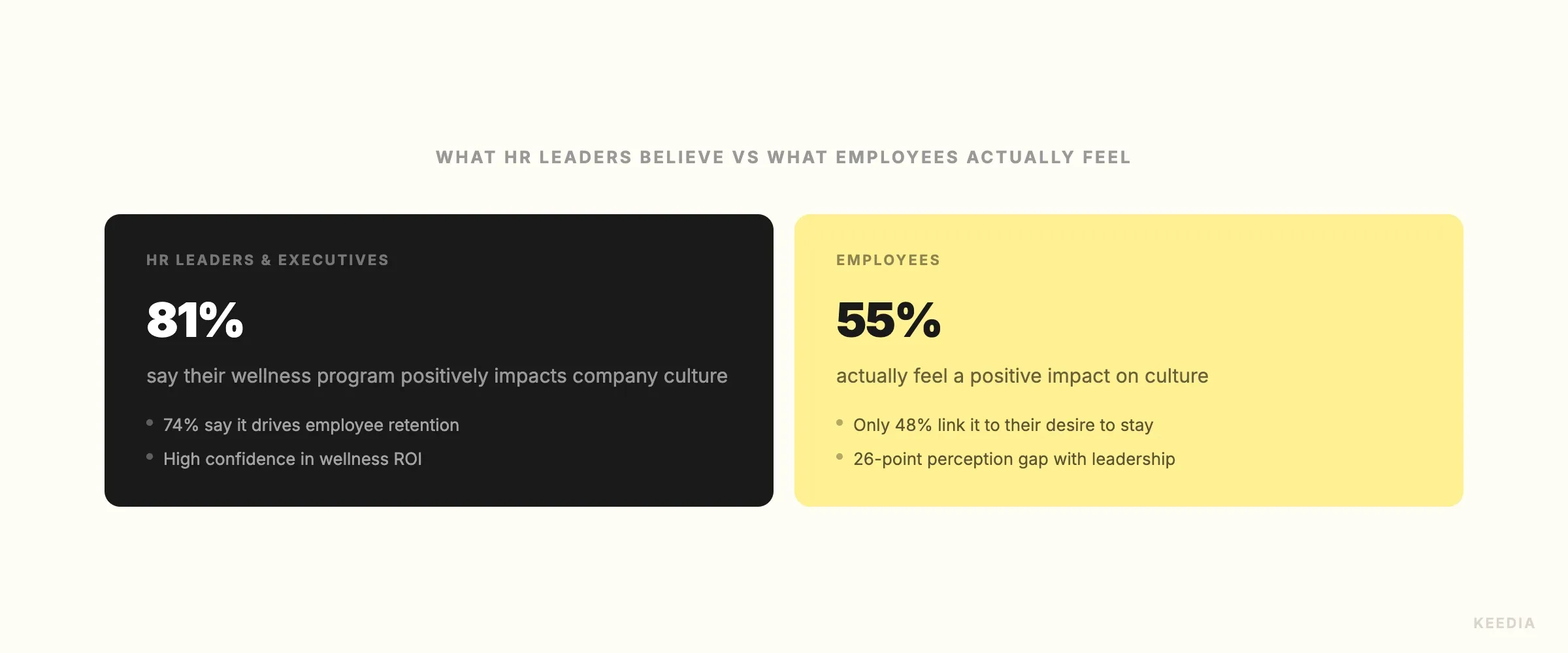
74% of Leaders Say It Drives Retention. 48% of Employees Agree.
The retention disconnect is even sharper. Nearly three-quarters of organizational leaders believe their wellness programs help keep employees around. Fewer than half of employees feel the same way.
This matters because retention is one of the primary business justifications for wellness spending. If the people the program is supposed to retain don't experience it as a retention factor, then that part of the ROI calculation is built on a shaky foundation.
Employees leave jobs for reasons that wellness apps don't fix. Workload, management quality, lack of autonomy, unclear growth paths. A quarterly mindfulness webinar doesn't address structural dissatisfaction. And when employees can see that leadership treats wellness as a retention tool rather than a genuine investment in their health, the program actively erodes trust rather than building it.
For a deeper look at the underlying business case and where the ROI evidence is strongest, Corporate Wellness ROI in 2026: What the Data Actually Shows is worth reading alongside this.
The $1.47 ROI Figure Needs Context
You've probably seen the statistic: corporate wellness programs return $1.47 for every dollar spent. It gets cited in boardroom decks, vendor pitches, and industry reports. What it rarely comes with is the fine print.
That figure applies to well-implemented, evidence-based wellness programs. The kind with structured behavior change components, manager involvement, measurable health outcomes, and consistent employee participation. It does not describe the average corporate wellness spend, which skews heavily toward gym membership subsidies, wellness app licenses, and one-off initiatives that employees use irregularly if at all.
Participation rates in employer-sponsored wellness apps typically hover between 10% and 20% of the workforce. Gym subsidy reimbursements are used by a similarly small slice of employees, and research consistently shows those users would likely have exercised anyway. You're often subsidizing existing behavior rather than creating new ones.
The ROI story improves significantly when programs shift focus. Evidence-based approaches that address sleep, exercise as a mental health intervention, and psychological safety show more durable results. The research on exercise and mental health is particularly relevant here. physical activity's effect on mood, anxiety, and cognitive performance is one of the most consistently supported findings in wellness science, and it's still underrepresented in most workplace programs.
The 2026 Shift: From Crisis Response to Proactive Emotional Fitness
Something is changing in how better-performing companies approach this. The old model was reactive. Employee Assistance Programs, therapy hotlines, crisis intervention. These are necessary, but they're not wellness infrastructure. They're a safety net for when things have already gone wrong.
The 2026 shift is toward proactive emotional fitness. Resilience training built into working hours rather than assigned as optional homework. Manager training focused on psychological safety. Mindfulness practices embedded into team routines rather than pushed as individual self-help tools.
This approach is showing better engagement numbers precisely because it doesn't require employees to opt in during their personal time. When wellness is structured into the workday, participation follows naturally. When it's offered as a benefit that employees access independently, after hours, through an app, most people simply don't.
It also reflects a more honest understanding of what drives burnout. Burnout isn't usually a deficit in personal resilience. It's a product of unsustainable workloads, poor management, and organizational dysfunction. Training managers to recognize and address those conditions early is more effective than offering stressed employees a breathing exercise.
Community Beats Apps. Every Time.
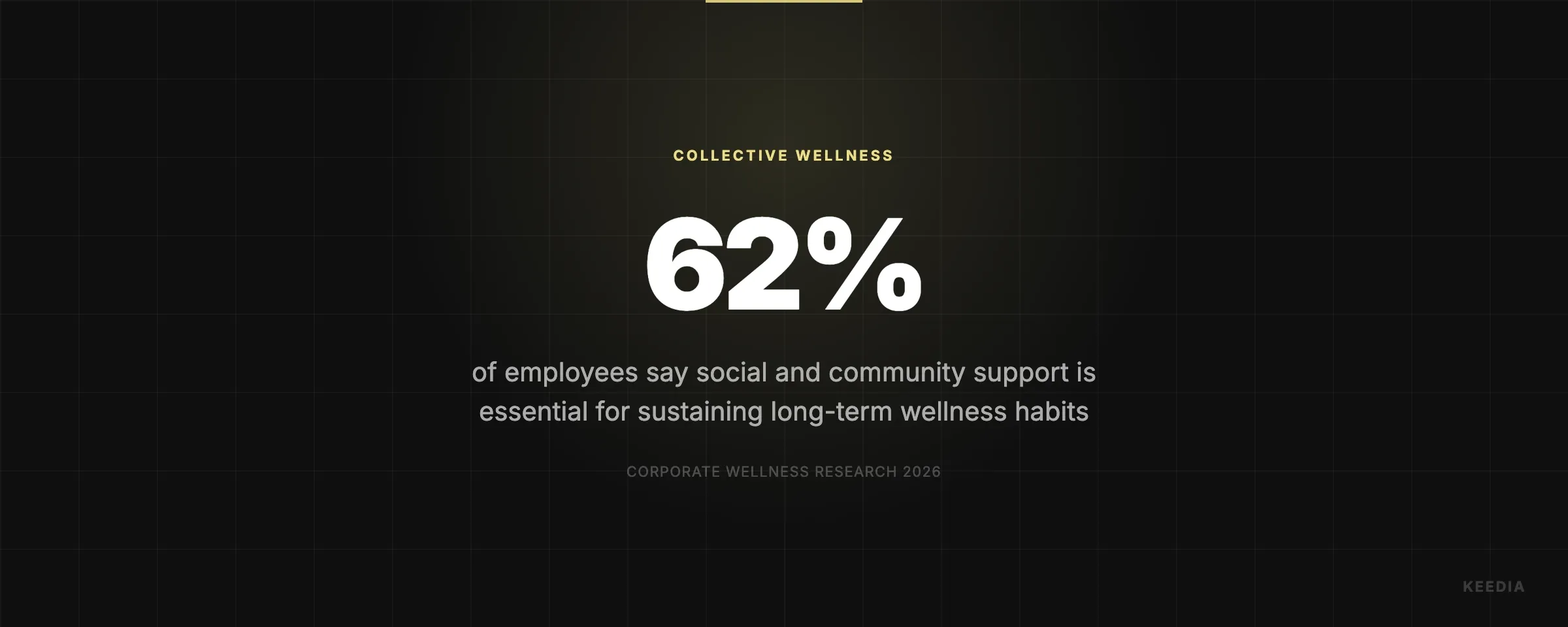
One of the clearest signals in the 2026 data is this: 62% of employees say community and social support are essential for sustaining long-term wellness habits. That finding should reframe how companies think about program design entirely.
The dominant model of corporate wellness is still individual and app-based. You download the platform, track your steps, log your meals, complete your mindfulness modules. You do all of this alone, on your phone, probably late at night when you remember the app exists.
The data suggests this model fails not because the content is wrong but because the format is isolating. Humans sustain behavior change better in social contexts. Group accountability, shared goals, visible peer participation. These mechanisms work in fitness settings, and they work in workplace wellness too. The same principle that makes group fitness classes more effective than solo treadmill sessions applies here.
Team-level challenges, department-based walking groups, shared recovery practices, even structured social time that's explicitly positioned as part of workplace wellbeing. These approaches have the social scaffolding that individual apps lack. The same community-driven logic shows up in fitness research more broadly. Findings from the HFA Show 2026 reflect an industry-wide recognition that connection and accountability are core to long-term engagement, not optional add-ons.
What Good Programs Actually Look Like
The companies with the smallest perception gaps share some common features. Their wellness programs are visible to leadership and employees equally. Managers participate, not just front-line staff. Initiatives are built into work time rather than added on top of it. Measurement goes beyond utilization rates and looks at actual health and engagement outcomes.
They also treat fitness and mental health as connected rather than separate tracks. The relationship between physical activity and psychological wellbeing is well-documented. Recovery-focused fitness approaches that prioritize sustainability over intensity mirror the kind of thinking that works in workplace wellness too. Sustainable, consistent, and manageable beats intense and short-lived every time.
The 26-point gap between employer confidence and employee experience isn't a PR problem. It's a design problem. Programs built around what leadership wants to communicate rather than what employees actually need will continue to produce exactly the results the 2026 data is showing: high spend, low impact, and a workforce that sees through it.
Closing that gap starts with asking employees what they need, building programs around those answers, and measuring outcomes that matter to the people using them rather than the people funding them.
Frequently Asked Questions
What's the average ROI of a corporate wellness program?
Recent studies show returns ranging from $1.50 to $6 for every dollar invested, depending on the program type. The key is measuring indicators aligned with your specific organizational goals.
How do you get leadership buy-in for wellness initiatives?
Use your own company's absenteeism, turnover, and productivity data. Internal numbers are always more convincing than industry averages.
What metrics should you track for a wellness program?
Key indicators include participation rate, absenteeism trends, engagement scores, and employee satisfaction measured through regular surveys.
Related articles
- 89% of Employees Work Better When They're Healthier. Only 1 in 4 Feels Their Company Actually Cares
- Corporate Wellness in 2026: What the ROI Data Actually Shows
- Client acquisition: the 3 channels that still work