
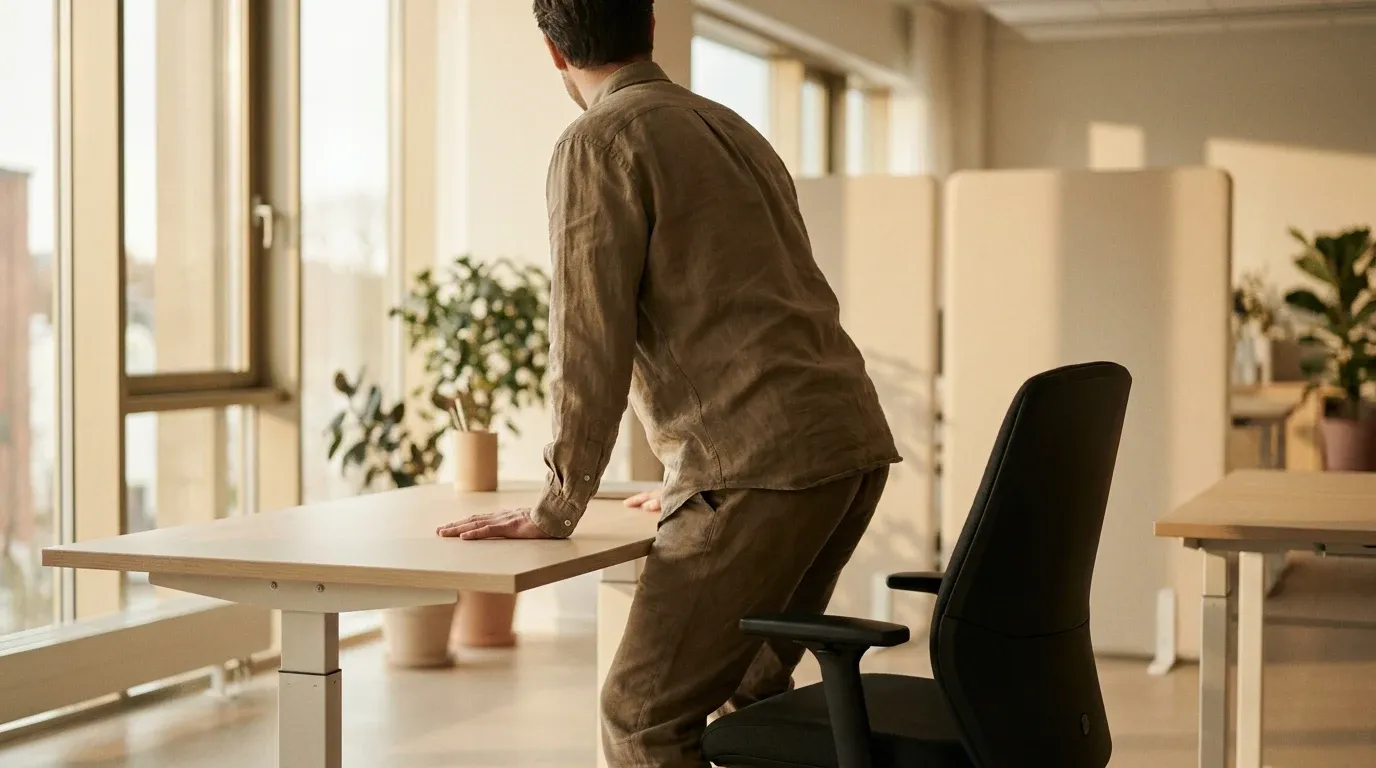
If you spend most of your workday at a desk, here's an uncomfortable truth: you're probably seated for more than six of every eight hours you work. That's not an estimate. September 2026 ergonomics research tracking Australian office workers found that desk-based employees spend an average of 76% of their working hours sitting down. That figure holds across age groups and job types. The chair, it turns out, is the most dangerous piece of furniture in the office.
The good news is that the same research community producing these alarming numbers has also identified exactly what to do about them. And the fixes don't require standing desks, treadmill workstations, or a single dollar of capital expenditure.
Why Six Hours of Sitting Is a Health Problem, Not Just a Comfort Issue
Prolonged sitting suppresses the metabolic activity your muscles perform when you're upright and moving. Lipoprotein lipase, an enzyme critical for fat metabolism, drops sharply after extended sedentary periods. Blood pools in the lower extremities. Glucose clearance slows. These aren't theoretical mechanisms. They're measurable changes that occur within the first hour of unbroken sitting.
The cumulative picture is worse. Published research has linked sedentary work to elevated cancer risk, placing it in the same category as occupational hazards that HR and safety teams are already required to manage. That framing matters. When sitting stops being a wellness conversation and becomes a compliance conversation, organizations tend to act faster.
Musculoskeletal complaints are the more immediate problem for most workers. Neck pain, lower back stiffness, shoulder tension, and wrist discomfort all intensify with sustained static posture. These complaints drive absenteeism, reduce productivity, and increase healthcare utilization. They're also the most preventable category of workplace injury.
The Minimum Effective Dose: 1 to 2 Minutes Every 20 to 30 Minutes
Ergonomists have been arguing about the ideal sitting-to-standing ratio for years. The consensus that's emerged from recent research is more practical than prescriptive: you don't need a dramatic overhaul of your day. You need frequent, brief interruptions.
The current recommendation from workplace ergonomics researchers is to stand and move for one to two minutes for every 20 to 30 minutes of seated work. That's the minimum effective dose. It's enough to restore blood flow, reactivate postural muscles, and reduce the cumulative physiological burden of prolonged sitting.
What counts as movement? Standing and walking to the printer, taking a phone call on your feet, refilling your water bottle, doing a few shoulder rolls, or simply standing at your desk for 90 seconds. The research doesn't demand exercise. It demands interruption of the sedentary pattern.
At a 30-minute interval, that's roughly 16 movement breaks across an eight-hour workday. Each one takes two minutes. Total time standing and moving: about 32 minutes. You're still seated for most of the day, but you've broken the unbroken sitting chains that cause the most harm.
Behavior Change Over Equipment: What a 2026 Trial Found
One of the most practically significant findings from 2026 comes from a randomized controlled trial examining ergonomics education in office settings. The study found that behaviorally designed ergonomics education, meaning structured programs that teach workers how to assess and adjust their own posture and workstation setup, significantly improved correct working posture and reduced both ergonomic risk scores and pain-related complaints.
The critical detail: these improvements happened without costly equipment upgrades. No new chairs. No adjustable desks. No capital outlay. The intervention worked because it changed what workers did and how they thought about their bodies at work, not because it changed their furniture.
This is worth sitting with for a moment. Organizations frequently delay ergonomic improvements because of cost. The evidence now suggests that a well-designed education program, delivered by a trained facilitator or even digitally, produces measurable clinical outcomes that equipment purchases often fail to match.
If you're managing a team or advising on workplace wellness, the behavioral approach is the place to start. The question isn't whether you can afford a standing desk for every employee. It's whether you can run a 45-minute posture workshop.
Digital Nudges Work: The Case for Computer Prompts
The scalability problem with most movement interventions is human nature. You intend to stand up every 30 minutes. Then you get absorbed in a document, lose track of time, and look up two hours later having barely moved. That's not a willpower failure. It's an attention failure. And it's exactly the problem that digital prompts are designed to solve.
A 2025 systematic review and meta-analysis examined the effect of computer-based prompts on workplace sitting time and physical activity across multiple studies. The finding was unambiguous: computer prompts alone significantly reduced sitting time and increased physical activity among office workers. The effect was consistent across different types of prompts, from simple pop-up reminders to more sophisticated software that tracks posture through the webcam.
Most of these tools are free or very low cost. Break reminder apps like Stretchly or Time Out are open source or under $5. Built-in calendar reminders set to 25-minute intervals cost nothing. At scale, across a workforce of hundreds or thousands, digital nudges represent one of the highest-return interventions in occupational health, precisely because the per-person cost rounds to zero.
The meta-analysis also found that prompts were more effective when paired with even minimal education about why movement breaks matter. That combination, knowing what to do and being reminded to do it, is the full behavioral loop.
What HR and Safety Teams Can Do Right Now
The research paints a clear picture of what works. Translating it into organizational action doesn't require a large budget or a dedicated wellness team. Here's a practical framework based on the evidence:
- Audit current sitting patterns. Before intervening, establish a baseline. Even a simple self-report survey asking employees how long they typically sit without a break will reveal where the highest-risk behaviors are concentrated.
- Deploy digital reminders organization-wide. Configure a shared calendar with recurring 25 or 30-minute movement reminders, or recommend a free break reminder app. Standardize this as part of onboarding.
- Run a behaviorally designed posture workshop. A single 45-minute session covering workstation setup, neutral posture cues, and why movement breaks matter can shift behavior for weeks. Based on the 2026 trial evidence, this alone reduces pain complaints.
- Reframe the compliance argument. Present sedentary risk, including the cancer-risk link, to leadership alongside injury and absenteeism data. Organizations respond differently when the conversation is about occupational health liability versus general wellness.
- Make movement socially normal. If managers visibly take movement breaks, employees follow. Normalizing the practice at the leadership level is a zero-cost culture intervention.
The sedentary workplace doesn't self-correct. Structural habits require structural nudges, and those nudges have to be designed in deliberately.
What You Can Do Individually
If you're a desk worker waiting for your employer to act, you don't have to wait. The individual version of this protocol is straightforward and entirely within your control.
Set a recurring timer on your phone or computer for every 25 to 30 minutes. When it goes off, stand up. Walk to get water, step outside for 60 seconds, or simply stand and stretch your hip flexors, which are among the most compressed muscles during prolonged sitting. Two minutes is enough. Then sit back down and continue working.
It's also worth thinking about what you do outside work hours. Sedentary time accumulates across the full day, not just the workday. The relationship between sleep, stress, and metabolic health is directly relevant here: workers who are under-recovered from poor sleep tend to move less and sit more, compounding the metabolic burden of a sedentary job.
Strength training outside work hours also helps. Compound lower body movements build the postural capacity that makes sitting less damaging over time. If you're unsure where to start with structured training, understanding what a trial session with a coach actually reveals can help you find someone who addresses your specific movement deficits rather than giving you a generic program.
And if you find yourself feeling burned out or unusually fatigued, it's worth knowing that burnout signals often appear outside work before they surface inside it. A sedentary job compounds that risk when movement, the most basic recovery mechanism, is removed from the day entirely.
The Bottom Line
Seventy-six percent of the workday spent sitting is a structural problem with structural solutions. The research from 2025 and 2026 is unusually consistent: you don't need expensive equipment, you need frequent interruptions. You don't need major programs, you need small behavioral loops that reset the body's physiology before damage accumulates.
Stand up for two minutes every half hour. Use a digital reminder if your attention doesn't cooperate. Learn correct posture once, from a qualified source, and apply it daily. These are not extraordinary demands. They're the minimum that occupational health evidence currently supports, and the minimum that your long-term physical health requires.
The chair isn't going anywhere. But neither is the research showing what it costs you to stay in it too long.